

TL;DR:
- A solar kilowatt hour measures the total energy generated or consumed when one kilowatt runs for one hour. Understanding kWh helps homeowners evaluate solar system output, reduce bills, and plan for energy independence. Properly distinguishing between kW and kWh ensures accurate system sizing and prevents costly misunderstandings.
A solar kilowatt hour (kWh) is defined as one kilowatt of electrical power produced or consumed continuously for one hour. It is the standard unit your utility company uses to bill you, and the same unit your solar panels use to measure how much energy they generate. Understanding what a solar kilowatt hour means puts you in control of your electricity costs and helps you size a solar system that actually fits your home. At Alphasolarsa, we find that homeowners who grasp this single concept make far better decisions about going solar.
What is a solar kilowatt hour and how is it measured?
A kilowatt hour equals 3.6 megajoules of energy. That number matters because it confirms kWh is a measure of total energy, not just speed or rate. Think of it this way: if you run a 1,000-watt microwave for exactly one hour, you have used one kWh of electricity.

The “solar” part simply refers to where that energy comes from. When your solar panels generate electricity, the output is tracked in kWh. Your inverter converts the raw DC power from your panels into usable AC electricity, and your monitoring system counts every kWh produced. That count is what determines how much of your utility bill gets offset.
Watts and kilowatts are the building blocks of this measurement. One kilowatt equals 1,000 watts. A kilowatt hour is what you get when you sustain one kilowatt of power for one full hour. The unit connects directly to your electric bill, where every line item is priced per kWh consumed.
What is the difference between kilowatt (kW) and kilowatt hour (kWh) in solar energy?
Confusing kW and kWh is the most common error homeowners make when sizing a solar system or reading an electricity bill. Getting this distinction right changes how you evaluate every solar proposal you receive.
A kilowatt (kW) measures power. It tells you the rate at which electricity flows at any given moment. A kilowatt hour (kWh) measures energy. It tells you the total amount of electricity used or produced over a period of time.
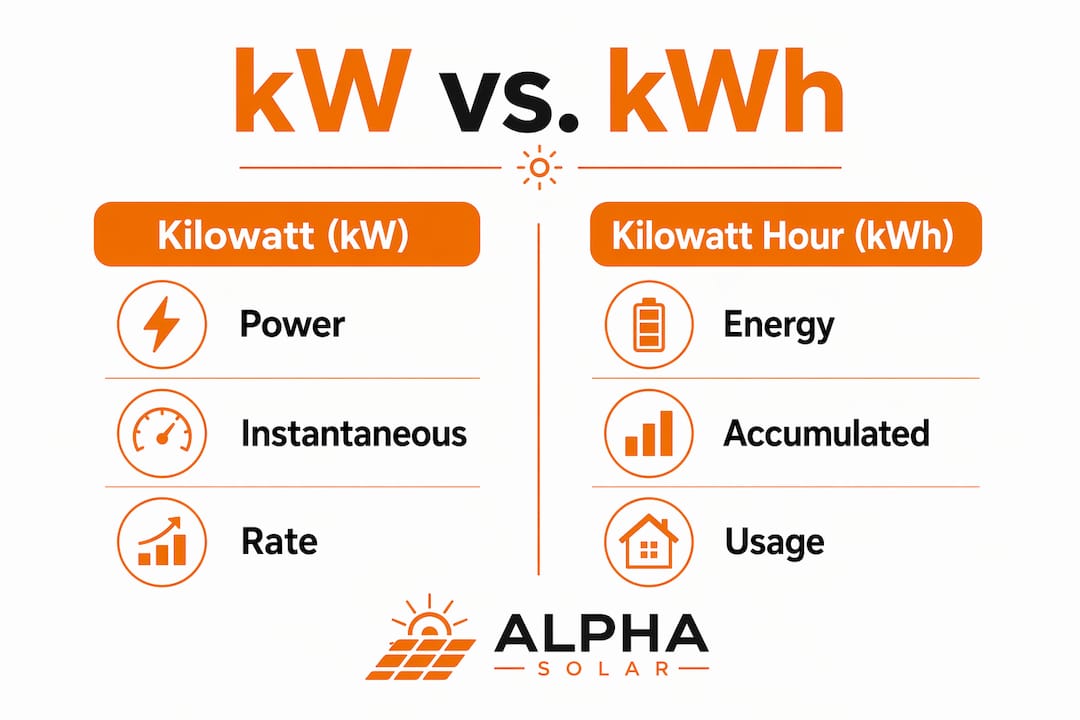
A useful analogy: kW is the size of a pipe, and kWh is the volume of water that flows through it. A wider pipe (higher kW) can move more water, but the total volume (kWh) depends on how long the water flows.
| Concept | kW (Kilowatt) | kWh (Kilowatt Hour) |
|---|---|---|
| What it measures | Power (rate of flow) | Energy (total amount) |
| Solar context | Panel system capacity | Actual energy generated |
| Billing context | Not billed directly | Billed by utility per unit |
| Example | A 7 kW solar system | That system producing 28 kWh in a day |
| Analogy | Pipe size | Water volume through the pipe |
A 7 kW solar system produces around 28 kWh per day in a location with 4 peak sun hours. That daily kWh output is what reduces your utility bill, not the kW rating alone.
Pro Tip: When a solar installer quotes you a “5 kW system,” ask how many kWh it will produce annually in your specific location. The kW rating is the starting point, but the kWh output is the number that determines your actual savings.
How do solar panels produce kilowatt hours of energy?
Solar power works through photovoltaic panels, which generate electric charge when sunlight strikes semiconductor materials inside each cell. That charge becomes direct current (DC) electricity, which an inverter converts into the alternating current (AC) your home uses. The total energy produced through this process is measured in kWh.
Your panels do not produce their full rated kW output every hour of the day. Production peaks around midday and drops off in the morning and evening. Four factors shape how many kWh your system actually delivers:
- System size in kW. A larger system has more capacity to generate energy per hour of sunlight.
- Peak sun hours. This is the number of hours per day when sunlight is strong enough for full production. Most U.S. locations receive 3–6 peak sun hours per day depending on season and geography. San Antonio typically sits at the higher end of that range.
- Panel orientation and tilt. South-facing panels at the right angle capture the most sunlight across the day.
- Shading and weather. Trees, clouds, and dust reduce the amount of sunlight reaching your panels, cutting kWh output below the theoretical maximum.
A 5 kW system does not produce 5 kWh every hour. It produces 5 kWh only during a true peak sun hour. Over a full day with 4 peak sun hours, that same system generates roughly 20 kWh.
Pro Tip: Solar experts recommend focusing on peak sun hours and environmental factors rather than panel wattage alone when estimating annual kWh production. Two homes with identical 6 kW systems can produce very different amounts of energy depending on their location and roof conditions.
Why understanding kilowatt hours is vital for managing your energy costs with solar
Utility companies bill electricity in kWh, which makes kWh the core metric for calculating your solar savings. Every kWh your panels generate is a kWh you do not buy from the grid. That direct substitution is how solar reduces your monthly bill.
Knowing your kWh consumption and production gives you a clear picture of your energy independence. Here is what tracking kWh helps you do:
- Measure your offset. If your home uses 1,200 kWh per month and your solar system produces 1,000 kWh, you are offsetting about 83% of your consumption.
- Catch performance drops early. A sudden drop in monthly kWh production often signals a dirty panel, a shading issue, or an inverter problem before it becomes costly.
- Size your system correctly. Knowing your annual kWh usage lets you design a system that matches your actual needs rather than guessing.
- Evaluate battery storage. If your panels produce excess kWh during the day, a battery stores that energy for evening use instead of sending it back to the grid at a lower rate.
Typical residential solar systems range from 5 kW to 10 kW, generating thousands of kWh annually depending on local conditions. A well-sized system in San Antonio can cover most or all of a typical household’s annual electricity consumption.
How to calculate your solar energy production and savings in kWh
Estimating solar kWh output uses a straightforward formula: multiply your system’s kW rating by your location’s average daily peak sun hours. The result is your estimated daily kWh production.
The basic formula:
Daily kWh = System size (kW) × Peak sun hours
Follow these steps to estimate your own system’s output:
- Find your system size in kW. This is on your solar proposal or inverter display. Example: 8 kW.
- Look up your local peak sun hours. San Antonio averages roughly 5 peak sun hours per day.
- Calculate daily production. 8 kW × 5 hours = 40 kWh per day.
- Estimate monthly production. 40 kWh × 30 days = 1,200 kWh per month.
- Compare to your usage. Check your utility bill for your monthly kWh consumption. If you use 1,100 kWh, this system covers your full usage with some surplus.
The table below shows estimated monthly kWh production for different system sizes at varying peak sun hour levels.
| System size | 3 peak sun hours | 4 peak sun hours | 5 peak sun hours |
|---|---|---|---|
| 5 kW | 450 kWh/month | 600 kWh/month | 750 kWh/month |
| 7 kW | 630 kWh/month | 840 kWh/month | 1,050 kWh/month |
| 10 kW | 900 kWh/month | 1,200 kWh/month | 1,500 kWh/month |
Real-world production runs slightly below these estimates due to heat, dust, and inverter efficiency losses. A solar monitoring app tracks your actual kWh output daily and flags any gap between expected and real production. That data is your most reliable tool for confirming your system performs as designed.
Key Takeaways
A solar kilowatt hour (kWh) is the single most important unit for understanding your solar system’s output, your utility bill, and your path to energy independence.
| Point | Details |
|---|---|
| kWh definition | One kWh equals one kilowatt of power sustained for one hour, totaling 3.6 megajoules. |
| kW vs. kWh | kW measures instantaneous power capacity; kWh measures total energy produced or consumed over time. |
| Production formula | Multiply your system’s kW rating by daily peak sun hours to estimate daily kWh output. |
| Billing connection | Utilities bill in kWh, so every solar kWh generated directly reduces what you owe. |
| Monitoring matters | Tracking actual kWh output monthly reveals performance issues and confirms real savings. |
Why the kW vs. kWh confusion costs homeowners real money
I have talked with hundreds of homeowners in San Antonio who came to us after a frustrating first experience with solar. The most common thread is not a bad product. It is a misunderstood proposal. A homeowner sees “10 kW system” and assumes that means 10 kWh of electricity every hour, all day long. When the bill does not drop as expected, they feel misled.
The confusion is understandable. The terms look almost identical. But the difference between kW and kWh is the difference between the size of your car’s engine and the miles you actually drive. A bigger engine does not guarantee more miles if you only drive for 20 minutes.
What I tell every homeowner is this: pull out your last 12 utility bills and add up your total kWh consumption for the year. That number is your target. Any solar proposal worth considering should show you exactly how many kWh the system will produce annually in your specific location, not just the kW capacity. If a proposal only lists panel count and system size without projected annual kWh, ask for it before signing anything.
Seasonal variation also catches people off guard. A system that produces 1,400 kWh in july may produce only 900 kWh in december. Annual averages smooth this out, but monthly monitoring keeps you informed. Knowing your kWh numbers month by month is what separates homeowners who feel confident about their solar investment from those who feel uncertain about it.
— Anthony
Alphasolarsa residential solar: designed around your kWh needs
Understanding your kWh usage is the first step. Designing a system that matches it is where Alphasolarsa comes in.

Alphasolarsa designs custom residential solar installations for San Antonio homeowners based on your actual annual kWh consumption, your roof’s peak sun exposure, and your long-term energy goals. Every system we install includes monitoring so you can track your kWh production in real time and confirm your savings from day one. We also offer battery storage, EV charger installation, panel cleaning, and panel removal and reinstallation. If you are ready to replace a rising utility bill with predictable energy ownership, our team is ready to build the system that gets you there.
FAQ
What is a kilowatt hour in simple terms?
A kilowatt hour is the amount of energy used or produced when one kilowatt of power runs for one full hour. It is the unit on your electricity bill and the unit your solar panels use to measure output.
How many kWh does a solar panel produce per day?
A single residential solar panel typically produces 1–2 kWh per day depending on its wattage and local peak sun hours. A full home system of 7–10 kW can produce 28–50 kWh per day in a sunny location like San Antonio.
Why does my solar system show kW and kWh differently?
Your system displays kW to show how much power it is generating right now, and kWh to show the total energy it has produced over time. kW is the real-time rate; kWh is the running total.
How do I know if my solar system is producing enough kWh?
Compare your system’s monthly kWh production to your utility bill’s monthly kWh consumption. If production consistently falls short of your usage, your system may be undersized or underperforming due to shading, soiling, or equipment issues.
Does more sun always mean more kWh from solar?
More peak sun hours directly increase kWh output. However, extreme heat can slightly reduce panel efficiency, which is why real-world kWh production is typically a few percent below the theoretical maximum even on sunny days.