
TL;DR:
- A solar array, not a single panel, is essential for meaningful home energy benefits.
- Proper wiring, shading analysis, and placement optimize solar system performance and savings.
- Self-consumption and battery storage are key to maximizing savings in San Antonio’s sunny climate.
Most San Antonio homeowners think a single solar panel is the key to cutting their electricity bill. It isn’t. The real workhorse is the solar array, a system of panels working together to generate meaningful power for your home. A solar array is a collection of multiple solar panels electrically interconnected and mounted to function as one unified electricity generator. Understanding how arrays work, how they’re wired, and what they actually produce in San Antonio’s climate is what separates homeowners who get great results from those who feel underwhelmed after installation. This guide covers all of it.
Table of Contents
- What is a solar array?
- How solar arrays generate and deliver electricity
- Array wiring: series, parallel, and hybrid explained
- San Antonio solar production, savings, and payback
- Our expert take: optimizing your array for San Antonio success
- Ready to design your solar array?
- Frequently asked questions
Key Takeaways
| Point | Details |
|---|---|
| Solar array definition | A solar array is a connected group of panels working together to generate electricity efficiently for your home. |
| San Antonio output and savings | Typical arrays produce 12,400 kWh/year, saving local homeowners up to $2,180 per year. |
| Wiring and shade impact | Proper wiring and panel placement are key to maximizing energy with San Antonio’s sun and avoiding shading losses. |
| Payback and incentives | Solar arrays pay back in 6.9–10.7 years, with property tax exemption but limited rebates in 2026. |
| Battery and cleaning enhancements | Adding battery storage and regular panel cleaning boosts reliability and total savings. |
What is a solar array?
A solar array isn’t just a bunch of panels stuck on a roof. It’s a carefully engineered system where every component plays a role. A solar array is multiple panels electrically interconnected and structurally mounted to function as a unified DC (direct current) electricity generator from sunlight.
Think of it this way: one panel produces a limited amount of power on its own. Wire several together correctly, and you have a system capable of running your air conditioner, refrigerator, and lights simultaneously on a sunny San Antonio afternoon.
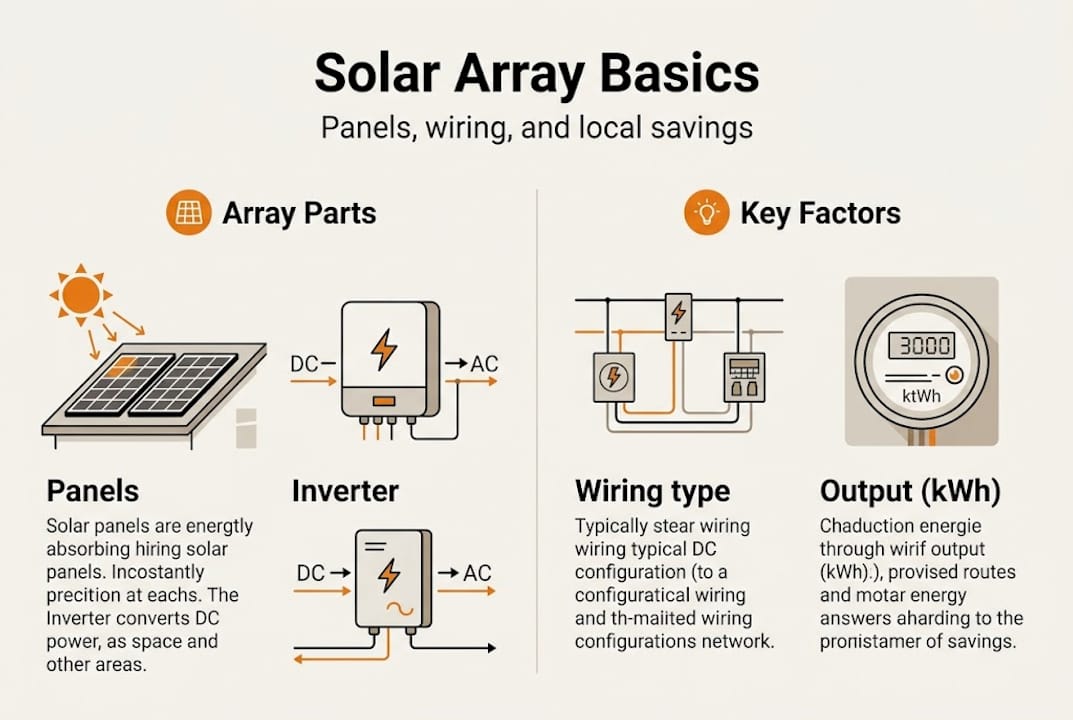
The main components of a typical residential array include:
- Solar panels (modules): The cells that capture sunlight and convert it to electricity
- Mounting system: Racking that secures panels to your roof at the right angle
- Wiring and connectors: The modules and wiring that link panels into strings and circuits
- Inverter: The device that converts DC power from your panels into AC (alternating current) power your home can use
- Monitoring system: Software that tracks production and flags issues
For most San Antonio homes, a properly sized array falls in the range below:
| System size | Number of panels | Estimated annual output |
|---|---|---|
| 6 kW | 15 panels | ~8,400 kWh |
| 8 kW | 20 panels | ~12,400 kWh |
| 10 kW | 25 panels | ~15,500 kWh |
Most homes in San Antonio need a 6 to 10 kW system (roughly 15 to 25 panels) to offset the majority of their electricity usage. The exact number depends on your roof space, panel efficiency, and how much electricity your household consumes each month.
Understanding solar panel basics helps you ask better questions when getting quotes. Now that you know what an array is, let’s look at how it actually makes power for your home.
How solar arrays generate and deliver electricity
The process starts with sunlight and ends with your lights staying on. Here’s how it works, step by step.
Solar arrays work via the photovoltaic effect: sunlight photons hit silicon cells inside each panel, exciting electrons and generating DC electricity. That current flows through wiring into your inverter, which converts it to the AC electricity your appliances actually use.
Here’s the full sequence in your home:
- Sunlight hits the panels and generates DC electricity in each cell
- Panels are wired into strings, which boosts voltage and current to usable levels
- DC power travels to the inverter, where it’s converted to AC electricity
- AC power flows to your electrical panel, powering your home in real time
- Excess power is exported to the grid or stored in a battery backup system
San Antonio is one of the best cities in Texas for solar production. San Antonio receives 5.4 to 6.0 peak sun hours per day on average, which means a 1 kW array produces roughly 6 kWh daily. A typical 9 to 11 kW system can offset 100% of a home’s usage, which usually runs between 12,000 and 15,000 kWh per year.
That’s a significant amount of power generated right on your rooftop.
Pro Tip: Your array produces the most power between 10 a.m. and 3 p.m. Running high-draw appliances like dishwashers and washing machines during those hours maximizes your self-consumption and reduces what you pull from the grid.
For a deeper look at how production translates to savings statewide, the Texas savings guide breaks down the numbers by region. Understanding basic function sets you up for why design and wiring choices matter so much.
Array wiring: series, parallel, and hybrid explained
How your panels are wired together has a bigger impact on performance than most homeowners realize. There are three main approaches, and each has real trade-offs for San Antonio rooftops.
Wiring methods compared:
| Wiring type | How it works | Best for | Weakness |
|---|---|---|---|
| Series | Voltage adds up, current stays constant | Unshaded roofs | One shaded panel hurts the whole string |
| Parallel | Current adds up, voltage stays constant | Shaded or complex roofs | Requires thicker, more expensive wire |
| Series-parallel hybrid | Combines both methods | Most residential rooftops | More complex to design |
Series wiring adds voltage while keeping current constant, which is efficient but shade-sensitive. Parallel wiring adds current while keeping voltage constant, making it more tolerant of partial shading but requiring heavier gauge wire. The hybrid approach balances both, and it’s the most common configuration used on San Antonio homes.

Shading is where things get serious. Partial shading in series strings causes mismatch losses of 20 to 70% from just one shaded panel. A single tree branch or a neighbor’s shadow at the wrong time of day can drag down your entire string’s output.
Key wiring considerations for San Antonio homeowners:
- Nearby trees, chimneys, or roof features that cast shadows should be mapped before installation
- Older neighborhoods with mature trees often benefit most from microinverters or power optimizers
- Microinverters attach to each panel individually, so shading one panel doesn’t affect the others
- Power optimizers work similarly, conditioning DC power at the panel level before it reaches a central inverter
Pro Tip: If your roof has multiple angles or faces different directions, ask your installer about panel-level optimizers. They can recover 15 to 25% of production that would otherwise be lost to shade or mismatch.
For a full picture of how wiring design connects to your long-term solar benefits, it’s worth reviewing your installer’s shade analysis before signing anything. Once wiring is chosen, it’s time to model real-world production tied to San Antonio’s sun exposure.
San Antonio solar production, savings, and payback
Numbers make decisions easier. Here’s what a well-designed solar array actually delivers for San Antonio homeowners.
What a typical 8 kW array produces and saves:
- Annual production: approximately 12,400 kWh per year
- Annual savings: $1,736 to $2,180 at the current average rate of around 14 cents per kWh
- Payback period: 6.9 to 10.7 years depending on system cost and usage
- 25-year savings: $43,000 to $96,000 over the life of the system
Those are meaningful numbers. And they’re based on conservative estimates.
Statistic to know: CPS Energy, San Antonio’s utility, currently credits surplus solar power exported to the grid at roughly 1.65 to 2 cents per kWh, compared to the retail rate of around 12 cents per kWh. That gap is significant.
What this means practically: the more electricity you use directly from your panels during the day, the more you save. Exporting excess power earns very little credit. This is why self-consumption matters and why battery storage has become a smarter investment for many San Antonio homeowners.
In 2026, there are no major CPS rebates or federal residential tax credits remaining for new solar installations. However, Texas does exempt the added home value from solar from property taxes, which is a real financial benefit when you consider that a solar system typically increases home value by 3 to 4%.
For a current breakdown of solar cost trends and how to evaluate quotes, that resource walks through what to expect. You can also review the solar array benefits page for a side-by-side look at ownership versus renting power from the grid. More context on building a sustainable solar future in Texas is also worth a read.
For local production benchmarks, San Antonio solar facts provides a solid overview of what homeowners in this area typically experience. Financial clarity gives motivation. Next, we’ll cover optimization strategies that most articles skip.
Our expert take: optimizing your array for San Antonio success
Here’s something most solar articles won’t tell you: the design choices made before installation matter more than the brand of panel you choose.
In San Antonio, a south-facing array at a tilt of approximately 29 degrees is optimal for year-round production. That matches our latitude and maximizes exposure during both summer and winter months. A roof that faces southeast or southwest still performs well, but a north-facing installation is a real compromise.
The bigger insight we share with every homeowner is this: self-consumption beats export every time under CPS Energy’s current net metering structure. Earning 1.65 cents per kWh for exported power while paying 12 cents to buy it back is a losing trade. The answer is to shift energy use to daylight hours and, if your budget allows, add battery backup to store what you don’t use immediately.
Batteries also protect you from outages, which are more common in Texas than most people expect. The combination of a well-designed array and a battery system is the most resilient setup we see in San Antonio homes today.
For a practical walkthrough of how to apply this thinking to your own home, the savings workflow for Texas homes is a useful next step.
Ready to design your solar array?
Now that you understand how solar arrays work, how they’re wired, and what they can save you in San Antonio, the next step is turning that knowledge into a real system designed for your home.

At Alpha Solar Solutions, we handle everything from system design and residential installation to ongoing maintenance. A dirty array can lose 15 to 25% of its output, which is why our panel cleaning services keep your investment performing at its best. We also offer battery backup solutions to help you maximize self-consumption and stay protected during outages. If you’re ready to stop paying rising electricity bills and start owning your energy, we’d love to help you get there.
Frequently asked questions
How many solar panels does a typical San Antonio solar array need to offset most of my home’s electricity?
Most homes need 15 to 25 panels (6 to 10 kW) to cover 100% of electricity usage, depending on your roof size and daily consumption habits.
Does partial shading affect the output of my solar array?
Yes. Shading can cut output by 20 to 70% in series-wired arrays. Using optimizers or microinverters at the panel level significantly reduces those losses.
How much can San Antonio homeowners save by installing a solar array?
Typical savings run from $1,736 to $2,180 per year, with payback in 6.9 to 10.7 years and total savings up to $96,000 over 25 years.
Are there solar tax credits and rebates available in San Antonio in 2026?
No major CPS rebates or federal residential tax credits are currently available, but Texas does offer a property tax exemption for the added home value from your installed solar array.