
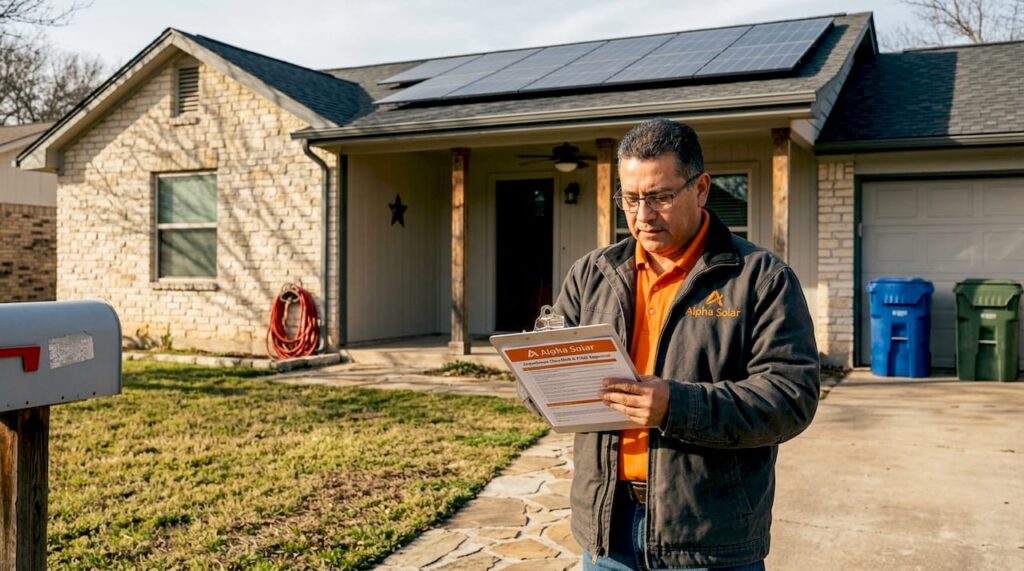
TL;DR:
- Many Texas homeowners overlook or fail to complete paperwork to claim thousands in solar savings through property tax and sales tax exemptions. Maximizing incentives requires proactive steps, proper documentation, and understanding how programs stack together for full benefit. Careful follow-through and expert guidance can significantly boost long-term savings and ensure all available benefits are secured.
Texas homeowners are sitting on thousands of dollars in solar savings that most never fully claim. Between a statewide property tax exemption, a sales tax break on equipment, utility buyback programs, and the federal solar tax credit, the combined value can cut your total installation cost by 40% or more. Yet a surprising number of homeowners either miss programs entirely or stop short of stacking every available benefit. This guide breaks down exactly what’s available in 2026, how each incentive works, and the specific steps you need to take to keep more money in your pocket.
Table of Contents
- How Texas solar incentives work in 2026
- Navigating property tax and sales tax exemptions
- Utility, buyback, and battery incentives: maximizing your savings
- Stacking federal and state incentives: the complete savings picture
- What most Texas homeowners miss about solar incentives
- Ready to claim your savings? Next steps with expert help
- Frequently asked questions
Key Takeaways
| Point | Details |
|---|---|
| Texas home solar is tax-advantaged | Texas exempts 100% of your solar system’s value from property tax and waives sales tax on qualifying equipment. |
| Stack and maximize incentives | You can combine federal, state, and local utility programs for significant savings if you navigate the claim process. |
| Details matter for savings | Filing paperwork correctly—and confirming your utility’s buyback rules—determines how much you save each year. |
| Local and federal programs interact | Using resources like DSIRE helps you check program eligibility and optimize your home solar investment. |
How Texas solar incentives work in 2026
Having set the stage for potential savings, let’s clarify exactly which incentives you can tap in Texas and how they stack up.
Texas is one of the most solar-friendly states in the country, and not just because of the sunshine. The state has built a layered set of incentives that work at three levels: state law, local government, and your specific utility company. Understanding all three is what separates homeowners who save big from those who only capture part of the picture.
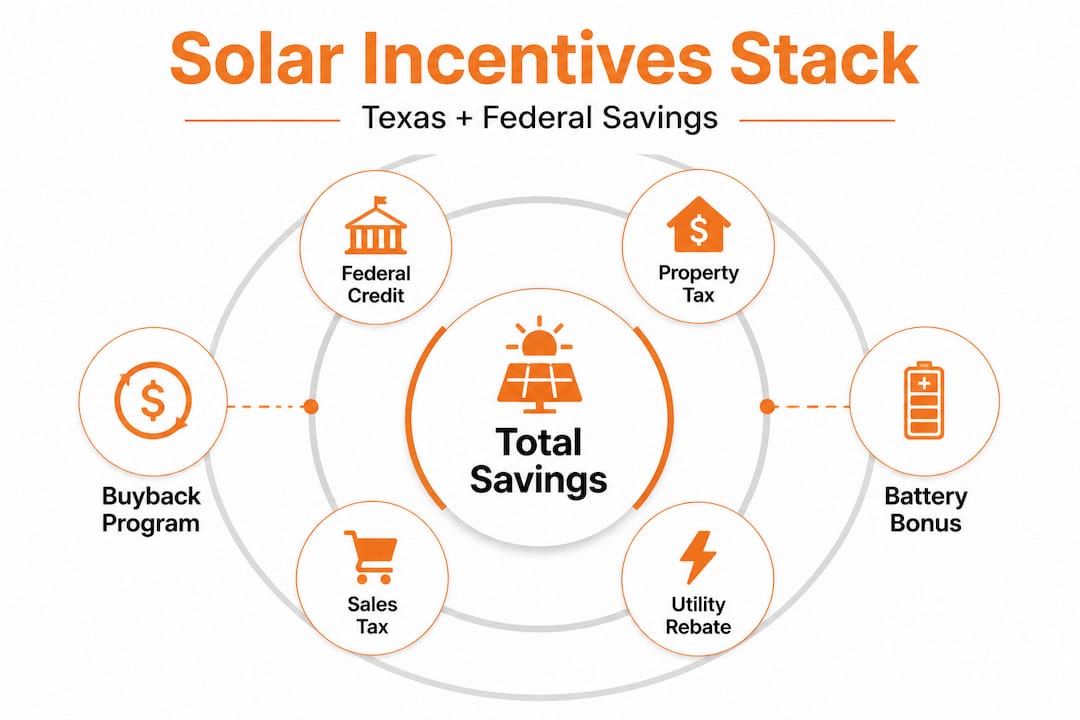
Here is a quick breakdown of the core programs available to Texas homeowners right now:
| Incentive type | What it covers | Average value | How to claim |
|---|---|---|---|
| Property tax exemption | Added home value from solar system | Hundreds to thousands per year | File with your county appraisal district |
| Sales tax exemption | Solar equipment purchase | 6.25% of equipment cost | Applied at point of sale by installer |
| Utility rebate | Upfront cost reduction | Varies by utility | Apply through your utility provider |
| Solar buyback / net metering | Credits for excess energy sent to grid | Varies by plan and utility | Enroll through your retail energy provider |
Key definitions to know:
- Property tax exemption: This means the added value that solar panels bring to your home is not included when your county calculates your property tax bill. Texas allows excluding the full added value of a solar energy system from property tax assessments under Texas Tax Code section 11.27. That is a 100% exclusion, not a partial one.
- Sales tax exemption: Texas provides a sales tax exemption for qualifying solar equipment, which directly reduces what you pay upfront at installation.
- Utility incentive: A rebate or credit offered by your local utility or retail energy provider when you install solar or a battery backup system.
One important thing to know: these incentives are available statewide, but some require local action. The property tax exemption, for example, does not apply automatically. You have to file paperwork. Many homeowners assume it kicks in on its own and end up paying more in taxes than they should.
Main benefits for Texas homeowners who take full advantage:
- ➡ Lower annual property tax bills, even as your home value rises
- ➡ Reduced upfront installation cost through the sales tax exemption
- ➡ Monthly bill credits through buyback or net metering programs
- ➡ Long-term energy cost predictability instead of rising utility rates
- ➡ Increased home resale value without a corresponding tax penalty
For a broader look at how these programs fit into your long-term financial picture, the Texas homeowner solar savings guide walks through the full value of going solar in this state. You can also get a solid overview of the Texas solar incentives that save homeowners thousands each year.
Navigating property tax and sales tax exemptions
Understanding these incentives is just the start. Actually securing your exemption means following a few specific steps, and missing even one can cost you real money.
The property tax exemption: step by step
Under Texas Tax Code Sec. 11.27, homeowners can exclude 100% of the added value of a qualifying solar energy system from their property tax assessment. This benefit applies for as long as the system remains on the property.
This is one of the most valuable long-term incentives available, but it requires action on your part. Here is how to claim it:
- Complete your solar installation. The exemption applies to installed systems, so you need to have your panels up and operational before filing.
- Obtain your installation documentation. You will need proof of the system, including the installer’s invoice, equipment specs, and any permits issued by your city or county.
- Download Form 50-128 from the Texas Comptroller’s website. This is the official application for the solar and wind-powered energy device exemption.
- Submit the form to your county appraisal district. Each county has its own office and submission process. Some accept online filings; others require paper submissions by mail or in person.
- Confirm the filing deadline. Most counties require the application by April 30 of the tax year in which you want the exemption to apply. Missing this date means waiting another full year.
- Keep a copy of everything. Retain your filed application, confirmation of receipt, and all supporting documents in a dedicated folder.
Pro Tip: Call your county appraisal district directly before filing. Deadlines, required attachments, and accepted formats vary by county. A five-minute phone call can save you from a rejected application or a missed deadline.
The sales tax exemption: what qualifies
The sales tax exemption covers solar panels, inverters (the device that converts solar energy into usable electricity for your home), mounting hardware, and other qualifying components. It does not automatically apply to labor or installation fees, so ask your installer to break out equipment and labor costs separately on your invoice. A reputable installer will already know how to handle this correctly.

Common mistakes homeowners make with these exemptions include not filing at all (assuming it is automatic), submitting the property tax form to the wrong office, and failing to include supporting documentation like permits or equipment specs. These are easy to avoid once you know what to watch for.
For a closer look at how these benefits play out for San Antonio homeowners specifically, the solar power benefits article covers local context in detail.
Utility, buyback, and battery incentives: maximizing your savings
Tax incentives are a major piece, but utility programs and batteries can accelerate your savings even more.
Texas has a deregulated electricity market, which means your options vary significantly depending on where you live and who your utility or retail energy provider is. Some utilities offer upfront rebates for solar installation. Others offer buyback programs that credit you for the excess electricity your panels send back to the grid.
| Program type | What it offers | Typical value | Key requirement |
|---|---|---|---|
| Utility rebate | Cash or bill credit at installation | $500 to $2,500+ | Must apply before or during install |
| Solar buyback credit | Credit per kWh sent to grid | Varies by plan (often $0.06 to $0.12/kWh) | Enroll in a buyback-eligible plan |
| Battery storage rebate | Incentive for adding a battery backup | Varies by utility | Battery must meet program specs |
To find out exactly what programs are available in your ZIP code, the DSIRE solar incentives database is the most reliable starting point. DSIRE’s database is the primary mechanism for verifying what incentives apply in a specific Texas ZIP code in 2026. Search by your location and filter by program type to see current options.
Battery storage is worth special attention. Adding a home battery (like a Tesla Powerwall or similar system) lets you store excess solar energy for use at night or during outages. Some Texas utilities offer rebates specifically for battery systems, and pairing storage with solar often qualifies you for better buyback terms. The value of solar and battery savings in Texas goes well beyond what most homeowners initially expect.
Pro Tip: Before signing up for any buyback or net metering plan, ask your utility or retail energy provider these specific questions:
- What is your current buyback rate per kilowatt-hour?
- Is the rate fixed or variable, and how often does it change?
- Are there monthly fees or minimum usage requirements to stay enrolled?
- Does adding a battery system affect my buyback eligibility?
- What documentation do I need to submit before my system is approved?
Getting clear answers to these questions before your installation is finalized can make a significant difference in your long-term monthly savings. For a detailed breakdown of how buyback rates work, check out the guide on Texas solar buyback rates.
Stacking federal and state incentives: the complete savings picture
Combine these Texas programs with federal incentives for the biggest impact. Here is how the pieces fit together.
The federal Investment Tax Credit (ITC) for solar allows you to deduct a percentage of your total solar installation cost directly from your federal income tax bill. As of 2026, the credit sits at 30% for residential systems. This is not a deduction from your taxable income. It is a dollar-for-dollar reduction in what you owe the IRS.
Here is what a stacked savings scenario looks like for a typical Texas homeowner:
| Incentive | Applied to | Example value (on a $25,000 system) |
|---|---|---|
| Federal ITC (30%) | Total system cost | $7,500 |
| Sales tax exemption (6.25%) | Equipment cost (~$18,000) | $1,125 |
| Property tax exemption | Annual tax savings on added value | $300 to $800/year |
| Utility rebate | Upfront cost | $1,000 to $2,500 |
| Total first-year savings | ~$10,000 to $11,900 |
That kind of stacking is real, but it requires you to own the system outright or through a loan in your name. If you lease a solar system or use a power purchase agreement (PPA), the installer typically claims the federal tax credit, not you.
What is stackable and what is not:
- ✅ Federal ITC + Texas property tax exemption: fully stackable
- ✅ Federal ITC + Texas sales tax exemption: fully stackable
- ✅ Federal ITC + utility rebate: stackable, but the rebate may reduce your ITC basis
- ✅ Property tax exemption + utility buyback: fully stackable
- ❌ Leased systems: homeowner typically cannot claim the federal ITC
- ❌ Some utility rebates: may not be available if you use certain financing structures
Before you buy, confirm three things, as recommended for 2026 planning: your tax credit access path (owner vs. lease), your county filing process for the property tax exemption, and your specific utility’s program requirements for solar and battery systems. For more on how federal credits work, the federal solar tax credits guide covers the details clearly.
If you want to go even deeper on layering energy tax strategies, maximizing 2026 energy tax deductions covers broader investment-level approaches worth reviewing.
What most Texas homeowners miss about solar incentives
Now that you understand how incentives work, here is what we have learned helping Texas families maximize their results.
The biggest gap we see is not a lack of information. It is a lack of follow-through on the paperwork. Homeowners research incentives, get excited about the savings, and then assume their installer or the government handles the rest automatically. The property tax exemption alone goes unclaimed by a large portion of eligible homeowners every year simply because no one filed Form 50-128.
The second most common gap is stopping at one incentive. Most people claim the federal tax credit and call it done. But leaving the property tax exemption, the sales tax break, and a utility rebate on the table can mean missing out on $3,000 to $5,000 or more in combined value. That is real money.
Here is the other thing we want you to hear clearly: general articles (including this one) give you the framework, but your specific savings depend on your county, your utility, and your ownership structure. Do not assume you qualify for everything just because you live in Texas. Use the DSIRE database, call your county appraisal district, and ask your utility rep directly.
An hour of research and paperwork today can generate years of compounded savings. The homeowners who benefit most from solar are the ones who treat incentive claiming as seriously as they treat the installation itself.
Pro Tip: Create a dedicated “solar file” (physical or digital) the day your system is installed. Store your permits, installation invoice, equipment specs, Form 50-128 confirmation, and utility enrollment documents together. Set a calendar reminder each January to review your exemption status and check for new utility programs. This simple habit protects your savings year after year.
Most people overlook the compounding effect of these benefits over time. The solar benefits most people overlook article covers several of these longer-term advantages that rarely get enough attention.
Ready to claim your savings? Next steps with expert help
With clarity on Texas incentives, choosing the right partner can help you lock in the very best results.
Working with a local, experienced solar company changes the entire experience. Instead of navigating county offices, utility paperwork, and equipment specs on your own, you have a team that has done this hundreds of times for Texas homeowners just like you.

At Alpha Solar Solutions, we handle custom system design, residential solar installation, battery backup setup, and ongoing support so your incentives are claimed correctly from day one. Whether you are a homeowner or a business owner exploring commercial solar solutions, we walk you through every incentive available in your area, help you file the right paperwork, and make sure your utility enrollment is set up to maximize your buyback credits. Schedule a free incentive consultation today and find out exactly how much you can save in 2026.
Frequently asked questions
How do I find out what solar incentives are available in my Texas ZIP code in 2026?
Use the DSIRE database to search your local options by ZIP code, utility, and program status. It is the most reliable tool for verifying current incentives in your specific area.
Are solar panels added to my home taxed higher in Texas?
No. Texas homeowners can exclude 100% of the solar system’s added value from property tax assessments, as long as they file the required exemption form with their county appraisal district.
Do I need to pay Texas sales tax on a new solar system?
Qualifying solar energy equipment is exempt from state sales tax, which reduces your upfront installation cost automatically when your installer applies the exemption at the point of sale.
Can I claim both the federal solar tax credit and Texas incentives?
Yes, most homeowners can stack the federal credit with Texas and utility incentives if they own the system. Confirm your ownership structure and county filing requirements before assuming full eligibility.
Who handles the paperwork for these incentives?
You are responsible for submitting most state and county paperwork, but reputable installers often assist or guide you through the process to make sure nothing is missed.