
TL;DR:
- Solar panels support EV charging by supplying power to your home, which your vehicle draws from just like other appliances. Proper system sizing, storage, and smart charging strategies maximize self-consumption, especially under San Antonio’s net billing policies. Future bidirectional charging technology will enable EVs to act as mobile energy storage, enhancing grid stability and household resilience.
If you own an electric vehicle in San Antonio, you have probably wondered whether going solar makes your charging “free.” That idea is appealing but a little oversimplified. Understanding the real role of solar for EV owners means looking past the surface and into how your home electrical system, your panels, your utility’s policies, and your driving habits all interact. Get this right, and you can meaningfully reduce what you pay to keep your EV on the road while building genuine energy independence. This guide covers everything you need to know.
Table of Contents
- How solar energy supports your electric vehicle charging
- Sizing your solar system for efficient EV charging in San Antonio
- Navigating San Antonio’s utility policies for solar and EV charging
- Strategies to maximize solar value for your EV charging needs
- The future role of EVs and solar: bidirectional charging and grid integration
- Rethinking solar for EVs: beyond simple offsets to integrated energy ecosystems
- Alpha Solar Solutions: your partner for solar and EV charging in San Antonio
- Frequently asked questions
Key Takeaways
| Point | Details |
|---|---|
| Solar powers EV via home | Solar panels supply electricity to your home, from which your EV charger draws power, not directly to the car. |
| Typical system size | Covering average driving requires roughly 5–10 solar panels to meet yearly EV charging energy needs. |
| Local utility impacts | San Antonio’s Net Billing pays low rates for solar export, making self-consumption and battery storage critical. |
| Smart charging plus storage | Charging during solar production and using batteries to shift energy boosts savings and reliability. |
| Future tech: bidirectional charging | EVs can soon supply power back to your home or grid, increasing flexibility and energy savings. |
How solar energy supports your electric vehicle charging
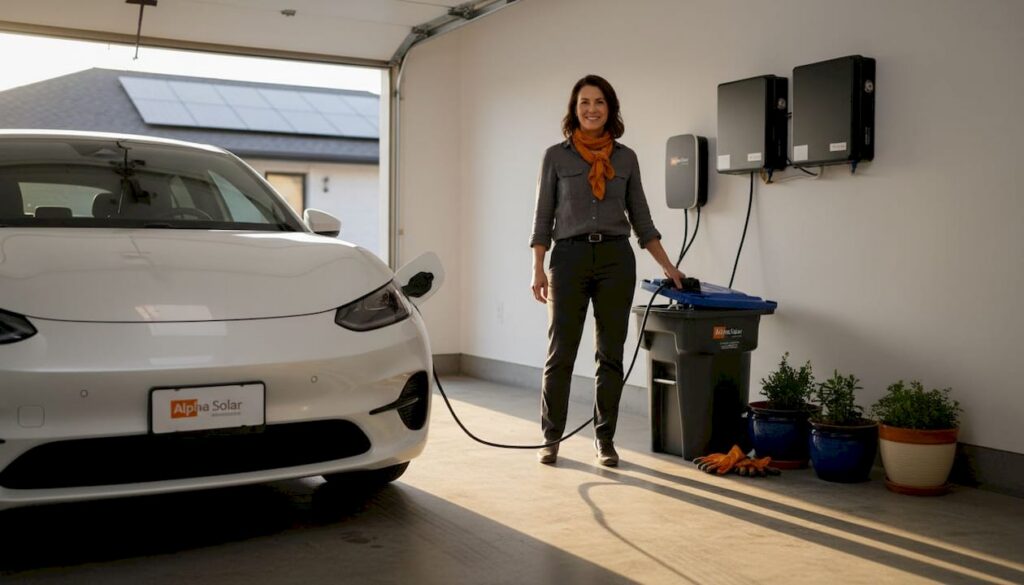
There is a persistent misconception that solar panels charge your EV the same way a gas pump fills a tank. They do not work that way. Your solar panels produce DC electricity (direct current), and an inverter converts that into AC electricity (alternating current) that flows through your home’s electrical panel. From there, your EV charging system draws power from the home electrical supply, exactly the way your refrigerator or washing machine does.
This matters because it changes how you think about sizing and timing. You are not routing solar energy directly to your car. You are supplying your home with solar power, and your car happens to be one of the loads drawing from it. The solar electrical system guide for San Antonio homeowners explains this flow in more detail if you want to go deeper on the wiring side.
Here is a simple picture of how it works:
- Solar panels on your roof generate electricity during daylight hours.
- Your inverter converts that DC power to AC power for your home.
- Your home electrical panel distributes that power to all loads, including your EV charger.
- When solar production exceeds home demand, excess power either feeds the grid or charges a home battery.
- Your EV charges using Level 1 (standard outlet) or Level 2 (dedicated 240V charger), just like normal household charging.
You should never attempt to wire solar panels directly to your car. That approach bypasses safety systems built into both the vehicle and the panels, and it creates a serious electrical hazard.
Pro Tip: If you have a Level 2 charger installed at home, your EV can draw around 7 to 11 kilowatts per hour of charging. On a sunny San Antonio afternoon, a well-sized solar system can cover that draw almost entirely from rooftop production, meaning your car charges without pulling a single watt from the grid.
Sizing your solar system for efficient EV charging in San Antonio
Most San Antonio EV owners drive somewhere between 10,000 and 14,000 miles per year. That translates into a meaningful electricity demand. A typical EV requires 3,000 to 5,000 kWh per year for charging, which roughly corresponds to 5 to 10 additional solar panels depending on your panel wattage, roof orientation, and shading.
San Antonio’s solar irradiance (the intensity of sunlight available) is strong. The city averages around 220 sunny days per year, which means your panels produce more energy per panel compared to cities in the Pacific Northwest or the Midwest. That works in your favor when sizing.
Here is a general sizing reference for San Antonio EV owners:
| Annual driving (miles) | Estimated charging energy needed | Additional panels required |
|---|---|---|
| 8,000 | ~2,500 kWh | 4 to 6 panels |
| 12,000 | ~3,750 kWh | 6 to 8 panels |
| 15,000+ | ~4,700 kWh | 8 to 10 panels |
Based on average EV efficiency of 3 to 4 miles per kWh and 400W panels in San Antonio conditions.
When you factor in your home’s baseline energy use, most EV-owning households in San Antonio need between 18 and 23 panels total. Key variables include:
- Panel wattage: Higher-watt panels (400W+) mean fewer panels for the same output.
- Roof angle and direction: South-facing roofs at a moderate pitch produce the most.
- Shading from trees or structures: Even partial shading can noticeably cut output.
- Battery storage: A home battery, paired with your solar setup, lets you store midday production and use it for overnight EV charging.
Choosing the right best home EV chargers also affects how efficiently your solar energy transfers to your vehicle. A smart Level 2 charger can be programmed to charge only when solar surplus is available.
Pro Tip: Ask your installer to run a load calculation that includes your projected EV charging demand, not just your current electricity bill. Many homeowners undersize their systems because they based the design on past usage before buying an EV.
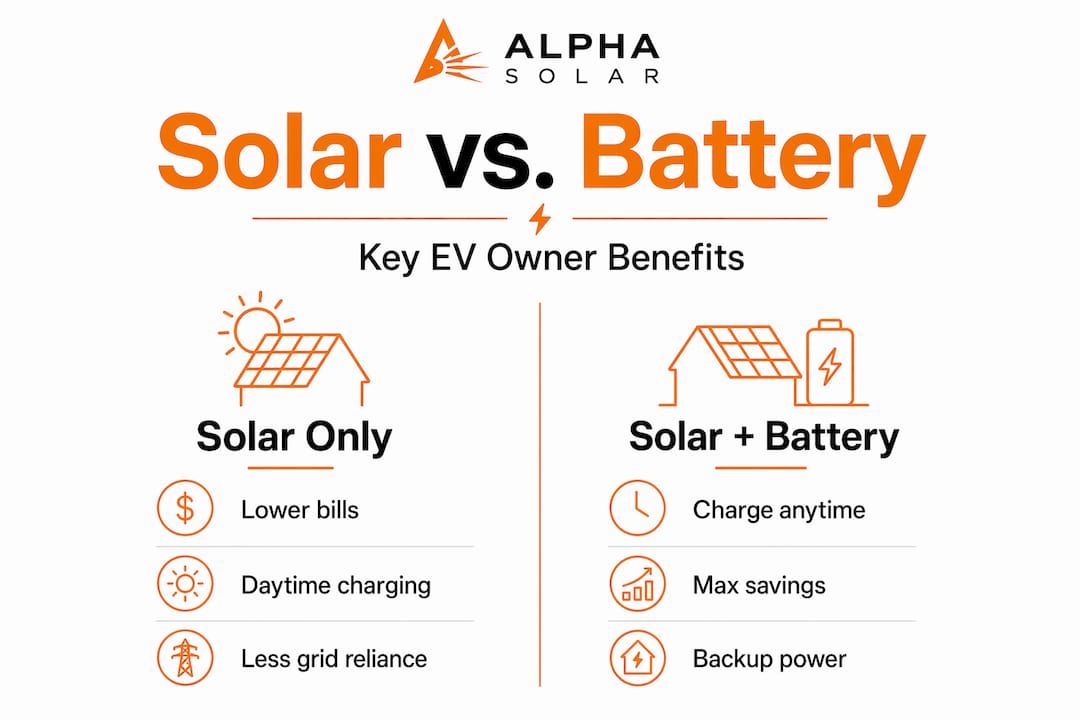
The solar battery benefits for EV owners in San Antonio are especially strong, and here is why.
Navigating San Antonio’s utility policies for solar and EV charging
CPS Energy, San Antonio’s public utility, uses a Net Billing policy rather than full Net Metering. The difference is significant for your solar economics. Under Net Metering, you would get retail credit (roughly 12.5 cents per kWh) for every unit of excess solar you send to the grid. Under Net Billing, CPS credits exported solar at a reduced avoided-cost rate of approximately 2 to 4 cents per kWh.
That gap is wide. Every kilowatt-hour of solar you export earns you about 3 cents. Every kilowatt-hour you consume yourself saves you about 12.5 cents. The math heavily favors self-consumption.
The bottom line for San Antonio EV owners: Export as little solar as possible. Use it yourself, store it in a battery, or charge your EV with it. That is how you extract maximum financial value from your system.
Here is how to structure your solar and EV setup to keep self-consumption high:
- Charge your EV during peak solar hours (typically 10am to 3pm) to use solar directly.
- Install a home battery to capture surplus solar for evening or overnight charging.
- Set smart charger schedules to avoid pulling from the grid during high-rate periods.
- Monitor your production and consumption with a home energy monitoring app to spot waste.
Understanding net billing and solar economics will help you design a system that works with San Antonio’s policy rather than against it. You may also want to review available solar tax credits to reduce your upfront installation costs.
Strategies to maximize solar value for your EV charging needs
Knowing the policy landscape, your next step is implementation. Here are five practical strategies that make a real difference:
-
Upgrade your electrical panel first. Most older San Antonio homes have 100-amp panels. Adding solar plus a Level 2 EV charger often requires a 200-amp service upgrade. Skipping this step creates safety risks and can trigger problems during your utility interconnection inspection.
-
Install a smart sub-panel or load controller. These devices let you assign priority to different loads. For example, you can tell your system to charge the EV only when solar production exceeds 3 kW, and stop charging if the house falls below a certain battery level.
-
Add battery storage for overnight charging. If you park your EV overnight, you are charging while the sun is down. A home battery charges from solar during the day and delivers that stored energy to your EV after sunset. This is the most effective way to reduce EV charging costs with solar in San Antonio’s Net Billing environment.
-
Use solar surplus for daytime charging. If your schedule allows, plug in your EV between 10am and 3pm on sunny days. You will draw directly from solar production and avoid the grid entirely. Many smart chargers can be set to automate this.
-
Work with a certified installer for your EV charger. Pairing your EV charger installation with your solar design from the start ensures your system is sized and wired to handle both loads without redundant costs or rework.
Charging on sunshine and pairing solar with battery storage consistently delivers the best return on your solar investment, especially as grid electricity rates continue to rise.
Pro Tip: Some smart EV chargers integrate directly with solar monitoring systems to automatically throttle charging speed based on available solar production. This approach, called solar-only or eco charging mode, is a low-effort way to minimize grid dependence without any manual scheduling.
The future role of EVs and solar: bidirectional charging and grid integration
The relationship between solar and EVs is about to get significantly more interesting. Bidirectional charging, sometimes called V2H (vehicle-to-home) or V2G (vehicle-to-grid), allows your EV battery to discharge electricity back into your home or the broader power grid. Instead of just being a load, your EV becomes a mobile energy storage device.
Toyota’s vehicle-to-grid pilot in Texas demonstrated that EVs with bidirectional charging can supply power during peak demand events, reduce household electricity costs, and contribute to a more stable grid. That pilot involved Oncor Energy and showed measurable grid support during periods of peak stress.
Here is what this means for San Antonio EV owners in practical terms:
- Backup power without a separate battery: Your EV’s battery pack (often 60 to 100 kWh) is far larger than a typical home battery (10 to 15 kWh). During a grid outage, a V2H-capable EV can power your home for days.
- Grid services revenue: V2G programs may eventually pay EV owners to export stored energy during peak demand, creating a new income stream.
- Solar plus EV as a coordinated system: When your EV, solar panels, and home battery all communicate, you have a flexible energy asset that charges when energy is cheap or abundant and discharges when it is not.
- Increased sustainability: More solar energy gets used locally rather than lost to export at low credit rates, improving the environmental and financial case for solar.
This technology is not fully mainstream yet, but compatible vehicles and chargers are entering the market now. Designing your solar system with bidirectional capability in mind today means you will not need a costly retrofit later.
Rethinking solar for EVs: beyond simple offsets to integrated energy ecosystems
Most articles about solar and EVs frame the relationship as an energy offset: your panels produce X kilowatt-hours, your car consumes Y kilowatt-hours, and you save Z dollars. That framing is not wrong, but it is incomplete, and it causes people to undersize their systems, skip storage, and leave money on the table.
The more useful frame is to think of solar plus EV charging as an energy management problem. You have a production asset (your panels), a storage asset (your battery and potentially your EV), and a variable load (your home plus your car). The value you capture depends on how well those three elements are coordinated, not just on how many panels you have.
Adding storage transitions solar’s role from simply offsetting energy consumption to providing dependable, always-ready power. That shift changes the economics meaningfully. A system designed with solar, storage, and a smart charger working together can capture two to three times more value from the same roof compared to a basic panels-only installation.
We have seen this play out repeatedly in San Antonio. Homeowners who installed solar without accounting for their EV end up short on production, especially in the evenings when they actually plug in. Those who designed the solar-ready EV charging system as an integrated whole from the beginning get better savings, better reliability, and a system that scales gracefully as their needs change.
The electrical architecture matters enormously here. Smart sub-panels, load controllers, and managed chargers are not optional extras. They are what make the system work as a coordinated whole rather than three separate components that happen to share the same electrical panel. If you are planning a solar installation and you own an EV, build for the whole system from day one. Explore your options with solar battery storage insights to understand how storage fits your specific situation.
Bidirectional charging will accelerate all of this. As more EVs gain V2H and V2G capability, the vehicle itself becomes part of the storage strategy. San Antonio’s grid conditions and CPS Energy’s rate structure make this kind of coordination especially valuable. Early movers who design their systems with this in mind will be in the best position when the technology becomes standard.
Alpha Solar Solutions: your partner for solar and EV charging in San Antonio
You now have a clear picture of what solar can do for your EV and what it takes to do it right. The next step is putting a plan together that fits your home, your driving habits, and your budget.
At Alpha Solar Solutions, we design and install residential solar systems specifically sized for EV-owning households in San Antonio. We handle EV charger installation as part of that same project so your charger and your panels are engineered to work together from the start. We also offer battery integration to store your solar production and keep your EV charged even when the sun is not out. Our team knows CPS Energy’s policies, San Antonio’s permitting requirements, and how to build a system that performs well for years. Contact us today for a custom solar and EV charging assessment.
Frequently asked questions
Can solar panels directly charge my electric vehicle?
No, solar panels feed electricity into your home’s electrical system, and your EV charger draws power from there just like any other appliance. There is no direct panel-to-vehicle connection in a properly designed system.
How many solar panels do I need to charge my EV in San Antonio?
A typical EV requires 3,000 to 5,000 kWh per year for average driving, which translates to roughly 5 to 10 additional solar panels. Combined with your home’s energy needs, most San Antonio EV owners end up with 18 to 23 panels total.
Why is battery storage important for solar-powered EV charging in San Antonio?
CPS Energy’s Net Billing policy means exported solar earns only 2 to 4 cents per kWh rather than the full retail rate. A home battery lets you store midday solar for evening EV charging instead of sending it to the grid for minimal credit.
What is bidirectional charging and how does it benefit EV owners?
Toyota’s V2G pilot in Texas showed that bidirectional charging allows your EV battery to supply power back to your home or the grid, providing backup power during outages and potentially reducing electricity costs by timing energy use around demand peaks.