
TL;DR:
- Off-grid solar systems generate, store, and supply all home electricity independently without utility grid connection. Proper sizing, especially of the battery bank, and energy management are crucial to system performance and cost-effectiveness. Hybrid systems combining grid access with battery backup offer a flexible, less costly alternative for many homeowners.
An off-grid solar system is a fully independent electrical setup that generates, stores, and delivers all the power your home needs without any connection to the utility grid. Unlike grid-tied systems, there is no utility company involved, no monthly electricity bill, and no exposure to rate increases or outages. The four core components are solar panels, a battery bank, a charge controller, and an inverter. Together, they form a self-contained power station sized specifically to your home’s energy needs. This guide covers how off-grid solar works, what it costs, and what you need to know before committing.
How does off-grid solar work?
Off-grid solar, known in the industry as a stand-alone power system (SAPS), operates through a simple four-step process. Sunlight hits the solar panels and is converted into direct current (DC) electricity. That power flows through a charge controller, which regulates how much energy enters the battery bank and prevents overcharging. The battery bank stores the energy for use at night or during cloudy days. When you flip a switch, the inverter converts the stored DC power into alternating current (AC), which is the standard form of electricity that runs your appliances.
Each component plays a specific role, and none of them are optional in a true off-grid setup.
- Solar panels: Convert sunlight into DC electricity. Modern solar panels retain at least 80% of their original output after 25 years under manufacturer warranty. That durability makes them the most reliable part of the system.
- Charge controller: Manages power flow from panels to batteries. MPPT (Maximum Power Point Tracking) controllers are the current standard for efficiency in residential systems.
- Battery bank: Stores energy for use when the sun is not shining. Lithium LiFePO4 batteries offer 3,000 to 5,000+ cycles and are safer and longer-lasting than older lead-acid types. That lifespan translates to roughly 10–15 years of reliable storage before replacement.
- Inverter: Converts DC battery power to AC for your home. Inverter sizing must account for peak surge currents, which can run 3–6 times the normal operating load of an appliance. Undersizing the inverter is a common and costly mistake.
Pro Tip: If you are comparing battery options, prioritize LiFePO4 chemistry. You can learn more about how battery storage affects your long-term costs in this breakdown of solar battery storage.
What size off-grid solar system do you need?
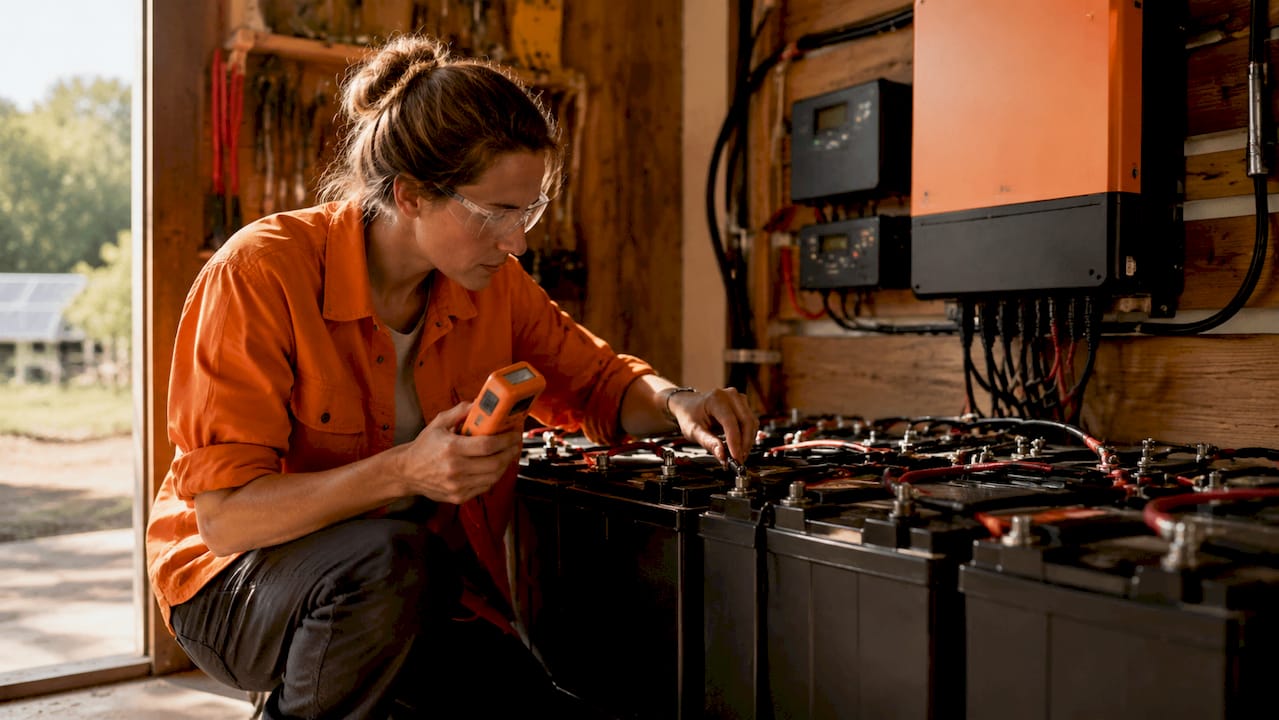
Sizing an off-grid system correctly is the most critical step in the entire process. A system that is too small will leave you without power. A system that is oversized wastes money upfront. Proper off-grid sizing follows a structured process that accounts for your daily energy use, your location’s sunlight availability, and how many days of backup power you want.
Here is the step-by-step approach used by professional installers:
- Calculate your daily energy load. Add up the watt-hours consumed by every appliance you plan to run. A typical U.S. home uses 30 kilowatt-hours per day, but an off-grid home with efficient appliances can often get that down to 10–15 kWh.
- Find your worst-month peak sun hours. Use your location’s lowest monthly solar irradiance data, not the annual average. Sizing to the worst month means your system works year-round, not just in summer.
- Size your solar array with a derate factor. Panels never perform at 100% of their rated output due to heat, dust, and wiring losses. A standard derate factor of 0.8 is applied to account for real-world conditions.
- Determine battery capacity and days of autonomy. Most off-grid homes plan for 2–3 days of storage without sun. Battery depth of discharge (DoD) also matters. LiFePO4 batteries can safely discharge to 80–90% of capacity, while lead-acid types should only go to 50%.
- Size your inverter for continuous and surge loads. Add up all appliances that could run simultaneously, then factor in surge currents for motors and compressors.
Undersizing the battery bank is the single biggest mistake new off-grid users make. It leads directly to power outages during winter months when sun hours drop. Starting with more battery capacity than you think you need is always the smarter call.
Pro Tip: Reducing your daily load by 30% through LED lighting, efficient appliances, and non-electric water heating can cut your total system cost by 25–30%. Shrinking your load is cheaper than buying more panels and batteries.
For homeowners in the San Antonio area, Alphasolarsa has a detailed resource on sizing your solar system that walks through local sun hour data and real household examples.
What are the advantages and challenges of going off-grid?
Off-grid solar delivers real, measurable benefits. It also comes with genuine trade-offs that every homeowner should understand before signing a contract.
The core advantages
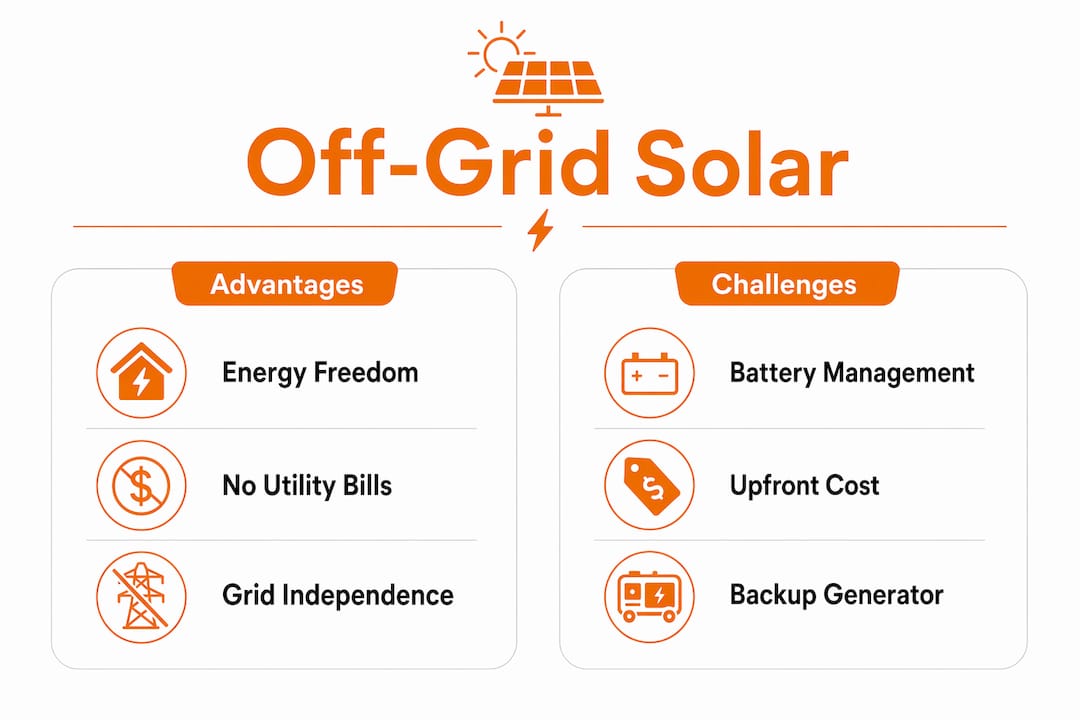
Off-grid solar provides complete immunity to grid outages and utility rate increases. Once your system is paid off, your electricity is effectively free. For homeowners in rural or remote locations, this is especially compelling. Extending utility grid lines costs over $20,000 per kilometer, which makes off-grid solar the more affordable option for properties more than a kilometer from the nearest power line.
The real challenges
Off-grid systems require daily energy management and sometimes a backup generator during extended cloudy weather. That is a lifestyle adjustment that not every homeowner is prepared for. Battery replacement every 10–15 years also adds to the long-term cost of ownership and must be factored into your budget from day one.
| Factor | Off-Grid Solar | Grid-Tied Solar |
|---|---|---|
| Monthly utility bills | None after payoff | Reduced but not eliminated |
| Grid outage protection | Full immunity | None without battery backup |
| Upfront cost | Higher ($25,000–$60,000+) | Lower ($10,000–$25,000) |
| Energy management required | Yes, daily discipline | Minimal |
| Best for | Remote or rural properties | Suburban homes with grid access |
| Battery replacement cost | Every 10–15 years | Only if battery backup added |
Grid-tied solar with battery backup can provide many of the same independence benefits at a lower upfront cost for homeowners who have grid access. That hybrid approach is worth considering if you are not fully committed to cutting the cord.
What does an off-grid solar system actually cost?
Cost is where many homeowners get surprised. A basic off-grid system for a small home or cabin starts between $3,000 and $8,000 upfront. A full residential system sized for a typical American household runs considerably more.
| System Type | Estimated Upfront Cost | Best For |
|---|---|---|
| Small cabin or weekend home | $3,000–$8,000 | Low-consumption, part-time use |
| Mid-size off-grid home | $15,000–$25,000 | Efficient homes under 15 kWh/day |
| Full residential off-grid | $25,000–$60,000+ | Standard U.S. home consumption |
| Rural grid extension (alternative) | $20,000+ per km | Only viable within 1 km of grid |
Residential off-grid systems often range from $25,000 to $60,000 depending on size and consumption patterns. The battery bank alone represents 30–50% of that total cost. Battery replacement every 10–15 years is a recurring expense that must be planned for in any long-term budget.
Hidden costs also add up. Generator fuel, periodic maintenance, and component upgrades over a 25-year system life are real expenses. The good news is that reducing household power consumption through LED lighting, efficient appliances, and non-electric water heating can substantially reduce the system size you need, and therefore the total price you pay.
For a broader look at how solar costs compare to utility bills over time, Alphasolarsa’s guide on solar vs. utility costs breaks down the long-term numbers clearly.
Key takeaways
Off-grid solar is a viable path to energy independence, but it requires accurate sizing, realistic budgeting, and a commitment to managing your energy use daily.
| Point | Details |
|---|---|
| Core components are non-negotiable | Every off-grid system needs solar panels, a charge controller, a battery bank, and an inverter. |
| Size to your worst month | Use lowest monthly sun hour data to size your system so it performs reliably year-round. |
| Battery bank is the biggest cost | Batteries represent 30–50% of total system cost and need replacement every 10–15 years. |
| Load reduction saves real money | Cutting daily energy use by 30% can reduce total system cost by 25–30%. |
| Hybrid systems are a valid middle ground | Grid-tied with battery backup delivers many independence benefits at a lower upfront investment. |
What i’ve learned about off-grid solar after years in the field
Most homeowners come to us with one of two misconceptions. Either they think off-grid solar is too complicated to manage, or they think it is a plug-and-play solution that requires zero lifestyle adjustment. Neither is accurate.
The truth is that off-grid solar rewards people who are willing to be intentional about their energy use. The homeowners I have seen thrive with these systems are not necessarily the most tech-savvy. They are the ones who took the time to understand their daily consumption before the system was ever installed. That preparation is what separates a system that works beautifully from one that runs out of power every cloudy week in January.
One thing I always tell people: size conservatively on the solar array, but never cut corners on the battery bank. You can always add panels later. Running out of stored energy at 2 a.m. because you undersized your batteries is a much harder problem to fix.
I also think the hybrid option, meaning grid-tied with battery backup, is underrated for homeowners who have grid access but want more independence. Off-grid system design is highly site-specific, and what works for a rural homestead in west Texas will not work for a suburban home in San Antonio. Getting a professional assessment before you commit to any configuration is not optional. It is the difference between a system that pays you back and one that costs you more than expected.
The technology has genuinely improved. LiFePO4 batteries, smarter charge controllers, and better inverters have made off-grid systems more reliable than they were even five years ago. If you looked at this option before and walked away, it is worth a second look in 2026.
— Anthony
Ready to explore solar for your home?
Alphasolarsa designs and installs custom solar systems for homeowners across the San Antonio area, from full off-grid setups to grid-tied systems with battery backup. Every system starts with a professional energy assessment so your setup is sized correctly from day one, not guessed at.
Whether you are planning a remote property build or looking to cut your dependence on the utility grid, our team handles the full process from design through installation. We also offer solar panel maintenance and cleaning services to keep your system performing at its best for decades. Visit our residential solar installation page to schedule a consultation and get a quote tailored to your home and energy goals.
FAQ
What is off-grid solar energy?
Off-grid solar energy is electricity generated and stored entirely on your property using solar panels and batteries, with no connection to the utility grid. The system operates independently, supplying all power needs from sunlight captured and stored onsite.
How long do off-grid solar batteries last?
Lithium LiFePO4 batteries, the current standard for off-grid storage, last 10–15 years and deliver 3,000 to 5,000+ charge cycles. Lead-acid batteries have a shorter lifespan and lower usable capacity, making LiFePO4 the better long-term investment.
What is the biggest mistake when installing an off-grid solar system?
Undersizing the battery bank is the most common and costly mistake. It causes power outages during low-sunlight periods, especially in winter, and is far more disruptive than having slightly more battery capacity than you initially thought you needed.
Is off-grid solar worth it for a suburban home?
For most suburban homes with grid access, a grid-tied system with battery backup delivers similar independence benefits at a lower upfront cost. Full off-grid setups are most cost-effective for rural or remote properties where grid extension costs exceed $20,000 per kilometer.
How much does a residential off-grid solar system cost?
A basic system for a small cabin starts at $3,000 to $8,000. A full residential off-grid system for a standard U.S. home typically costs between $25,000 and $60,000 or more, depending on daily energy consumption and battery capacity required.