

Buying wins on lifetime savings for most homeowners, even after the residential federal credit ends in 2025. Leasing, a power purchase agreement (PPA), or a prepaid lease can still be the smarter move if you’re short on cash, plan to move soon, or want zero maintenance responsibility.
Here’s when each path actually makes sense:
- Buying usually wins if you’re staying in your home long-term, want to capture every incentive dollar yourself, and plan to boost your home’s resale value.
- Leasing or a PPA can win if you have little upfront capital, don’t qualify for competitive loan terms, or want a fully hands-off maintenance arrangement.
- A prepaid lease splits the difference for homeowners who want lower monthly bills without a full cash outlay, though it locks you into a single provider for decades.
Market data from sources like EnergySage and IRS guidance on current credit rules both point the same direction: the math has shifted, but it hasn’t flipped.
Key Takeaways
Buying a residential solar system typically delivers greater lifetime savings than leasing, but leasing, PPAs, and prepaid leases remain the more practical choice for homeowners without upfront capital or strong loan access.
| Point | Details |
|---|---|
| Ownership usually wins long-term | Buying captures incentives and lifetime savings that leasing structures pass to the third-party owner. |
| The 2025 tax change matters | Residential §25D ended after 2025, while third-party owners can still access commercial §48E in some structures. |
| Escalators erode lease savings | Lease and PPA payments often climb 1 to 3% a year, regardless of what utility rates actually do. |
| Selling requires planning | Buyers must qualify to assume a lease or PPA, so negotiate buyout terms before you list your home. |
| Get a real comparison | Alpha Solar Solutions models cash, loan, lease, PPA, and prepaid lease options against your actual roof and usage. |
Table of Contents
- Lease vs Buy Solar: How the Options Actually Work
- What Actually Determines Your Long-Term Savings
- How Did the 2025 Tax Change Affect Your Options?
- What Happens to Your Lease or PPA When You Sell?
- Contract Terms and Red Flags Before You Sign
- Which Homeowners Should Lease, and Which Should Buy?
- How to Compare Quotes Apples-to-Apples
- Get a Side-by-Side Buy vs. Lease Comparison for Your Roof
- Frequently Asked Questions
- Sources
Lease vs Buy Solar: How the Options Actually Work
Multiple ownership structures exist in the residential solar market, each shifting risk and reward differently.
Cash purchase means you own the system outright from day one. You pay the full cost upfront, you claim any available incentives, and every kilowatt-hour of production is yours to bank as savings.
A solar loan gets you to ownership without draining your savings. You make fixed monthly payments to a lender, but you still own the system and claim incentives just like a cash buyer.
A lease works more like renting your roof space. You pay a fixed or escalating monthly fee to use equipment owned by a third party, who handles maintenance and retains any tax benefits associated with ownership.
A PPA charges you per kilowatt-hour produced instead of a flat fee, so your bill tracks your actual usage and the sun’s cooperation that month.
A prepaid lease asks for a large lump sum upfront, in exchange for a locked-in low (or zero) monthly rate for the contract term. Companies like Alpha Solar Solutions can walk you through how each structure prices out for your specific roof and usage.
| Factor | Cash/Loan Purchase | Lease | PPA | Prepaid Lease |
|---|---|---|---|---|
| Upfront cost | Full price (cash) or down payment (loan) | Typically no upfront cost | Typically no upfront cost | Large lump sum |
| Payment structure | None or fixed loan payment | Fixed monthly, often escalating | Per kWh, often escalating | Minimal or no monthly cost |
| Who claims incentives | Homeowner | Third-party owner | Third-party owner | Third-party owner |
| Maintenance/warranty | Homeowner (system warranty applies) | Provider | Provider | Provider |
| Home-sale impact | Adds value, no transfer issue | Buyer must qualify to assume | Buyer must qualify to assume | Buyer must qualify to assume |
| Lifetime cost | Lowest over 25 years | Higher than ownership | Higher than ownership | Middle ground |
| SREC ownership | Homeowner | Third-party owner | Third-party owner | Third-party owner |
| Best for | Long-term homeowners, equity builders | Limited capital, hands-off preference | Variable usage, no upfront cash | Wants low bills, has lump sum available |
What Actually Determines Your Long-Term Savings
The numbers that matter aren’t complicated, but you need the same five inputs for every quote you compare: total system cost, estimated annual kilowatt-hour production, your local retail electricity rate, the rate of escalation (utility rate increases vs. lease/PPA escalator), and your loan APR and term, or the lease escalator and contract length.
Here’s a simplified worked example. At a local rate of 14 cents per kilowatt-hour and average production of 12,000 kWh a year, the loan or cash buyer’s levelized cost per kWh drops well below retail within a few years and keeps falling as the system pays itself down. The lease payment, by contrast, climbs every year regardless of what the grid does. Sample market analyses from sources like SurgePV show ownership advantages on comparable 8 kW systems reaching well into the tens of thousands of dollars over 25 years.
- Pull the exact system size, panel brand, and inverter warranty from each quote.
- Ask every provider for a 25-year production and payment projection, not just year one.
- Compare levelized cost per kWh, not just the monthly payment.
Pro Tip: Run both quotes with identical system specs and the same 25-year horizon. A cheaper monthly lease payment can still cost more than a loan once you account for the escalator compounding for two decades.
How Did the 2025 Tax Change Affect Your Options?
The homeowner-claimed residential clean energy credit (Section 25D) ended for new purchases after 2025, and that single change reshaped the buy-versus-lease decision. Homeowners who buy or finance a system today no longer get a federal credit on their purchase, according to IRS guidance on the residential clean energy credit.
Third-party owners, meanwhile, can still access a separate commercial credit (Section 48E) in certain ownership structures, and GoGreenCalc’s analysis of the 2026 shift shows this narrows the gap between leasing and buying in some markets, though it doesn’t erase ownership’s lifetime advantage.
What this means for the incentives you’ll actually see:
- State rebates typically go to whoever owns the system, homeowner or third party.
- SRECs (solar renewable energy certificates) usually stay with the system owner, which is the leasing company under a lease or PPA.
- Utility performance payments often follow ownership rules that vary by state and program.
Ask any leasing company point-blank whether the commercial credit they claim is passed through to lower your price. It’s often marketed as a benefit but not always reflected in the actual monthly rate you’re quoted. Alpha Solar Solutions’ team can help you sort through current tax credit rules as they apply to your specific purchase.
What Happens to Your Lease or PPA When You Sell?
Selling a home with a leased system adds an extra step to closing, and it’s worth planning for months in advance rather than discovering it during escrow.
- Buyers must qualify to assume the lease or PPA, which means a credit check and approval process that can delay closing.
- Buyout costs let you pay off the remaining contract value and transfer clear ownership to the buyer, but the formula varies widely by provider.
- Removal and relocation fees apply if you want the system taken off before selling, which some buyers request.
- Prepaid leases transfer differently since you’ve already paid upfront. The buyer typically just assumes the remaining contract term at little or no monthly cost, which can be a selling point.
Negotiate the buyout formula before you sign, not when you’re trying to close a sale.
Contract Terms and Red Flags Before You Sign
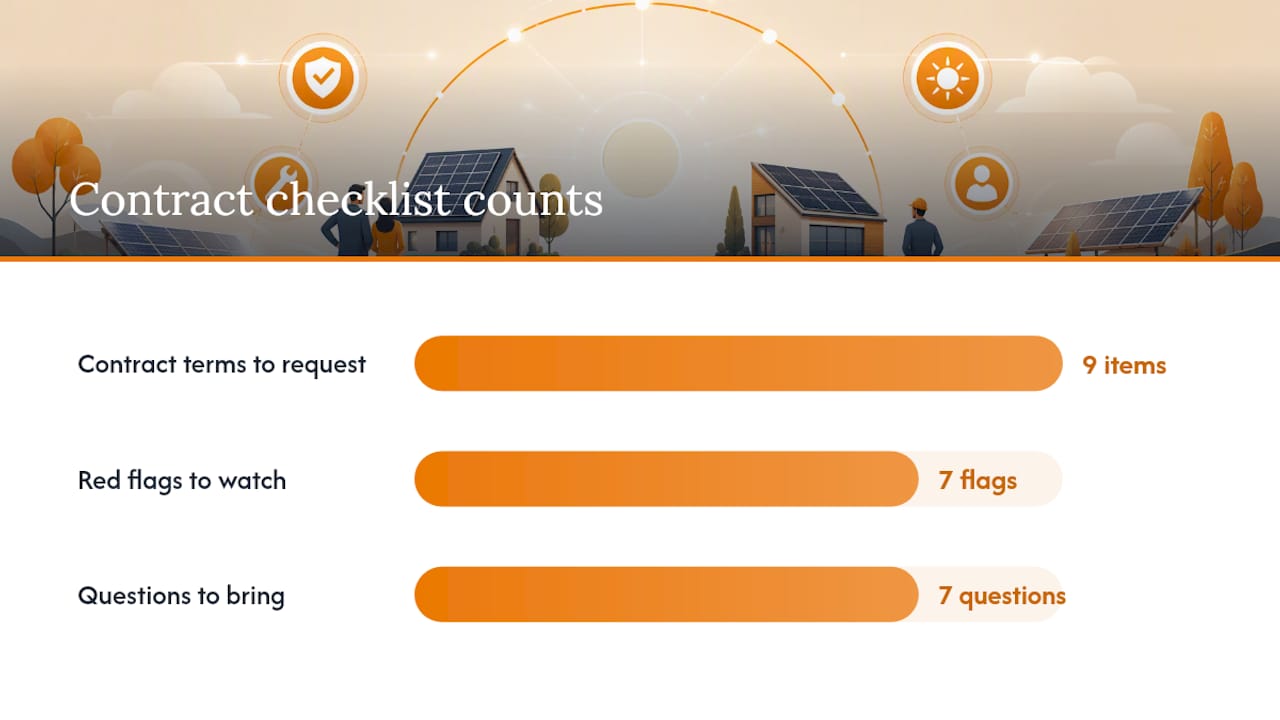
Before signing anything, request these terms in writing and read every line: the escalator rate and how it’s calculated, the exact buyout formula, transfer conditions at sale, performance guarantees, warranty length and coverage, who insures the equipment, SREC ownership, the maintenance response time commitment, and default remedies if the provider fails to deliver. The FTC’s consumer guidance on home solar recommends treating the fine print with the same scrutiny you’d give a mortgage.
Watch for these red flags:
- Ambiguous buyout language that doesn’t specify an exact formula or schedule.
- Uncapped escalators that can climb indefinitely with no ceiling.
- Rebates or credits that aren’t transferable if you sell.
- Arbitration clauses that favor only the leasing company in disputes.
- Performance guarantees written so vaguely they’re unenforceable.
- No clear maintenance response time commitment.
- Missing language on who covers the deductible if equipment is damaged.
Bring seven questions to your first sales call: What’s my exact escalator rate and how is it applied? What’s the buyout formula in year 10? Who owns the SRECs? What’s your average maintenance response time? What happens if I sell my home? Who insures the equipment? And can I see a sample 25-year cost projection in writing?
Which Homeowners Should Lease, and Which Should Buy?
Your situation, not a generic rule, decides this.
- Cash buyers staying 10+ years almost always come out ahead buying, since they capture full lifetime savings and add home value.
- Homeowners using a solar loan still get ownership benefits with manageable monthly payments, often close to what a lease would cost.
- Homeowners with limited capital or weaker credit may find a lease or PPA the only realistic path to immediate bill relief.
- Anyone planning to sell within 2 to 3 years should think hard before leasing, since buyer qualification adds friction to closing.
Weigh how long you’ll stay in the home, how much capital you can put down, how much maintenance responsibility you want, and whether capturing state incentives yourself matters to you. Alpha Solar Solutions can run a side-by-side comparison for your roof across all four structures so you’re deciding on real numbers, not estimates.
How to Compare Quotes Apples-to-Apples
Follow these steps before comparing any two quotes:
- Confirm identical system specs (panel wattage, inverter type, total system size in kW) across every quote.
- Request each provider’s estimated annual kWh production for your specific roof.
- Get your utility rate and net metering terms in writing.
- Collect loan APR and term, or lease/PPA escalator rate and contract length.
- Confirm which incentives each structure lets you claim, if any.
- Ask who owns the SRECs generated by the system.
- Note maintenance responsibilities and any service fees.
For your spreadsheet, record: system size in kW, total price, warranty length, expected annual kWh, utility rate in cents per kWh, escalation percentage, and loan or lease terms. Resources like Solar Energy Management’s savings calculation guide walk through these inputs in more detail, or ask your installer to model a 25-year cost-per-kWh projection directly.
A note from an Alpha Solar Solutions installer
The most common mistake we see isn’t picking the wrong option. It’s comparing a lease quote against a purchase quote with mismatched system sizes or production estimates, which makes the comparison meaningless from the start. Homeowners who insist on identical specs across every quote make far better decisions.
Get a Side-by-Side Buy vs. Lease Comparison for Your Roof
Running these numbers yourself takes time most homeowners don’t have, and the inputs matter more than most quotes let on. Alpha Solar Solutions builds you a written comparison across cash purchase, solar loan, lease, PPA, and prepaid lease options, using your actual roof, your actual usage, and real production modeling instead of generic estimates.
What’s included in your comparison:
- A site assessment and custom production model for your roof
- A buyout and transfer estimate in case you sell before the contract ends
- Financing coordination if a loan turns out to be your best fit
- System monitoring setup so you can track real performance against the model
- EV charger integration if you’re planning to add one down the road
Start with a residential solar installation quote from Alpha Solar Solutions, and get the real numbers for your home before you sign anything with anyone.
Frequently Asked Questions
Is it ever better to lease solar than to buy it outright?
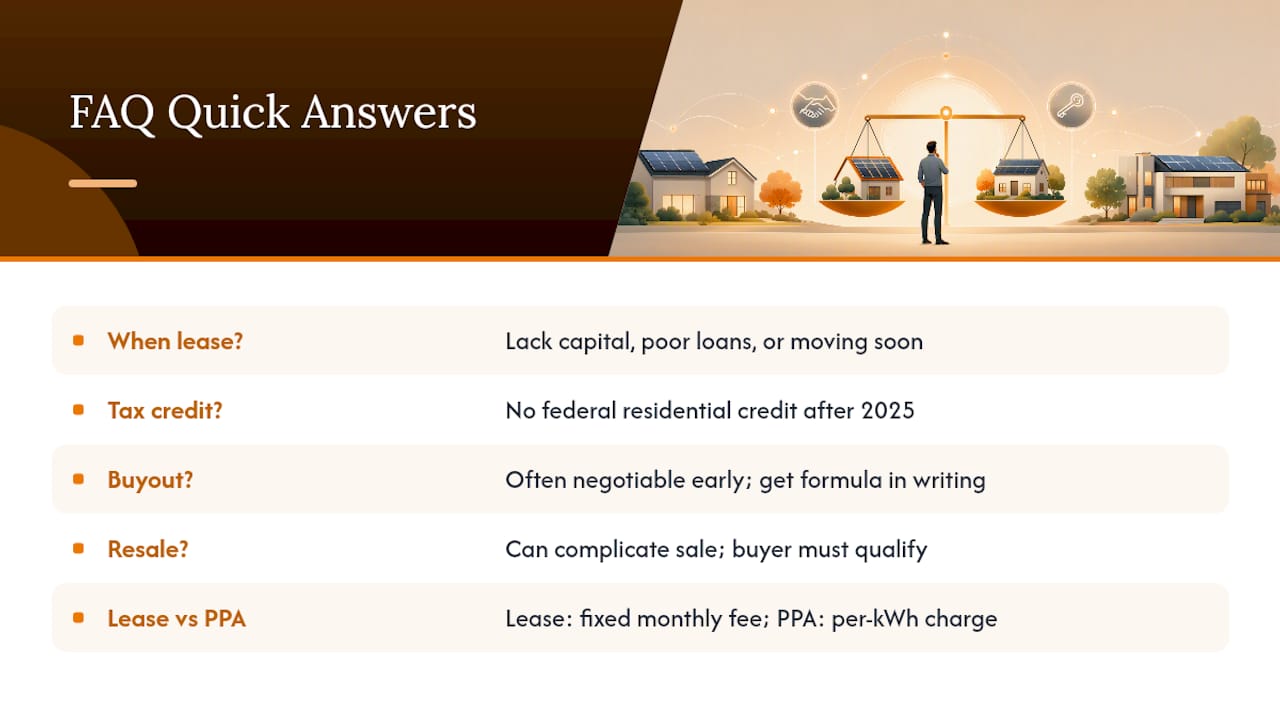
Yes, if you lack upfront capital, don’t qualify for competitive loan terms, or plan to move within a few years and want to avoid transfer complications tied to ownership.
Do I still get a tax credit if I buy solar panels in 2026?
No federal residential credit applies to homeowner purchases after 2025. Confirm current rules directly through IRS guidance before assuming any credit applies to your purchase.
Can I negotiate the buyout price on my solar lease?
Often yes, especially early in the contract term. Get the exact buyout formula in writing before signing, not just a verbal estimate.
Does leasing solar hurt my home’s resale value?
It can complicate the sale rather than reduce value outright, since buyers must qualify to assume the lease or you’ll need to negotiate a buyout before closing.
What’s the difference between a lease and a PPA?
A lease charges a fixed (often escalating) monthly fee regardless of production. A PPA charges per kilowatt-hour actually produced, so your bill moves with output.
This article is general information, not a substitute for advice from a qualified financial advisor. Consult a qualified financial professional about your own circumstances before acting on anything here.
Sources
Run your own comparison using these references before signing any contract:
- FTC: Solar power for your home
- IRS: Residential clean energy credit
- Solar Lease vs Buy in 2026: The Tax Credit Changed the Math | GoGreenCalc
For a modeled comparison specific to your roof rather than a national average, Alpha Solar Solutions’ residential installation team can generate one directly.