

Yes, you can power most of your EV’s home charging with rooftop solar, and for most homeowners it’s simpler than it sounds. The condition is timing: your panels need to be producing when your car is plugged in, or you need a way to store or redirect that surplus. Three approaches get you there: schedule charging for daylight hours, install a solar-aware charger that automatically follows your panels’ surplus output, or add a home battery that banks daytime solar for nighttime charging.
Homeowners who match charging to production typically cut their per-mile driving cost well below what grid charging or public fast charging runs. How much solar you need depends on your mileage and your panel wattage. Here’s the quick version before we get into the math and the wiring details:
- Daytime scheduling costs nothing extra and works with any charger you already own.
- Solar-aware chargers use a CT sensor to track and match your home’s surplus automatically.
- Battery storage shifts your solar-charged miles to overnight, at a higher upfront cost.
The right mix depends on your roof, your driving pattern, and your budget. Let’s break down what you actually need.
Key Takeaways
Most home EV miles can run on solar power when charging is scheduled for daylight hours, matched to surplus with a solar-aware charger, or backed by battery storage.
| Point | Details |
|---|---|
| Verdict | Solar EV charging works well for most homeowners once charging timing matches solar production. |
| Sizing rule | Expect to add roughly seven to 12 panels to fully cover typical EV charging needs, depending on mileage and climate. |
| Best first upgrade | A solar-aware charger with a CT clamp usually beats adding a battery for cost-to-convenience. |
| Code compliance | NEC Article 625 requires wiring and breakers sized at 125% of the charger’s rated current. |
| Next step | Alpha Solar Solutions offers site assessments covering shading, inverter headroom, and charger sizing for San Antonio homeowners. |
Table of Contents
- What Equipment Do You Need for EV Charging From Solar?
- How Many Solar Panels Do You Need to Charge an EV?
- When Should You Charge Your EV to Maximize Solar Use?
- Do You Need a Home Battery to Charge Your EV With Solar?
- What Electrical Code and Safety Rules Apply to Solar EV Charging?
- What Does Solar EV Charging Cost and How Fast Does It Pay Back?
- How Does a Real Solar EV Charging Installation Work?
- Sources
What Equipment Do You Need for EV Charging From Solar?
Before you request quotes, confirm you understand what each piece of hardware actually does. Solar EV charging setups usually involve five components, and mixing up their roles is where most homeowner confusion starts.
- PV array. Your panels convert sunlight into DC electricity. Capacity, measured in kilowatts (kW), determines how much energy you can generate on a clear day.
- Inverter. DC power from panels can’t run your car charger or your home directly. An inverter converts it to usable AC power and synchronizes with grid frequency, which is why you can’t just wire panels straight into a charger. Behind-the-meter charging requires that synchronization step.
- Level 2 EV charger (EVSE). This is the wall-mounted charging unit, and it needs a dedicated 240-volt circuit, separate from your other household loads. A basic Level 2 unit charges from any power source; it doesn’t inherently know if that power came from your roof or the grid.
- CT sensor or solar diverter. This is what makes a charger “solar-aware.” A current transformer (CT) clamp monitors your home’s net energy flow and tells the charger to speed up, slow down, or pause based on how much solar surplus is available.
- Home battery (optional). Stores excess daytime solar for use after sunset, letting you keep charging with solar-sourced energy even when the sun’s down.
Compatibility matters here. If you’re shopping for a charger, check whether it supports Open Charge Point Protocol (OCPP), an open standard that lets third-party apps and utilities communicate with your charger for scheduling and demand response. It also matters whether your charger and inverter play well together. Some manufacturers build closed ecosystems where their charger only talks to their own inverter and monitoring app; others support open integration across brands. If you want flexibility down the road, OCPP compatibility is worth asking about even if you don’t need it today.
How Many Solar Panels Do You Need to Charge an EV?
The math is more approachable than most people expect. Start with your annual mileage and your car’s efficiency rating, usually listed in miles per kWh.
- Annual EV energy use (kWh) = annual miles ÷ vehicle efficiency (miles per kWh)
- Required solar capacity (kWp) = annual EV kWh ÷ average annual production per kWp
In the US, a rough national average is that each kW of installed solar capacity produces about 1,500 kWh per year, though this swings with your location, roof angle, and shading. Enphase notes that a typical EV can require somewhere between 3,000 and 4,700 kWh annually, depending on how much you drive and how efficient your vehicle is.
Statistic to know: AAA’s guidance puts the common rule-of-thumb at seven to 12 additional solar panels to fully cover a typical EV’s annual charging needs, depending on your battery size, mileage, and local sun exposure.
Here’s how that plays out in two realistic scenarios:
The daily commuter (about 8,000 miles per year). At 3.5 miles per kWh, that’s roughly 2,286 kWh of annual EV energy use. Dividing by 1,500 kWh per kWp puts you at just over 1.5 kWp of added solar capacity, or roughly four to five panels using common 400 watt panels.
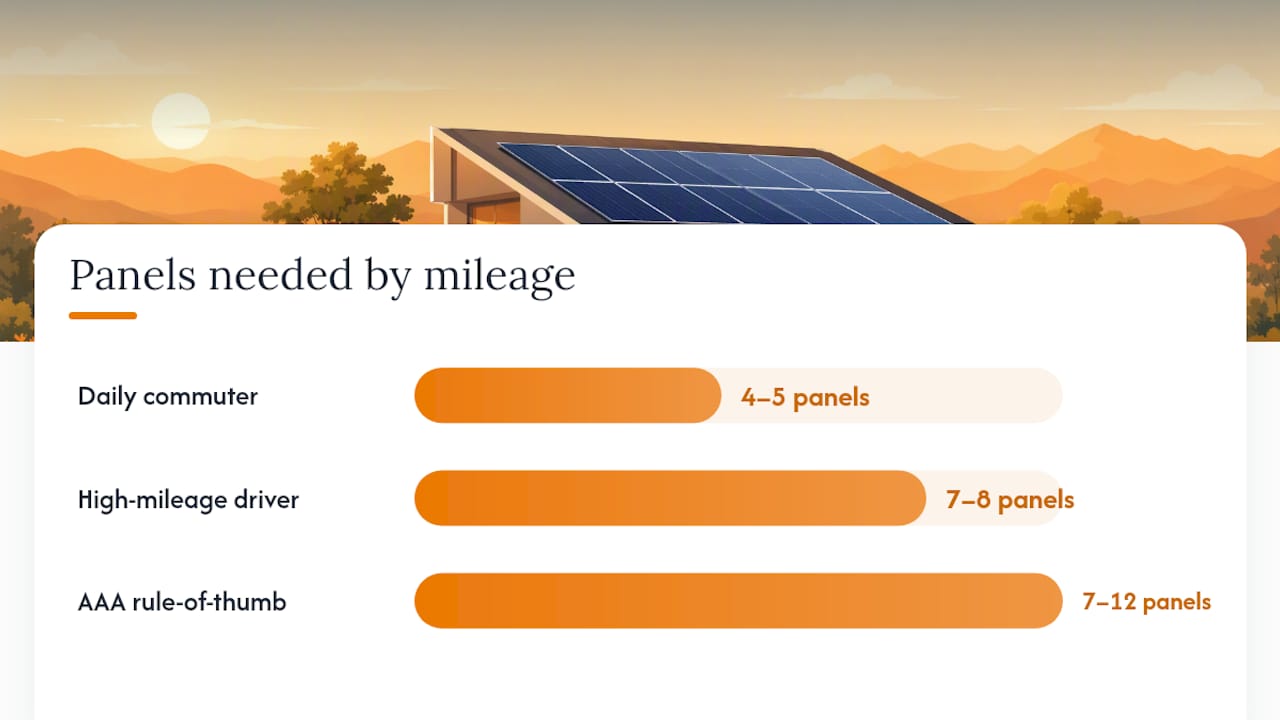
The high-mileage driver (about 15,000 miles per year). At the same efficiency, that’s about 4,286 kWh annually, landing you closer to 2.9 kWp, or about seven to eight panels. This tracks closely with the AAA range once you factor in real-world losses from shading, inverter inefficiency, and panel degradation over time.
If your existing solar system was sized before you owned an EV, there’s a decent chance it’s undersized now. Running these numbers yourself takes ten minutes and tells you exactly what conversation to have with an installer.
When Should You Charge Your EV to Maximize Solar Use?
Timing is everything with solar EV charging, and the approach you choose depends on how hands on you want to be.
- Daytime scheduling is the simplest option. Set your charger’s timer for midday hours when your panels are producing at peak output. It costs nothing extra, but it’s a blunt instrument. On a cloudy day, you’re still pulling from the grid, and you’re locked to a fixed window whether or not your car actually needs a full charge that day.
- Solar-aware chargers with CT diversion solve that blind spot. The CT clamp measures real-time surplus at your main panel and adjusts charging speed automatically, ramping up when your panels are producing more than the house is using and throttling back when clouds roll in. Earth Energy Log explains that this surplus-following approach is generally the best balance of cost and convenience for most homeowners, since it requires no manual scheduling and adapts to weather in real time.
- OCPP-compatible chargers open the door to third-party apps that layer in scheduling logic, utility demand-response programs, or remote monitoring, useful if you want more control without buying a proprietary ecosystem.
Your utility’s rate structure changes the calculation too. If you’re on a Time-of-Use plan with cheap overnight rates, grid charging at 2 a.m. might beat solar charging at noon on pure cost, even though it’s not solar-sourced. If your utility offers net metering or a solid feed-in rate, exporting surplus solar and importing cheap off-peak power can sometimes pencil out better than trying to consume every solar watt onsite. Run both scenarios against your actual utility bill before assuming daytime charging automatically wins.
Pro Tip: Check your utility rate plan before choosing a charging window. A solar-aware charger set to “maximize solar use” can actually cost you more than simple off-peak grid charging if your utility has steep Time-of-Use discounts overnight.

A well-configured home EV charger with smart scheduling features gives you the flexibility to test both strategies before committing to one.
Do You Need a Home Battery to Charge Your EV With Solar?
Not necessarily, and for most homeowners, it’s not the first upgrade to make. A battery lets you store daytime solar surplus and release it to your car overnight, which matters if your driving schedule doesn’t line up with sunlight hours, say, you get home at 7 p.m. and need a full charge by morning.
- Cost tradeoff. Battery systems represent a meaningful upfront investment on top of your solar and charger costs, and the payback period stretches out compared to a solar-aware charger alone. ROI improves in households with high electricity rates, frequent grid outages, or utility rate structures that reward stored solar use over exported solar.
- V2H and V2G potential. Bidirectional charging, where your EV’s battery can power your home (Vehicle-to-Home) or even feed the grid (Vehicle-to-Grid), is gaining traction but still requires a compatible vehicle, a bidirectional charger, and often utility approval depending on your local interconnection rules. It’s a feature to watch, not yet a mainstream option for most drivers.
- The practical recommendation. Most homeowners see the biggest jump in solar self-consumption simply by switching to daytime charging or installing a solar-aware charger, before ever adding a battery. Save the battery decision for after you’ve maximized the cheaper wins.
If you’re weighing whether storage makes sense for your situation, Alpha Solar Solutions’ guide to home energy storage walks through the cost bands and use cases in more detail.
What Electrical Code and Safety Rules Apply to Solar EV Charging?
EV charging isn’t a casual DIY wiring project, and the code exists for good reason. Under the National Electrical Code, EV charging is classified as a continuous load, meaning it draws current steadily for three hours or more at a stretch. NEC Article 625 requires conductors and equipment to be rated at 125% of the charger’s maximum current, a buffer that prevents overheating and breaker nuisance trips during long charging sessions.
Statistic to know: A charger rated for 40 amps continuous draw needs a breaker and wiring sized for 50 amps under the 125% rule, not 40. Skipping this step is one of the most common installer errors and a leading cause of post-install rework.
Before signing off on any installation, verify these points with your electrician or installer:
- The circuit is dedicated to the EV charger, not shared with other 240V loads.
- Breaker sizing follows the 125% continuous-load rule, not just the charger’s nameplate rating.
- The CT sensor is placed at your main service panel, where it can accurately read whole-home net consumption.
- Your inverter supports export-limited or curtailment control if your utility caps how much solar you can send back to the grid.
- Permits and inspections are pulled locally. Skipping this step can void warranties and create resale headaches.
If an installer waves off any of these questions or can’t explain how they’re sizing your circuit, treat that as a red flag and get a second opinion.
What Does Solar EV Charging Cost and How Fast Does It Pay Back?
Your total investment depends heavily on which pieces you’re adding. A Level 2 charger install, incremental solar capacity, and battery storage each carry their own price band, and stacking all three at once costs more than phasing them in over a couple of years.
Statistic to know: Enphase’s analysis finds that solar-charged miles can cost 50% to 100% less per mile than relying on public fast charging, largely because you’re bypassing the markup that public networks charge per kWh.
- Level 2 charger installation covers the unit itself, the dedicated circuit, and labor. Costs vary based on how far the charger sits from your electrical panel and whether a panel upgrade is needed.
- Incremental solar capacity is typically priced per watt installed, and adding panels to an existing system usually costs somewhat more per watt than a full new install, due to smaller-batch labor and equipment.
- Battery storage carries the widest price range of any component here, driven by capacity (kWh) and brand.
Your actual payback speed hinges on four things: how sunny your area is, your local electricity rate, how many miles you drive annually, and how much of your solar output you personally consume versus export. A homeowner in a high-sun region with high driving mileage sees a faster payback than someone in a cloudier climate who drives infrequently. Running your own sizing math from the earlier section, or requesting a site-specific quote, tells you where you actually land.
How Does a Real Solar EV Charging Installation Work?
Case studies help because the sizing math only tells half the story. A recent Alpha Solar Solutions install for a San Antonio homeowner added a modest number of panels specifically to offset a new EV’s charging load, paired with a solar-aware Level 2 charger and CT clamp at the main panel. The customer’s existing system had been sized for household use only, before the EV purchase, which is a common gap.
The homeowner’s biggest surprise wasn’t the installation itself. It was learning that their existing inverter had enough headroom to support the added panels without an upgrade, cutting the project cost and timeline significantly.
Anthony and the Alpha Solar Solutions team walk every EV charging site through the same checklist before quoting:
- Roof shading and azimuth check to confirm production estimates hold up.
- Inverter headroom review to see if existing equipment can support added capacity.
- CT clamp placement planning at the main service meter.
- Cable run mapping to minimize voltage drop between panel and charger.
- A realistic install timeline communicated upfront, not adjusted after the fact.
If you’re weighing a similar project, Alpha Solar Solutions’ EV charger installation page outlines what a site visit covers.
Who benefits most from solar EV charging, and when should you act?
The homeowners who gain the most are daytime drivers with decent south-facing roof exposure and predictable commutes, because their charging windows naturally line up with peak solar production. If you work from home, or your schedule lets you plug in during the day, you’re leaving money on the table without a solar-aware charger.
I’d prioritize a battery or bidirectional setup only after you’ve confirmed a solar-aware charger alone can’t close the gap, most households overestimate how much they need one. Run the sizing math from this guide first. If the numbers look promising, book a site assessment before assuming your existing system is enough.
Get a Site Assessment for Solar EV Charging
If the math above has you convinced but you’d rather not spend a Saturday climbing on your roof to check shading yourself, that’s exactly what a site assessment is for. Alpha Solar Solutions handles residential solar installation, EV charger installation, battery storage, and solar panel cleaning and reinstallation across San Antonio and the surrounding area, and a site visit for EV charging typically covers your roof’s shading and orientation, your inverter’s remaining capacity, CT clamp placement, and a realistic install timeline before you commit to anything.
Homeowners already generating solar often just need an incremental capacity add and a solar-aware charger rather than a full system overhaul, and an assessment tells you which one you actually need. If you’re starting from scratch, the residential solar installation page covers what a new system build involves. If your panels are already up but underperforming, panel cleaning service can recover lost output before you spend money on new capacity you might not need. Ready to find out what your roof can actually support? Request an EV charger installation quote and get a scope, timeline, and price based on your actual home, not a rule of thumb.
Sources
- Charging Your EV With Solar Panels – AAA
- EV charging and solar – Enphase
- NEC Article 625 and EV charging – GetLicenseReady
- Solar EV charging at home 2026: how to charge your EV with solar — Earth Energy Log