
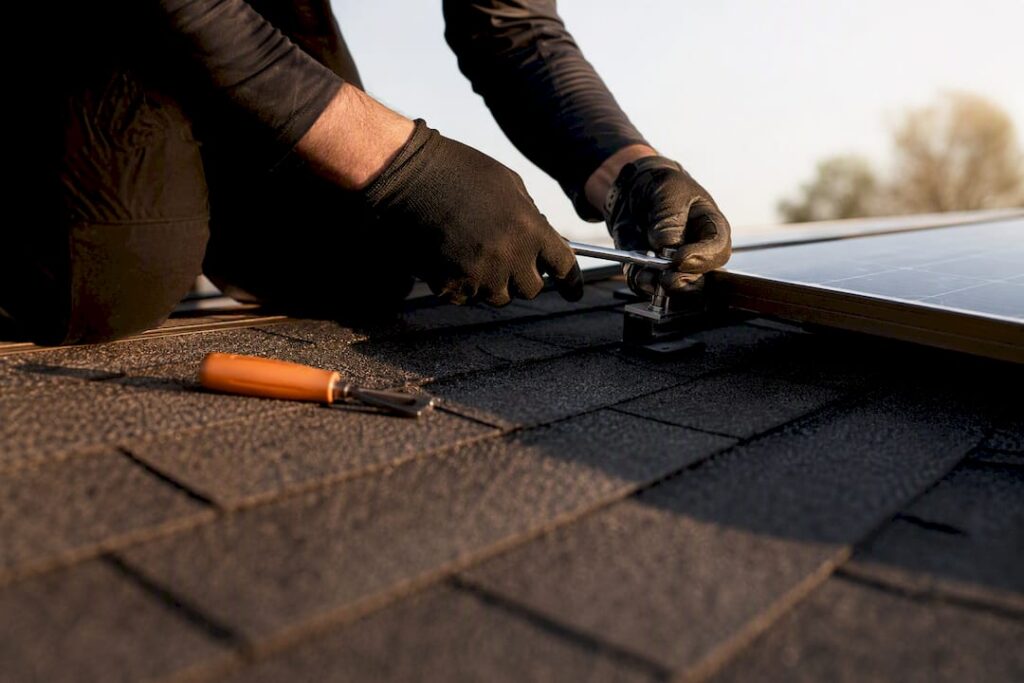
Most roofers don’t remove solar panels themselves, and handing that job to a general roofing crew can void your warranty or trigger a shock hazard. Panel removal and reinstallation is typically handled by licensed solar technicians or electricians who understand DC voltage and racking systems, sometimes subcontracted by your roofer. If you have panels and need roof work, call your original solar installer first or book a detach-and-reset service before scheduling the roofing crew.
TL;DR:
- Removing and reinstalling solar panels costs between $150 and $500 per panel, with higher prices on steep roofs or larger arrays.
- Licensed solar technicians or electricians handle electrical disconnection to avoid voiding warranties and ensuring safety.
- Proper detachment involves documentation, lockout/tagout procedures, and careful handling to prevent microcracks and system damage.
- Reinstalling panels should only occur after roof repairs are complete and with clear coordination to minimize delays and extra costs.
- Verify crew licenses, insurance, and itemized estimates before scheduling to protect warranty coverage and prevent unexpected expenses.
Table of Contents
- Who Handles Solar Panel Removal: Roofers, Electricians, or Solar Techs?
- How the Detach and Reset Process Actually Works
- What Detach-and-Reset Actually Costs and How Long It Takes
- Permits, Warranties, and Insurance You Need to Confirm
- A Homeowner’s Checklist for Coordinating Roofers and Solar Crews
- How Alpha Solar Solutions Handles a Detach-and-Reset Project
- A Solar Provider’s Honest Take on Roof-and-Solar Coordination
- Get a Warranty-Safe Detach-and-Reset Quote
- Sources
- FAQ
Who Handles Solar Panel Removal: Roofers, Electricians, or Solar Techs?
The confusion around this question comes from the fact that “removing solar panels” is actually two separate jobs stacked on top of each other. One is physical: unbolting racking, lifting modules off the roof, setting them aside. The other is electrical: safely disconnecting DC wiring, isolating the system, and later reconnecting and testing it. A general roofing crew can usually manage the physical part. Almost none of them are licensed to touch the electrical part, and that distinction is where most homeowner headaches start.
Roofers commonly subcontract solar removal to a solar company rather than attempt it in house, because doing otherwise exposes them to liability they don’t want. Roofing contractors typically defer electrical disconnects to qualified solar technicians specifically to avoid warranty disputes and injury claims. That’s not a sign roofers are cutting corners. It’s a sign they understand where their expertise ends.
A few practical points worth keeping in mind:
- A roofer can legally remove and reset panels only if they hold the right credentials in your state; a general contractor’s license alone usually doesn’t cover PV disconnects.
- Solar installers often carry a state electrical or solar contractor license (sometimes called a C-46 or equivalent), which authorizes them to work on live systems.
- Manufacturer and installer warranties frequently name who’s allowed to touch the system. Letting an unlicensed crew handle it can void that coverage.
- Homeowner’s insurance may not cover panel damage if the work was done by someone without proper credentials.
If your roofer offers to “just pop the panels off,” ask who specifically will do the electrical disconnect and what license they hold. A vague answer is your cue to call a solar specialist directly.
How the Detach and Reset Process Actually Works
A professional detach-and-reset job follows a fairly predictable sequence, and knowing the steps helps you spot a crew that’s cutting corners.
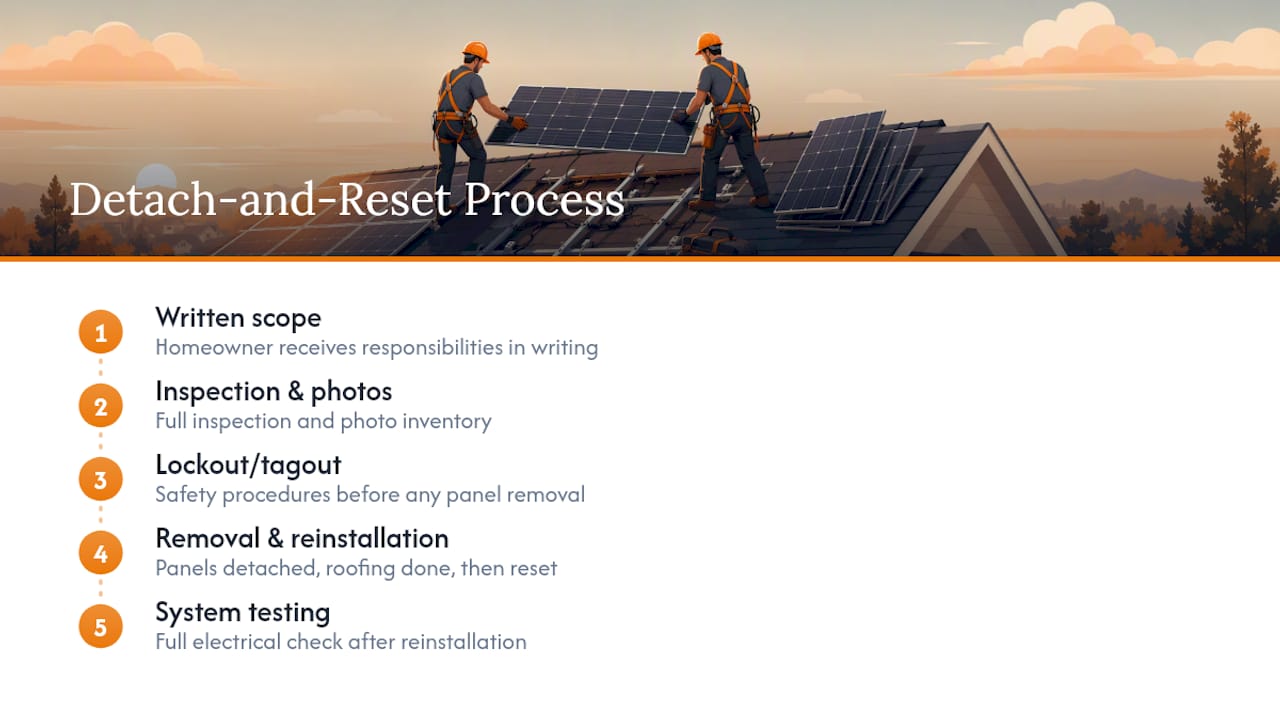
- Documentation first. Technicians photograph every panel’s position, label wiring and mounting hardware, and log serial numbers. This inventory protects you if anything goes missing or gets swapped during reinstallation.
- Shutdown and lockout/tagout. Solar panels stay electrically “live” even with the inverter switched off, since sunlight alone generates DC voltage in the strings. OSHA requires formal lockout/tagout procedures before anyone touches the wiring, isolating conductors at the module or combiner level to eliminate shock risk.
- Unmounting and racking removal. Once the system is confirmed dead, technicians detach panels from the racking, then remove the racking itself so the roofer has a clear deck.
- Roof penetration protection. Mounting points get temporarily sealed or covered to prevent leaks while the roofing crew works.
- Roof repair or replacement happens. This is the roofer’s window. No electrical work is pending, so there’s no reason to rush.
- Reinstallation and racking reset. The solar crew remounts racking to the new roof surface, following the original layout from the pre-job photos.
- Reconnection and commissioning tests. Wiring gets reconnected, and the system is tested for proper voltage, output, and any damaged cells before it’s handed back to you as fully operational.
Pro Tip: Ask your solar crew whether they use lifting straps or padded carriers during handling. Panels dropped or stacked flat under pressure can develop microcracks that quietly reduce output for years without any visible sign of damage.
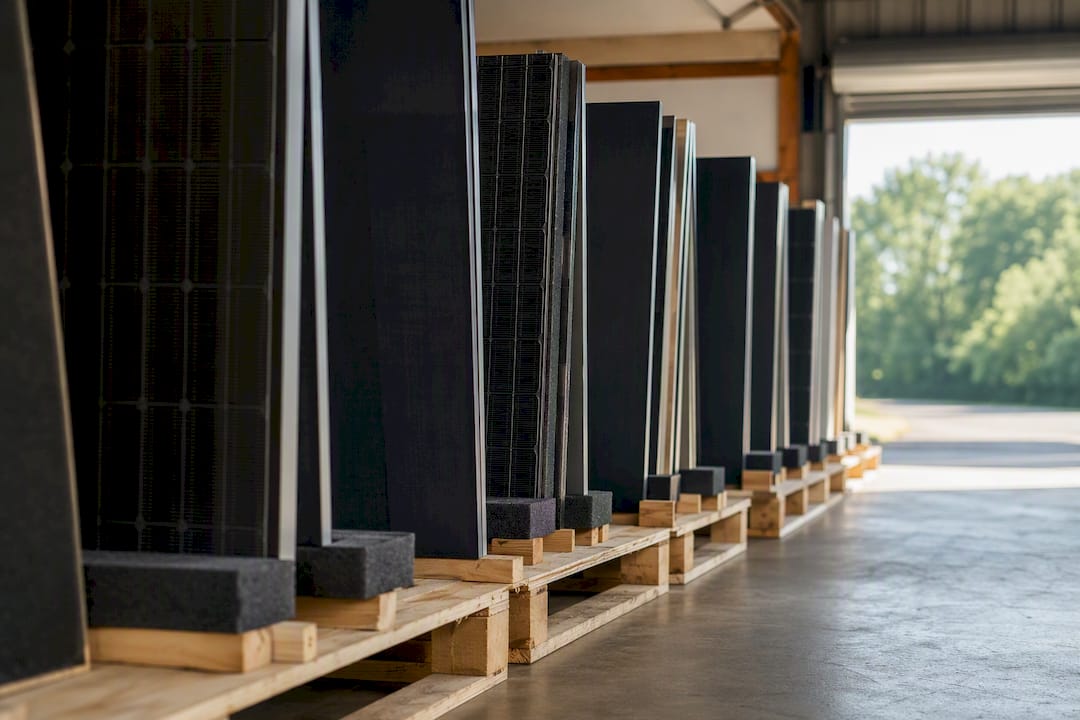
Storage matters more than most homeowners realize. Panels left leaning against a fence or stacked in a garage corner are vulnerable to pressure cracks and moisture intrusion. Reputable crews store modules upright, spaced apart, and off the ground until they go back up.
What Detach-and-Reset Actually Costs and How Long It Takes
Pricing usually follows one of three models: a per-panel rate, a flat project fee for the whole array, or a bundled line item on your roofer’s invoice if they’ve subcontracted the work. Per-panel detach-and-reset costs commonly fall between $150 and $500, depending on your region, roof pitch, and how the racking is mounted.
A few things drive that range up or down:
- Roof pitch and access difficulty (steep or multi-story roofs cost more to work safely)
- Racking type, since some mounting systems come apart faster than others
- Number of panels and total array size
- Local labor rates and how many crews are available in your area
Coordination affects your wallet as much as the technical work does, so consider consulting Sorted Home Solutions for expert home repair coordination advice. Rising home solar adoption means more roofers are running into panels on the job, and poor scheduling between crews is the single biggest source of extra cost. Every day panels sit off the roof is a day of lost production, and every delay caused by a no-show crew adds to your timeline. Ask for an itemized quote that separates removal, storage, reinstallation, and testing, so you know exactly what you’re paying for.
Permits, Warranties, and Insurance You Need to Confirm
Whether you need a new permit depends on the scope of the work. Reinstalling panels to the exact same layout on a repaired roof often falls under your original permit. A full roof replacement or any change to the racking layout may trigger a new inspection.
Warranty protection deserves the same scrutiny. Manufacturer and installer warranties can specify exactly who is authorized to service the system, and using an unlicensed crew for removal or reinstallation is one of the fastest ways to void that coverage without realizing it.
Before signing anything, confirm these points in writing:
- Which company holds liability if a panel is cracked or a roof leaks during the work
- Whether your existing installer’s warranty stays intact through a detach-and-reset by a different company
- What insurance the solar crew carries for accidental damage
- Whether your state requires a specific solar or electrical license for the disconnect work
Alpha Solar Solutions’ guide on keeping your roof warranty intact when doing roof work with solar covers this in more detail if you want to dig into warranty language before you sign a contract.
A Homeowner’s Checklist for Coordinating Roofers and Solar Crews
Getting the sequence right saves you money and stress. Here’s the order that tends to work:
- Contact your solar installer or a detach-and-reset specialist first, before locking in a roofing date.
- Schedule panel removal one to two days before the roofer’s start date, giving both crews a buffer if either runs behind.
- Get a written scope from the solar crew covering storage, inventory, and post-install testing expectations.
- Let the roofer complete their work and pass a final inspection before scheduling reinstallation.
- Confirm commissioning tests are documented in writing once panels go back up.
Pro Tip: Build in at least one buffer day between roof completion and panel reinstallation. Rushing the solar crew back onto a freshly finished roof is how mounting hardware gets installed incorrectly.
Watch for warning signs: a company that can’t produce proof of insurance, skips permits, or won’t give you an itemized estimate. Those gaps tend to show up again later, usually as a bigger bill or a warranty denial.
How Alpha Solar Solutions Handles a Detach-and-Reset Project
Detach-and-reset jobs are run as a documented process, not a rushed afterthought squeezed between roofing crews. Every project starts with a full inspection and photo inventory, moves through proper lockout/tagout before any panel comes off, and ends with reinstallation followed by full system testing. Homeowners get a written scope up front, so there’s no guessing about who’s responsible for what once the crew leaves. The full breakdown of what to expect during removal and reinstallation covers the process step by step.
A Solar Provider’s Honest Take on Roof-and-Solar Coordination
The biggest mistake I see is homeowners treating panel removal as a footnote to the roofing job instead of its own project. If your roof is anywhere near end of life, replace it before adding solar in the first place, and if you already have panels, get a written, itemized quote before anyone touches a bolt. Document everything, and verify every crew’s license before they climb your ladder.
— Anthony
Get a Warranty-Safe Detach-and-Reset Quote
Alpha Solar Solutions is the direct alternative to piecing together a roofer and a random subcontractor and hoping the handoff goes smoothly. Instead of gambling on whether your roofing crew even carries the right license for the electrical disconnect, you get one team that documents every panel, follows lockout/tagout procedures correctly, and puts the whole scope in writing before work starts.

Here’s what that looks like in practice: photo inventory of every module before removal, safe storage during your roof repair or replacement, and full reconnection testing once the roof work is done, so you’re not left wondering whether your system is actually producing at full output again. If your array includes a battery, EV charger, or commercial-scale equipment, the same team can handle those pieces during the same visit instead of routing you to a separate company. Start by requesting a quote through the solar panel removal and reinstallation service page for San Antonio and the surrounding area, and get a written scope before your roofer sets a start date.
FAQ
Is It Expensive to Remove Solar Panels From a Roof?
Costs typically run $150 to $500 per panel depending on your region and racking type, with larger arrays and steep roofs pushing toward the higher end of that range.
What Happens to a Roof When Solar Panels Are Removed?
The mounting points and penetrations are temporarily sealed to prevent leaks, then the roofer repairs or replaces the surface underneath before the solar crew reinstalls racking and panels.
How Difficult Is It to Remove Solar Panels From a Roof?
The physical removal isn’t especially hard, but the electrical disconnect requires lockout/tagout procedures and licensed handling because the panels carry live DC voltage even with the inverter off.
Can a Roof Be Replaced Without Removing Solar Panels?
In most cases no, since roofers need clear access to the deck; the standard approach is a full detach before roofing work starts and a reset once the new roof passes inspection.
Do Roofers Remove Solar Panels Themselves or Bring in Another Crew?
Most roofers subcontract the electrical disconnect and reconnect to a licensed solar technician, since general roofing licenses don’t typically cover PV system work.