
TL;DR:
- A grid-tied solar system connects your home’s solar panels directly to the utility grid, enabling solar power usage during the day and grid power at night. It relies on net metering, which credits excess energy exported to the grid, reducing your electricity bills significantly. However, standard systems shutdown during power outages for safety, unless combined with battery storage in a hybrid setup.
A grid-tied solar system is defined as a photovoltaic (PV) installation that connects your home’s solar panels directly to the utility grid, allowing you to use solar power during the day and draw from the grid at night or on cloudy days without any battery storage required. The industry standard term is “grid-connected PV system,” and it represents the most common residential solar configuration in the United States today. Understanding how this setup works, what it costs, and where it falls short gives you the clearest possible picture before you commit to an installation.
Defining grid-tied solar systems: how they work
A grid-tied system operates by linking your solar panels to the utility grid so that solar power flows to your home first, and any surplus exports automatically to the grid. Your panels generate direct current (DC) electricity. An inverter, the central piece of electrical equipment in the system, converts that DC into alternating current (AC) synchronized with the grid’s frequency and voltage. That AC power then runs your appliances, lights, and devices just like standard utility power does.
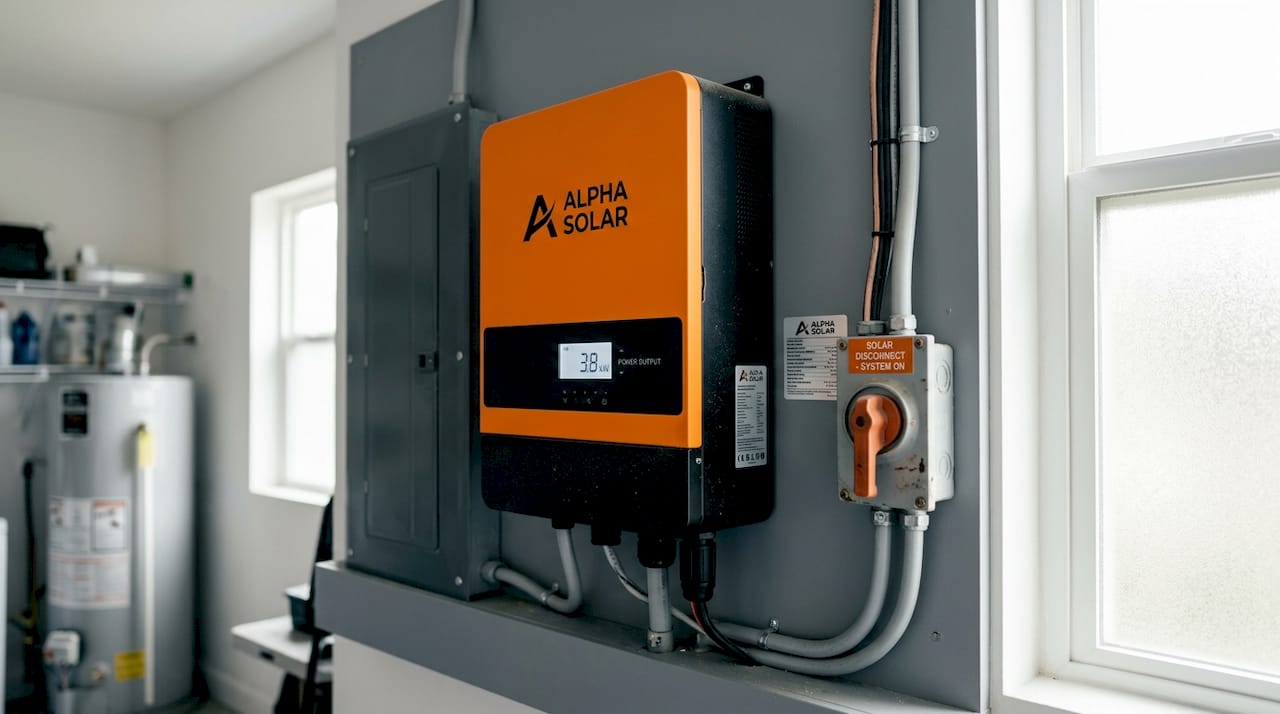
When your panels produce more electricity than your home needs, the excess travels back through your meter to the utility grid. When production falls short, such as at night or during heavy cloud cover, the grid supplies the difference automatically. Grid-tied systems link home solar panels to the utility grid so you use solar power during the day and grid power at night without any manual switching.
Net metering is the billing arrangement that makes this exchange financially worthwhile. Your utility credits you for the kilowatt hours (kWh) you export, which offsets the cost of the grid power you consume later. The net result appears on your monthly bill as a reduced charge or, in high-production months, a credit that carries forward.
Pro Tip: Ask your utility company specifically about their net metering rate before signing any solar contract. Some utilities credit exports at the full retail rate, while others credit at a lower wholesale rate. That difference can significantly affect your payback period.
To understand the key components in a residential grid-connected installation, including wiring, disconnect switches, and production meters, it helps to review a full component breakdown before your consultation.
What are the main benefits and limitations of grid-tied solar power?
Grid-tied solar delivers real financial and practical advantages for most homeowners, but it also carries one significant limitation that surprises many buyers.
Core benefits
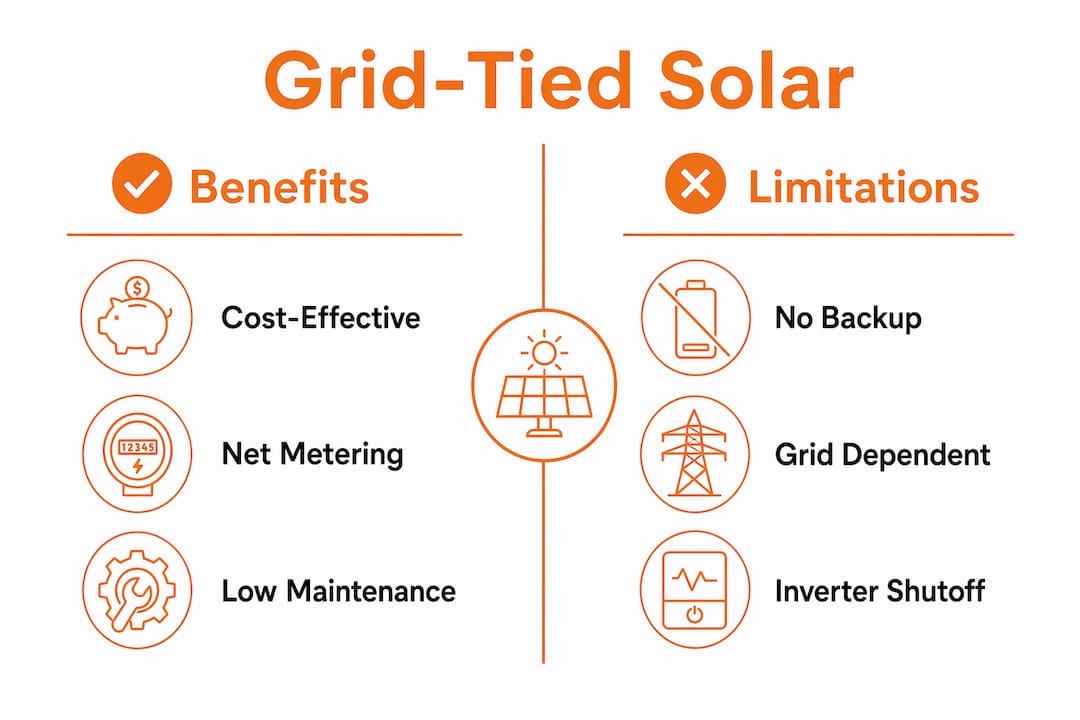
- Lower electricity bills. Grid-tied systems can reduce electricity bills by 80 to 100% through net metering, and savings over 25 years can reach $30,000 to $50,000 without the added cost of battery storage.
- No battery required. The grid itself acts as your backup supply, which eliminates the upfront cost of battery banks and the ongoing maintenance they require.
- Minimal maintenance. Solar panels have no moving parts. Periodic cleaning and an annual inverter check are typically all that is needed.
- Environmental impact. Every kWh your panels generate displaces a kWh that would otherwise come from fossil fuel generation, reducing your household carbon footprint directly.
The one limitation you need to know
Standard grid-tied inverters shut down automatically when the grid loses power. This is a deliberate safety feature, not a flaw. It protects utility line workers who may be repairing the outage. The practical result: your solar panels produce zero power during a blackout, even on a sunny day.
This surprises a lot of homeowners. If backup power during outages matters to you, the solution is a hybrid system. Adding battery storage to a grid-tied solar system converts it into a hybrid configuration, enabling backup power while maintaining your grid connection and net metering benefits.
Grid-tied vs. off-grid solar: a quick comparison
| Feature | Grid-tied | Off-grid |
|---|---|---|
| Battery required | No | Yes |
| Backup during outages | No (without battery) | Yes |
| Net metering available | Yes | No |
| Upfront cost | Lower | Higher |
| Best for | Urban/suburban homes | Remote locations |
Pro Tip: For most San Antonio homeowners with reliable grid access, a grid-tied system offers the best return on investment. Off-grid systems make sense primarily when utility connection is unavailable or prohibitively expensive.
For a deeper look at how grid-tied and off-grid designs compare in real residential scenarios, including cost and independence tradeoffs, the design examples are worth reviewing.
What does a grid-tied solar system cost to install?
Installed pricing for residential grid-tied solar currently ranges from approximately $2.50 to $4.00 per watt, with one industry estimate placing the 2025 average near $2.56 per watt before incentives. That means a typical 8 kW residential system runs between $20,000 and $32,000 installed, depending on your location, roof type, and equipment choices. Payback periods generally fall in the 6 to 10 year range, after which your solar production represents pure savings.
Several factors move your final number up or down.
- System size. Larger systems cost more in total but often less per watt due to economies of scale.
- Inverter type. String inverters are the most affordable option. Microinverters and power optimizers cost more but improve output on roofs with shading or multiple orientations.
- Location and permitting. Local permit fees, utility interconnection charges, and labor rates vary by city and state.
- Roof condition. If your roof needs repair or replacement before installation, that cost adds to your total project budget.
| Cost factor | Typical range |
|---|---|
| Installed cost per watt | $2.50 to $4.00 |
| 8 kW system total | $20,000 to $32,000 |
| Payback period | 6 to 10 years |
| 25-year savings estimate | $30,000 to $50,000 |
Ongoing operational costs are minimal. Inverters carry warranties of 10 to 25 years depending on the brand, and panels typically carry 25-year performance warranties. For current pricing benchmarks specific to 2026, the solar trends overview provides updated cost context for San Antonio homeowners.
How does grid-tied solar fit into home electrical systems and code requirements?
A grid-tied solar installation is not just a matter of mounting panels and plugging them in. It must meet specific electrical codes and utility interconnection standards before it can legally operate.
NEC Article 690 governs safety requirements for residential PV systems in the United States, covering rapid shutdown, grounding, disconnect switches, and labeling. Rapid shutdown is particularly important: it requires that all conductors on the roof de-energize within seconds of a disconnect command, protecting firefighters and emergency responders. Every permitted grid-tied installation in the U.S. must comply with these standards.
Beyond NEC Article 690, California’s Rule 21 standard has become a national benchmark for smart inverter requirements. Rule 21 requires inverters to support autonomous grid protection functions including anti-islanding, voltage ride-through, and frequency response, as well as secure communication protocols under IEEE 2030.5. Many utilities outside California now require Rule 21 compliant inverters as a condition of interconnection approval.
Anti-islanding deserves a specific mention. This is the inverter function that detects a grid outage and shuts the system down within milliseconds. It is the reason your solar panels go dark during a blackout. It is also the reason utility workers can safely repair power lines without risk of a live feed coming from your home.
Common inverter types for residential grid-tied systems
- String inverters. The most widely used option for residential installations. String inverter architectures use series wiring to reach higher DC input voltages, which reduces current flow and allows smaller gauge cabling, lowering material costs. The SMA Sunny Boy is a well-known example used widely by U.S. installers.
- Microinverters. Mounted on each individual panel, these convert DC to AC at the panel level. They perform better on shaded or complex roofs but cost more per watt.
- Power optimizers with string inverters. A middle-ground option that adds panel-level DC optimization while keeping a single central inverter for AC conversion.
Pro Tip: Always confirm that your installer pulls the required permits and schedules a utility interconnection inspection. Unpermitted solar systems can create problems when you sell your home and may void your inverter warranty.
Key takeaways
Grid-tied solar systems are the most cost-effective residential solar option for homeowners with reliable utility access, delivering significant long-term savings through net metering without requiring battery storage.
| Point | Details |
|---|---|
| Core definition | A grid-tied system connects solar panels to the utility grid, using solar first and drawing grid power as needed. |
| No backup during outages | Standard grid-tied inverters shut down when the grid fails; a hybrid system with batteries is required for backup. |
| Cost and payback | Installed costs range from $2.50 to $4.00 per watt, with payback periods of 6 to 10 years. |
| Code compliance matters | NEC Article 690 and Rule 21 smart inverter standards govern safe, legal installation in the U.S. |
| Net metering drives savings | Exporting excess solar power earns utility credits that offset your bill, with 25-year savings reaching $30,000 to $50,000. |
What I’ve learned after years of residential solar installations
After working with hundreds of San Antonio homeowners, the single most common misconception I encounter is the expectation that a grid-tied system will keep the lights on during a blackout. It will not, and no amount of solar panels changes that without a battery. I always address this upfront because discovering it after installation creates real frustration.
What I have also seen consistently is that grid-tied systems deliver on their financial promise when the installation is done correctly and the net metering agreement is understood before signing. Homeowners who review their utility’s net metering policy, choose a quality inverter brand like SMA or Enphase, and work with a licensed local installer tend to have the smoothest experience and the strongest returns.
The maintenance reality is also better than most people expect. In several years of follow-up with customers, the most common service call is panel cleaning, not equipment failure. A well-installed grid-tied system is genuinely low-effort to own.
My advice: get at least two detailed quotes, ask each installer to show you the production estimate methodology, and confirm the inverter warranty terms in writing. The system you choose will be on your roof for 25 years. The decision deserves that level of care.
— Anthony
Ready to go solar in San Antonio? Alphasolarsa can help
If you are ready to move from understanding grid-tied solar to actually owning it, Alphasolarsa is here to make that process straightforward. As a full-service solar and battery installation company serving San Antonio homeowners, we design systems sized to your actual energy use, not a generic template.
Our team handles everything from system design and permitting to utility interconnection and final inspection. We also offer battery backup solutions, EV charger installation, and panel cleaning, so your solar investment stays protected long after installation day. Contact us for a personalized assessment and find out exactly what a residential solar installation would look like for your home and your budget.
FAQ
What is a grid-tied solar system?
A grid-tied solar system is a photovoltaic installation that connects your home’s solar panels directly to the utility grid, using solar power when available and drawing grid power when solar output is insufficient. No battery storage is required for basic operation.
Do grid-tied solar systems work during a power outage?
No. Standard grid-tied inverters shut down automatically when the grid loses power, a required safety feature that protects utility workers. Backup power during outages requires adding battery storage to create a hybrid system.
How much does a grid-tied solar system cost?
Installed costs typically range from $2.50 to $4.00 per watt, placing an 8 kW residential system between $20,000 and $32,000 before any available incentives. Payback periods generally fall between 6 and 10 years.
What is net metering and how does it affect my savings?
Net metering is a billing arrangement where your utility credits you for excess solar power you export to the grid. Those credits offset the cost of grid power you consume at night, and over 25 years the savings can reach $30,000 to $50,000.
What electrical code governs grid-tied solar installations?
NEC Article 690 sets the safety standards for residential PV systems in the U.S., covering rapid shutdown, grounding, disconnects, and labeling. Many utilities also require smart inverters that meet Rule 21 standards for grid stability and anti-islanding protection.