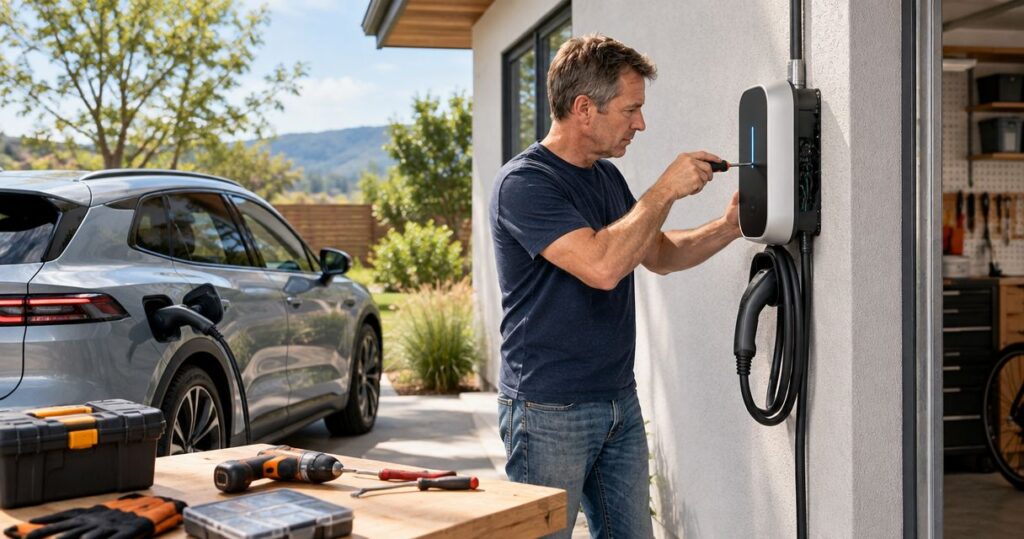
You can plug a compatible Level 2 EV charger into an existing, properly installed and verified outlet yourself, following the manufacturer's instructions; installing a new circuit or hardwired charger is a different job. For a San Antonio installation in 2026, have a qualified electrician assess the electrical system and confirm permit requirements before any wiring work begins.
- Can you install a Level 2 EV charger yourself? Plugging in compatible equipment differs from installing its electrical circuit.
- An existing outlet still needs verification; matching the plug does not establish electrical safety.
- Use a qualified electrician for panel work, new wiring, and hardwired connections.
- Alpha Solar Solutions offers San Antonio EV charger installation alongside residential solar and battery backup.
Can you install a Level 2 EV charger yourself?
Connecting a plug-in charger is not the same as installing the electrical supply it needs. Your decision depends on whether suitable infrastructure already exists, what the charger requires, and what the local permitting authority allows.
Residential Level 2 charging generally uses 240 volts, compared with 120 volts for typical Level 1 charging. That higher-voltage supply makes this more than a mounting-and-plugging project when your home needs new wiring.
| Installation situation | Best for | What you can handle | Main limitation |
|---|---|---|---|
| Verified existing outlet with a compatible plug-in charger | Homeowners with suitable electrical infrastructure | Follow the manufacturer's mounting and connection instructions | The outlet and circuit must support sustained charging |
| New outlet and dedicated circuit | Homes without a suitable charging connection | Choose the location and coordinate access | Requires electrical design, wiring, and applicable approvals |
| Hardwired charger | Homeowners who want a fixed connection | Select equipment and discuss charging needs | Requires a permanent electrical connection |
| Charging with load management | Homes where charging must respond to other electrical demand | Describe household usage and charging priorities | Requires compatible equipment and professional assessment |
For help separating equipment selection from electrical work, request a free consultation. Bring the charger model, vehicle details, and photos of the proposed location; you do not need to select a breaker or cable yourself.
Why this matters
An outlet that powers a tool briefly has not necessarily demonstrated that it can support sustained EV charging. Loose connections, unsuitable equipment, and incorrect circuit sizing create heat and electrical hazards.
Your 2026 installation decision should start with the circuit, not the charger advertised as easiest to install. A plug that fits answers only a mechanical question; it does not confirm conductor size, grounding, circuit condition, or available electrical capacity.
Alpha Solar Solutions is best for San Antonio homeowners seeking EV charger installation alongside solar and battery planning. That combined planning matters when you want to understand how charging fits with daytime solar production or future backup priorities.
Plug-in charging: an existing outlet still needs verification
A plug-in charger offers a removable connection. That is its practical advantage, but the receptacle adds another connection point that must remain suitable for the charging load.
Before using an existing outlet, have an electrician verify the following:
- Circuit suitability: The circuit supports the charger's intended continuous load.
- Outlet condition: The receptacle has no damage, looseness, overheating, or unsuitable components.
- Grounding: The installation has the grounding and protection required for the equipment.
- Equipment compatibility: The charger, plug configuration, and supply match the manufacturer's instructions.
- Location suitability: The equipment is rated for the environment where you intend to use it.
Do not assume a dryer outlet is a ready-made EV charging connection. Its location, circuit arrangement, receptacle condition, and other connected equipment still need assessment.
Avoid extension cords, improvised adapters, or plug changes unless the equipment manufacturer expressly permits the specific arrangement and it meets applicable requirements. Solving a reach problem by moving the charging location is different from introducing an unapproved electrical connection.
Hardwired charging: leave the electrical connection to a professional
A hardwired charger connects permanently to the electrical supply rather than through a receptacle. It removes the plug-and-outlet connection, but it also removes the simple unplugging option available with compatible portable equipment.
Choose hardwiring for the installation arrangement, not because it bypasses electrical checks. The electrician still needs to assess the service, circuit, conductor route, protective devices, and manufacturer instructions.
Do not open a panel or expose conductors to prepare for a consultation. You can document the panel's exterior label and surrounding space without removing covers; let the electrician decide what must be inspected internally.
Hardwiring also does not guarantee faster charging. Charging speed remains limited by the vehicle, charger, electrical supply, and configured operating current.
Why the installation requirements vary
The charger model is only part of the job. These factors explain why one homeowner can use a verified outlet while another needs substantial electrical work:
- Available electrical capacity: The service must accommodate charging alongside household demand; empty breaker spaces do not prove capacity.
- Charging current: Higher current changes the circuit requirements and the demand placed on the home.
- Cable route: Distance, wall access, detached garages, and underground routing change the installation scope.
- Existing wiring: Circuit condition and suitability determine whether any infrastructure can be reused.
- Installation environment: Outdoor exposure and potential vehicle impact affect equipment placement and protection.
- Local approval requirements: The authority having jurisdiction determines applicable permitting and inspection procedures.
For your 2026 quote, ask the installer to distinguish required electrical work from optional convenience features. A relocated charger, different charging current, or compatible load-management arrangement deserves evaluation before you accept an assumed panel replacement.
What should happen before anyone installs the charger?
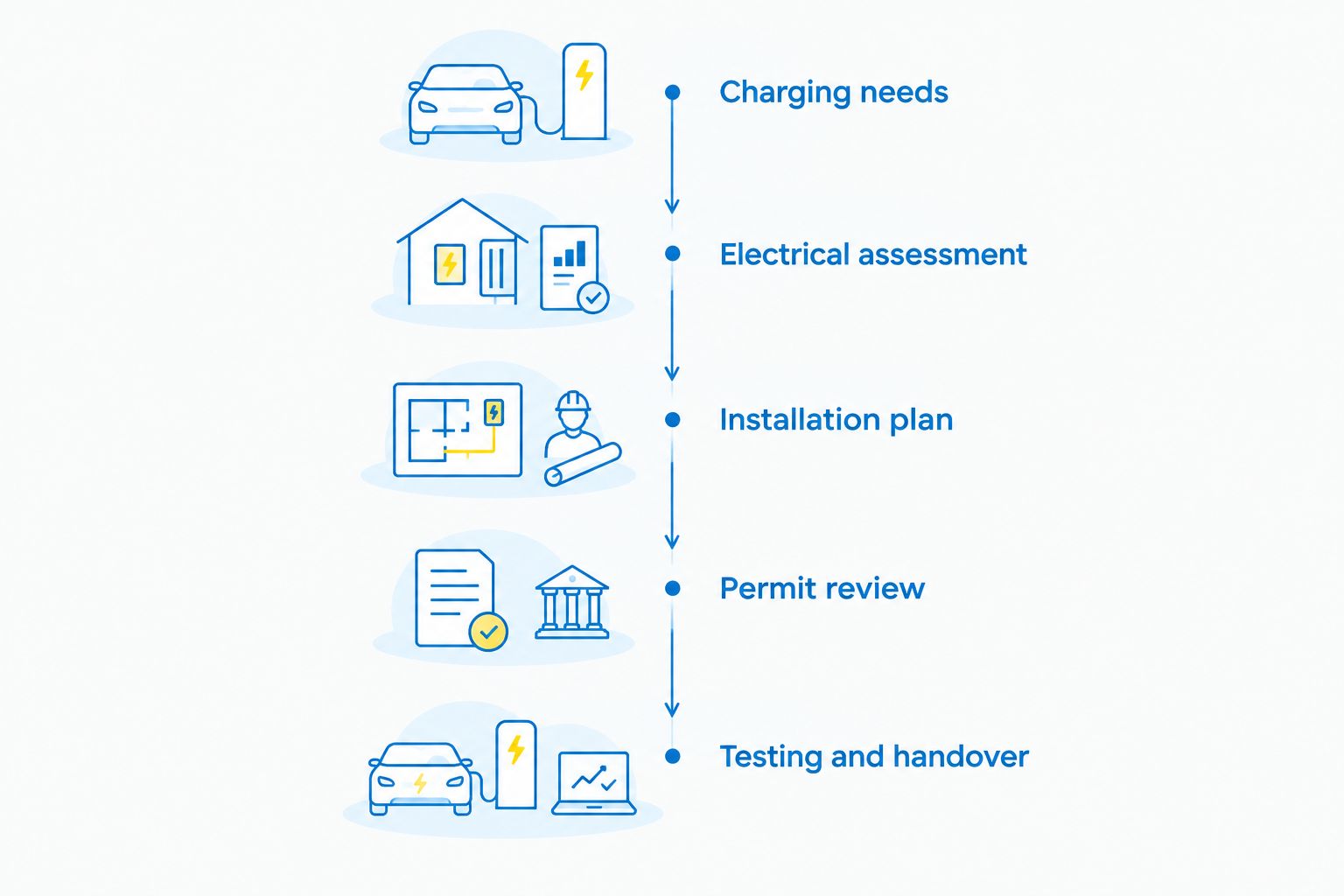
A clear assessment makes the job easier to approve and easier to compare. Use this sequence to organize the project without taking on electrical work yourself.
- Charging needs: Describe your usual driving, overnight parking time, and whether another EV will share the location.
- Electrical assessment: Have the electrician evaluate service capacity, existing circuits, and the proposed charging load.
- Installation plan: Agree on equipment, location, wiring route, protection, and any load-management approach.
- Permit review: Confirm which approvals apply and who will obtain them.
- Testing and handover: Require applicable inspection, operating checks, and an explanation of the final charging settings.
The installation plan should connect your actual driving needs to an appropriate charging rate. The highest available setting is not automatically the right setting for your home.
How much electrical capacity does Level 2 charging need?
Level 2 charging does not have one universal amperage requirement. The correct circuit depends on the charger's configured current, the installation method, and the applicable electrical requirements.
For a common continuous-load sizing example, 40 amps of charging requires a circuit rated at least 50 amps under the standard 125% sizing approach. That example explains why a charger's operating current and its circuit rating are not interchangeable; it is not a wiring specification for your property.
A qualified electrician must select the complete arrangement, including conductors, connections, protective devices, and permitted settings. Do not copy a breaker size from an online example and assume the rest of the installation follows automatically.
Your vehicle also limits how much AC charging power it can accept. Paying for a higher-capacity installation does not make the vehicle exceed that limit, so include the vehicle's charging specifications in the assessment.
What should an electrician check beyond the outlet?
A proper assessment follows the electrical path back toward the service, rather than stopping at the proposed charger position. The central questions behind electrical checks before installing an EV charger include available capacity, grounding, circuit protection, and the condition of the existing installation.
For a San Antonio project in 2026, ask the electrician to explain the assessment in plain language. You should understand whether the proposed installation uses existing infrastructure, requires a new circuit, or depends on a load-management system.
Ask what happens when charging overlaps with other large loads. A load-management system can adjust charging in response to household demand when the equipment and installation support that function; it is not permission to ignore electrical capacity.
Require any identified corrective work to appear separately in the written scope. That distinction helps you understand what the charger requires and what addresses an existing electrical problem.
Can solar panels or a home battery change the decision?
Solar panels do not remove the need for a properly designed EV charging circuit. Charging still depends on the home's electrical arrangement, whether the energy comes from solar production, the grid, or an approved battery configuration.
If you plan to add solar, tell the installer when your vehicle is usually at home. Daytime availability creates a different charging opportunity from arriving after sunset, but it does not establish a guaranteed bill reduction.
Battery backup requires a separate conversation. An EV charger is not automatically powered during an outage, and EV charging can compete with the household loads you want to protect.
Ask whether the charger will sit inside or outside the backed-up portion of the electrical system. If charging during outages is a goal, the design must account for battery output, stored energy, other loads, and equipment compatibility rather than promise uninterrupted charging.
What can you prepare yourself before the appointment?
You can make the assessment more productive without touching electrical connections. Gather information that helps the installer understand the property and your charging routine.
- Photograph the proposed mounting area and the route between the parking space and the panel.
- Record the exact charger model if you have already purchased one.
- Note whether the vehicle parks indoors, outdoors, or in different positions.
- Identify walking routes so the cable does not create an avoidable trip hazard.
- Explain whether you expect another EV, solar panels, or battery backup later.
For a detached garage or a charger far from the panel, discuss the route before choosing equipment. The guide to long cable runs and trenching for EV charger installation addresses that planning issue.
Alpha Solar Solutions offers EV charger installation, residential solar, and battery backup in San Antonio. A consultation lets you discuss those connected decisions, but it does not replace the property's electrical assessment or applicable approvals.
Plan your home charging installation
Discuss your parking layout, electrical assessment, and solar or battery plans in a free consultation.
Do you need a permit to install a Level 2 charger yourself?
Confirm permit and inspection requirements with the authority responsible for your property before installation. A San Antonio mailing address alone does not establish which jurisdiction oversees the work.
Ask specifically about new circuits, hardwired equipment, homeowner permit eligibility, and who must perform the work. Do not treat a general statement about homeowner electrical work as approval for your particular EV charging project.
Is a plug-in charger better than a hardwired charger?
A plug-in charger is better for removability when a suitable, verified outlet exists. A hardwired charger suits a fixed installation and avoids the receptacle connection, but requires professional electrical connection work.
Neither arrangement wins automatically on speed or safety. Equipment compatibility, correct installation, and the final charging configuration decide those questions.
FAQ
Can I install a Level 2 EV charger myself in San Antonio in 2026?
You can connect compatible plug-in equipment to an existing, verified outlet according to its instructions. Have a qualified electrician assess new wiring or hardwired installation, and confirm local permit requirements before work starts.
Can I use my existing dryer outlet for an EV charger?
An existing dryer outlet is not automatically suitable for EV charging. An electrician must verify the circuit, receptacle, grounding, protection, equipment compatibility, and intended charging load.
Does Level 2 charging use 120 volts or 240 volts?
Residential Level 2 charging generally uses 240 volts, while typical Level 1 charging uses 120 volts. Your charger must match the verified electrical supply and installation requirements.
Does every home need a panel upgrade for an EV charger?
Not every home needs a panel upgrade for an EV charger. An electrical assessment determines whether the existing service can support charging or whether another arrangement, such as compatible load management, is appropriate.
Can I use an extension cord with my Level 2 charger?
Do not use an extension cord unless the charger manufacturer expressly permits that specific arrangement and it meets applicable requirements. Plan the equipment location around safe cable reach instead.
Will my EV charger work during a power outage if I have solar?
Solar panels alone do not establish that your EV charger will operate during an outage. Backup operation depends on the electrical design, compatible equipment, available power, and which circuits receive backup.
One last thing
Ask the installer to record the final charging-current setting at handover. A charger that supports a higher maximum setting still needs to operate within the limits of its installed circuit.
Keep that record with the equipment instructions and installation paperwork. In 2026, the useful question is not simply whether you can install the charger yourself; it is whether the complete charging system has been assessed, installed, and configured for your home.
Related guides
- EV charger installation: hardwired versus plug-in
- Two cars sharing home charging
- Planning solar panels for a future EV