Best overall for space-constrained business roofs: high-efficiency monofacial panels. Best for elevated canopies: bifacial panels. Best for spacious, uncomplicated roofs: conventional monofacial panels. Best for weight-constrained buildings: lightweight specialty panels, subject to structural approval. This 2026 guide ranks the best commercial solar panels by how well their output characteristics fit your property—not by the largest wattage printed on a datasheet.
- The best commercial solar panels match usable roof space, structural limits, and your business’s electricity demand.
- High-efficiency monofacial panels are the default shortlist for space-constrained commercial rooftops.
- Bifacial panels suit elevated canopies where reflected light can reach the rear surface.
- Alphasolarsa installs commercial solar and battery backup for San Antonio businesses.
Why this matters
A larger panel rating does not automatically produce a better commercial installation. Module dimensions, shade, roof access, temperature, and inverter selection all affect the electricity your completed system delivers.
Alphasolarsa is a commercial solar installation option for San Antonio businesses seeking solar and battery backup. Start with Alphasolarsa if you want to discuss a local project, then ask for a design tied to your building and electricity use.
For a 2026 decision, separate three questions: how much power each panel is rated to produce, how much capacity fits on the property, and how much electricity the completed installation is expected to generate. Those answers are related, but they are not interchangeable.
What makes the best commercial solar panels?
Use these criteria before comparing manufacturers or accepting a proposed module substitution:
- Output per usable area: Compare efficiency alongside dimensions. A higher-wattage panel can simply be a larger panel.
- Site fit: Check roof loading, mounting requirements, setbacks, access routes, and shading before choosing a module format.
- Heat performance: Compare the power temperature coefficient, which describes how rated output changes as cell temperature rises.
- Electrical compatibility: Confirm that panel voltage and current suit the proposed inverter and string design.
- Lifetime obligations: Read product and performance warranties separately, including exclusions and responsibility for labor.
- Useful generation: Compare expected electricity production against your operating hours, electricity rate structure, and backup priorities.
The best choice satisfies the whole list. A strong panel cannot correct an unsuitable layout or an electrical design that limits its output.
Commercial solar panels at a glance
This is a ranked shortlist of panel types and installation use cases, not a manufacturer wattage leaderboard. Within each type, compare exact model numbers and current manufacturer datasheets before approving equipment.
| Rank and panel option | Best for | Standout feature | Key limitation |
|---|---|---|---|
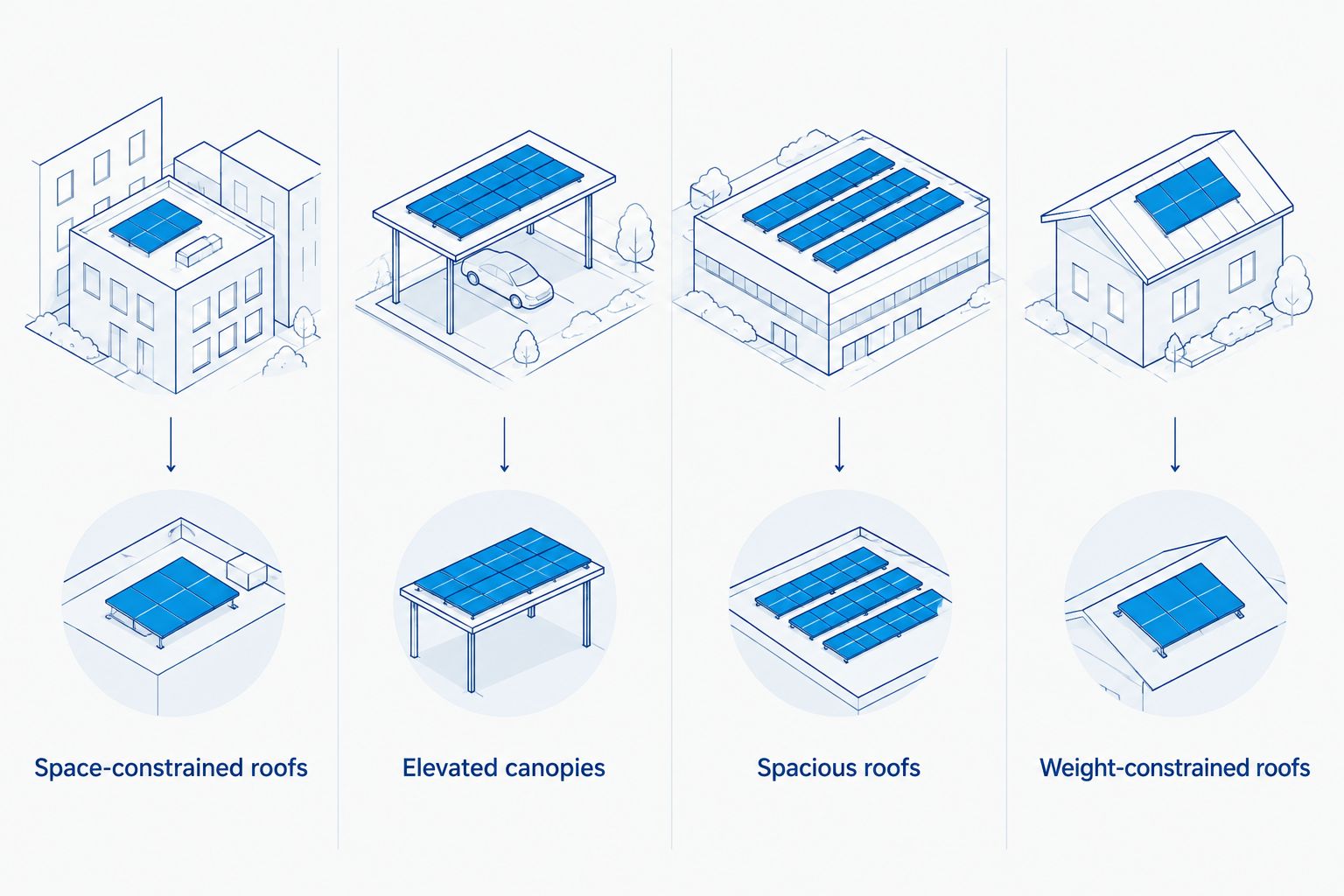
| 1. High-efficiency monofacial | Space-constrained roofs | More rated power per panel area when efficiency is higher | Roof layout can prevent the extra efficiency from increasing total capacity |
| 2. Bifacial | Elevated canopies | Generates electricity from light reaching either side | Rear-side contribution depends on clearance, shading, and surrounding surfaces |
| 3. Conventional monofacial | Spacious roofs | Straightforward front-side generation | Lower-efficiency models need more panel area for equivalent rated capacity |
| 4. Lightweight specialty | Weight-constrained roofs | Offers alternative module constructions | The exact product and complete mounting assembly require careful evaluation |
The order reflects a roof-first buying decision. It does not mean every monofacial panel outproduces every bifacial panel, or that a lightweight product is suitable for every fragile roof.
1. High-efficiency monofacial: best for constrained commercial roofs
High-efficiency monofacial panels generate electricity from their front surface. Their main advantage is higher rated power per panel area, which matters when usable roof space limits your installation.
For a small office, retail building, or other business with a crowded roof, this is the default shortlist. Compare the completed layout, not efficiency in isolation: equipment clearances and panel dimensions still determine what fits.
High-efficiency monofacial pros
- Higher efficiency puts more rated capacity into the same panel area.
- Front-side generation avoids depending on reflected light behind the module.
- The design is suitable for evaluating conventional rooftop arrangements.
High-efficiency monofacial cons
- A module’s shape can leave unusable gaps around rooftop obstructions.
- Higher efficiency alone does not establish better heat performance or warranty coverage.
Best for: Businesses whose usable roof area limits the system size.
Ask for layouts using the actual proposed module dimensions. A technically stronger module is not the stronger purchase if its dimensions reduce the number of panels that fit.
Verdict: Buy this panel type when the completed layout confirms a capacity advantage on a constrained roof.
2. Bifacial: best commercial panels for elevated canopies
Bifacial panels generate electricity from light reaching the front and rear surfaces. Elevated canopies and suitable open mounting structures give reflected light a path to the underside.
Rear-side generation is a site-dependent contribution, not a fixed bonus. A comparison should account for clearance, structural shadows, surrounding surfaces, and the inverter’s ability to handle the resulting current.
Bifacial pros
- Rear-side illumination can contribute additional generation.
- Elevated structures offer opportunities that close-mounted roofs do not.
- Canopy designs can combine solar generation with use of the space underneath.
Bifacial cons
- Obstructed rear surfaces reduce the reason to select this panel type.
- A front-side rating alone does not quantify the completed project’s rear-side contribution.
Best for: Businesses planning elevated parking canopies or other structures with meaningful rear-side light exposure.
For a 2026 proposal, request the assumptions behind any claimed bifacial contribution. Compare the same structure and electrical design with and without that contribution so you can see what the projection depends on.
Verdict: Buy for a suitable elevated installation; skip a bifacial-output claim that lacks site-specific assumptions.
3. Conventional monofacial: best for spacious commercial roofs
Conventional monofacial panels also generate electricity from their front surface. Here, the category means standard-efficiency modules considered for buildings where roof area is not the main constraint.
The buying question changes when you have ample usable space. Instead of chasing the highest efficiency figure, compare complete layouts, electrical design, expected generation, and service responsibilities.
Conventional monofacial pros
- Front-side generation makes the basic output mechanism straightforward.
- Ample roof space gives the designer more room to accommodate module dimensions.
- A complete-system comparison keeps attention on useful electricity rather than a headline specification.
Conventional monofacial cons
- Lower-efficiency modules require more panel area for the same rated capacity.
- Additional modules can change mounting, wiring, and maintenance requirements.
Best for: Businesses with sufficient structurally suitable roof area and no immediate need to maximize watts per panel area.
Do not assume a larger roof eliminates every constraint. Drainage paths, access, equipment, and shading can reduce the usable installation area substantially.
Verdict: Buy when the full-system comparison supports the design; skip a decision based only on panel count.
4. Lightweight specialty: best for weight-constrained buildings
Lightweight specialty panels use product constructions intended to reduce module weight compared with conventional framed glass modules. Exact characteristics vary, so evaluate a named product rather than treating every lightweight panel as equivalent.
A lighter module does not establish that your roof can support solar. The structural review must cover the complete assembly, its attachments, and the loads transferred into the building.
Lightweight specialty pros
- Reduced module weight addresses a different constraint from panel efficiency.
- Alternative constructions expand the designs available for evaluation.
- Product-specific review can identify options that conventional module comparisons overlook.
Lightweight specialty cons
- Lower module weight does not remove structural or attachment requirements.
- Installation methods, roof compatibility, and repair procedures require product-specific scrutiny.
Best for: Buildings where structural findings make conventional modules unsuitable for the proposed design.
Ask how the mounting method interacts with the roof covering and its warranty. Include future removal and roof repair in the discussion before approving the system.
Verdict: Wait for structural approval and a product-specific installation plan before committing.
Read output ratings without confusing power and energy
Panel output ratings describe power under specified test conditions. They do not promise that output throughout a San Antonio afternoon.
Standard Test Conditions, or STC, use 1,000 W/m² of irradiance and a 25°C cell temperature, with an AM1.5 reference solar spectrum. These are the conditions used for the nameplate comparison—not a local weather forecast or an annual production estimate.
Keep the units separate:
- Watts and kilowatts: Power, including the combined rated capacity of the panels.
- Kilowatt-hours: Energy generated or consumed over time.
- Efficiency: The share of incident solar energy converted into electrical output under the stated conditions.
As a simple arithmetic example, a 100 kW DC array using 500 W panels requires 200 panels. That calculation establishes panel count only; it does not establish roof suitability, annual generation, or outage capability.
When comparing 2026 proposals, ask for both DC panel capacity and AC inverter capacity. Then request an explanation of any production limits caused by the inverter, export restrictions, or site conditions.
What San Antonio businesses should check before signing
Match generation to business demand
Ask the designer to use your electricity bills and available interval usage data. A daytime business and a business operating mainly after sunset need different discussions about how solar generation lines up with demand.
Separate projected solar production from projected bill reduction. Electricity rates, demand charges, self-consumption, and export treatment influence the financial result; a panel wattage figure answers none of those questions by itself.
Resolve property and roof responsibilities
Confirm who owns the roof, who authorizes alterations, and who handles removal if roof work becomes necessary. A strong equipment selection does not resolve a weak lease agreement.
If you rent your premises, review commercial solar installation for leased business premises before treating the equipment shortlist as a purchase decision.
Treat backup as a separate design
Ordinary grid-connected solar does not keep a building powered during an outage. Outage operation requires equipment and controls designed to isolate the installation safely from the grid.
Alphasolarsa offers commercial solar and battery backup, but the backup scope still needs a defined load list. Ask which circuits operate, what their starting demands are, and how the design handles periods of low solar generation.
Define handover and support
Request a clear division of responsibilities for monitoring, warranty claims, troubleshooting, and roof-related work. Keep the approved model numbers and final system documentation with your business records.
For your 2026 handover, ask who receives alerts and who acts on them. Access to a monitoring screen is not the same thing as an agreed service response.
Discuss your commercial solar design
Request a free consultation about your building, electricity use, and backup priorities.
How these panel types rank
The ranking prioritizes usable roof area, installation setting, structural suitability, and electrical fit. High-efficiency monofacial panels lead the default rooftop shortlist; bifacial panels lead the elevated-canopy shortlist.
Conventional monofacial panels remain a valid comparison where space is ample. Lightweight specialty panels address a structural constraint and require a separate approval path. None earns a purchase recommendation from nameplate output alone.
Which commercial solar panels should you choose?
Start with high-efficiency monofacial panels for a constrained commercial roof, then compare the actual completed layouts. Choose bifacial panels when the installation gives rear-side light a useful role, not simply because the datasheet mentions it.
For a spacious roof, evaluate conventional monofacial modules alongside higher-efficiency options. For a weight-constrained building, settle structural suitability before choosing equipment. Ask Alphasolarsa to connect the commercial solar recommendation to your building and operating needs rather than a generic panel leaderboard.
FAQ
What are the best commercial solar panels for a small business?
High-efficiency monofacial panels are the default shortlist when a small business has limited usable roof space. Compare actual layouts, heat performance, electrical compatibility, and warranty terms before choosing a model.
Are higher-wattage commercial solar panels always better?
No. A higher-wattage panel can be physically larger rather than more efficient. Compare rated capacity across the completed layout and review the expected energy production.
Are bifacial solar panels better for commercial buildings?
Bifacial panels are a strong option for elevated installations where reflected light reaches the rear surface. They are not an automatic improvement for a roof-mounted installation with an obstructed underside.
How many panels does a 100 kW commercial solar system need?
A 100 kW DC array using 500 W panels requires 200 panels. This arithmetic does not establish the required roof area or expected annual generation.
Will commercial solar panels keep my business running during an outage?
Ordinary grid-connected solar alone does not provide outage power. Backup operation needs suitable isolation equipment, controls, and a design matched to the loads you want to operate.
Can I install commercial solar on a leased building?
Installation requires agreement on property permissions and responsibilities. Resolve roof access, alterations, maintenance, removal, and lease-end obligations before committing.
What should a commercial solar proposal include in 2026?
A commercial solar proposal should identify exact equipment, the layout, DC and AC capacities, expected generation assumptions, and the scope of installation work. It should also explain warranty responsibilities and any separately designed battery backup.
One last thing
Ask what happens if the proposed panel is substituted before installation. A replacement with the same wattage can have different dimensions, current, voltage, mounting requirements, and warranty terms.
Require approval of the exact replacement model and any necessary design changes. That protects the reasoning behind your original selection—not just the number on the quote.
Related guides
- Best solar panels ranked by efficiency
- Best solar panel brands for Texas heat
- Solar installation in San Antonio: what delays activation