
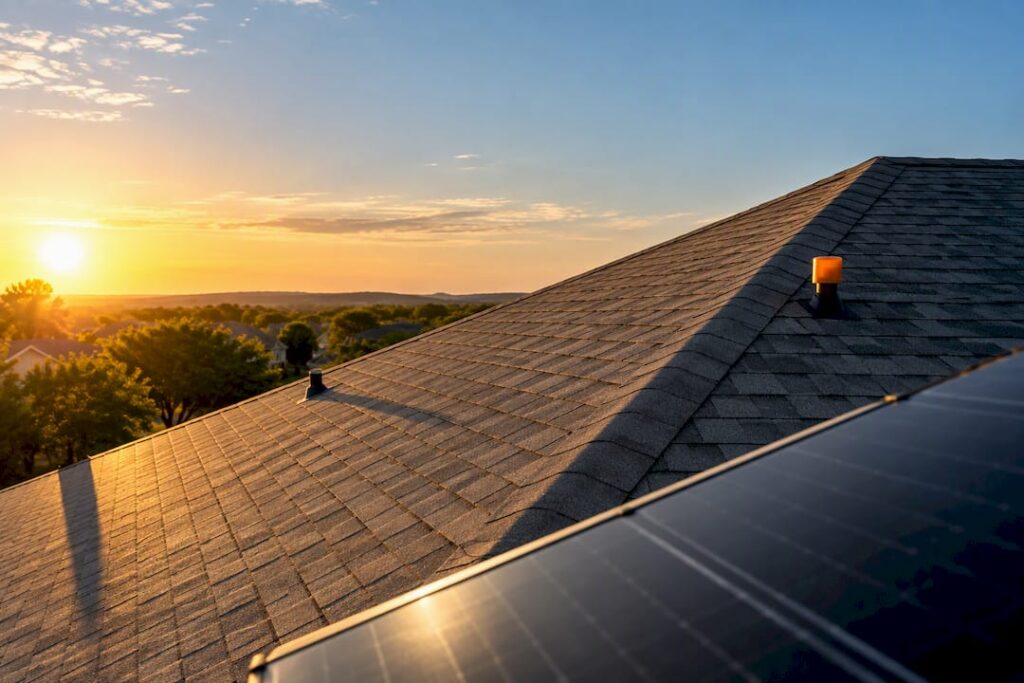
For most homes, south-facing panels win on raw energy: they catch the most sun over a year and remain the default choice. But west-facing or split east-west layouts can win on dollars, especially when your utility charges more for afternoon electricity or when your roof has room for extra panels facing those directions. The right answer depends on your roof, your rates, and when your household actually uses power.
TL;DR:
- West-facing panels can increase savings if your utility charges more for electricity during late afternoons, despite producing slightly less total energy annually.
- Split east-west systems offer a steady power output across the day, which can improve self-consumption and economic returns when rates reward production during usage peaks.
- Roof shading, limited space, and local climate conditions can make east or west orientations more practical even if they generate less overall energy than south-facing panels.
- Proper evaluation of azimuth, tilt, and shading, along with site-specific simulations, is essential to determine whether east or west layouts outperform south-facing systems in cost-effectiveness.
- Focusing on utility rate structures and your household’s consumption timing is key, as the most energy-efficient orientation may not always be the most financially beneficial.
Table of Contents
- How south, east and west systems differ in production
- When west or east orientations beat south for homeowners
- Why tilt and azimuth matter more than you’d think
- What the numbers actually look like on your bill
- A practical checklist for choosing your roof face
- Why our guidance reflects real installer experience
- Balancing total production with real homeowner value
- How Alpha Solar Solutions helps you choose the right layout
- Sources
- FAQ
How south, east and west systems differ in production
South-facing arrays track the sun through its highest arc, which gives them the longest exposure window and the tallest single production peak around midday. That’s why the Department of Energy recommends south-facing panels with a tilt roughly between 15 and 40 degrees as a solid starting point for most homes.
East and west arrays behave differently across the day rather than just producing less overall.
- East-facing panels generate more electricity in the morning, tapering off by early afternoon.
- West-facing panels ramp up later and peak in the afternoon and early evening.
- Split east-west systems flatten the daily curve, producing steadily from morning through evening instead of one sharp midday spike.
- South-facing systems still produce the highest total annual energy of the three orientations under most conditions.
A west-facing system shifts production later in the day and can increase homeowner value by offsetting late-afternoon peaks, even when total annual energy is slightly lower, according to ASES. That single fact reframes the whole decision. It’s not just about how many kilowatt hours you generate. It’s about when you generate them and what those hours are worth.
When west or east orientations beat south for homeowners
A handful of real-world conditions can make west or east the smarter pick, even with lower annual output.
- Time-of-use rates: if your utility charges more per kilowatt hour in the late afternoon and evening, west-facing production lines up with those expensive hours and can lower your bill more than extra midday kWh would.
- Roof area constraints: a smaller south-facing section paired with east and west faces can sometimes fit more total panels than a south-only layout, meaning more system capacity even if each panel produces slightly less.
- Shading: trees, chimneys, or neighboring structures that block your south roof for part of the day can make a clear east or west face the more practical choice.
- Local climate patterns: areas with regular morning fog or cloud cover may see their south-facing arrays underperform in the morning hours, shifting the practical sweet spot slightly off due south.
Pro Tip: Before ruling out a shaded south roof, ask your installer to run a shading analysis for each face separately. Sometimes the “worse” orientation is simply the one with a clear view of the sky.
Why tilt and azimuth matter more than you’d think

Azimuth is just the compass direction your panels face, and true south (not magnetic south) is the reference point installers use because it lines up with the sun’s actual path. The gap between magnetic and true south, called declination, varies by location and is something your installer accounts for automatically.
Tilt matters too. PNNL’s Building America guidance shows that with an optimal tilt around 30 degrees, azimuth can vary widely, sometimes by as much as 65 degrees off due south, and still capture 90 to 100% of available solar energy in many regions. In practice:
- Southeast to southwest orientations perform nearly as well as true south.
- East or west orientations typically retain about 80 to 90% of south-facing output, depending on tilt and latitude, according to NREL.
- Lower-slope roofs reduce the penalty for facing off-south, since a flatter panel is less sensitive to compass direction.
Direction matters less than most homeowners assume, particularly once tilt is factored in.
What the numbers actually look like on your bill

Representative figures put east-facing systems about 10 to 20% below south, and west-facing systems about 10 to 20% below south, according to NREL’s PVWatts data and modeling. Split east-west systems usually land somewhere in between, trading a little peak output for a flatter, longer production window.
Here’s how that plays out in practice:
- Start with a baseline: suppose a south-facing system produces a certain amount of kWh per year.
- Apply the west penalty: a west-facing system of the same size typically produces noticeably less annual energy, depending on exact location and tilt.
- Weigh the timing value: if your utility’s afternoon rate is meaningfully higher than its midday rate, that “missing” 1,800 kWh from the south scenario may be worth less than the higher-value kWh the west system generates instead.
Measured and simulated results show that east-west and southeast-southwest combinations can raise self-consumption and sometimes improve economic returns compared with a pure south layout, especially when tariffs reward matching production to actual usage, according to a study published in Energies. The lesson: fewer kilowatt hours doesn’t always mean less savings.
A practical checklist for choosing your roof face
Rather than guessing, work through these steps with whoever designs your system.
- Map your roof: note every usable face, its azimuth, its tilt, and any shading from trees, vents, or nearby structures.
- Track your load timing: note when your household actually uses the most electricity, especially if you charge an electric vehicle or run air conditioning heavily in the afternoon.
- Request a simulation: ask your installer to run PVWatts or a site-specific model comparing south, west, and split layouts against your actual utility rate structure, including any time-of-use tiers.
- Compare capacity, not just efficiency: sometimes a west-facing addition lets you fit more total panels than a south-only design, which can outweigh the per-panel efficiency loss.
- Watch for red flags: heavy recurring shade on your preferred face, net-billing rules that pay less for midday exports, or a roof too small to reach the system size you actually need.
Pro Tip: Ask your installer for a side-by-side dollar comparison, not just a kWh comparison. The orientation that produces less electricity can still be the one that saves you more money.
Why our guidance reflects real installer experience
I’m Anthony, and this framework comes from years spent designing residential systems where roof geometry, shading, and utility rate structures rarely match a textbook diagram. A knowledgeable solar installer handles custom system design, battery backup, EV charger installation, and panel cleaning and reattachment work that all touch this same question: which roof face actually earns its keep for a given home.
Balancing total production with real homeowner value
South remains the sensible default for maximizing annual energy, and tilt and roof area still set the outer limits of what’s possible. But raw kilowatt hours are not the same as dollars saved. Run the simulation, compare the rate structure, and let usable roof area and your own consumption habits guide the final call.
— Anthony
How Alpha Solar Solutions helps you choose the right layout
Figuring out whether south, west, or a split layout fits your home shouldn’t rest on guesswork. A thorough solar provider typically starts projects with a site assessment and production simulation modeled against actual utility rates, including time-of-use scenarios, to show the dollar impact before committing to a design.
Beyond installation, we handle:
- Custom-designed residential solar systems built around your roof’s actual geometry and shading
- Battery backup solutions that store west-facing afternoon production for evening use
- EV charger installation for households shifting more load into daytime charging windows
- Ongoing panel cleaning and maintenance to keep whichever orientation you choose performing as designed
If you want a straight answer on which roof face makes sense for your home, request a site assessment through our residential solar installation page and we’ll walk you through the numbers.
Sources
- West vs South: Why orientation matters | ASES
- Energy
- Why PV modules should preferably no longer be oriented to the south (Energies, MDPI)
- Solar orientation, solar arrays, and panels | Building America Solution Center (PNNL)
FAQ
Which is better for solar panels, east, west, or south?
South-facing panels generally produce the most total annual energy for a given system size. West-facing panels can deliver better financial value under time-of-use rates because they generate power during expensive late-afternoon hours, while east-facing panels front-load production into the morning.
What is the 33% rule in solar panels?
If you’ve seen this term used elsewhere, it likely refers to a specific program, incentive, or informal installer shorthand rather than a standard industry benchmark, so it’s worth asking your installer directly what they mean by it.
Why is it difficult to sell a house with solar panels?
This question falls outside what this article’s sources address directly, since it covers orientation and production rather than resale dynamics. Homeowners considering this concern should raise it with a local real estate professional familiar with solar transactions in their area.
Why are south-facing solar panels better?
South-facing panels track the sun’s arc for the longest continuous window each day, which is why the Department of Energy recommends them as a default for maximizing annual production. They aren’t automatically the better choice for every homeowner, though, since roof shading, available space, and time-of-use electricity rates can shift the math toward west or split east-west layouts.