

Bottom line: Texas law generally prevents homeowners associations from banning solar devices. Section 202.010 of the Texas Property Code makes prohibitive HOA covenants void, subject to a short list of narrow exceptions covering safety, placement, and appearance. If your HOA denies your solar application, check whether the denial actually falls under one of those Subsection (d) exceptions, and pay attention to new TDLR contract protections that now govern how solar retailers sell you a system in the first place.
TL;DR:
- Texas law renders any HOA rule prohibiting solar devices invalid unless it specifically falls under one of the limited statutory exceptions.
- Devices like solar water heaters, roof shingles, or passive solar systems are protected if they meet the broad legal definition, regardless of HOA terminology.
- During active development periods in small subdivisions, new homeowners may be temporarily restricted from installing solar until the builder’s period ends.
- HOA restrictions based on aesthetics or placement will fail if homeowners provide evidence of compliance, such as modeling data showing over 10% energy output difference.
- Proper documentation, including contractor plans and permits from a licensed electrician, is essential to avoid delays or disputes during the approval process.
Table of Contents
- What Does Texas Solar Rights Law Actually Say?
- What Are the Legal Exceptions HOAs Can Use?
- What Should You Do If Your HOA Denies Solar Approval?
- What New Solar Contract Protections Exist in Texas?
- Pre-Installation Checklist: What to Confirm Before You Sign
- Do Local City or County Ordinances Also Apply?
- Do Renters and Leased Systems Have the Same Protections?
- How Much Weight Do HOA CC&Rs Really Carry?
- Why Legal Clarity and a Licensed Contractor Go Together
- Get a Compliant Solar Installation Without the HOA Headaches
- Sources
- FAQ
What Does Texas Solar Rights Law Actually Say?
Texas Property Code §202.010 is the statute that gives homeowners the legal footing to install solar panels even when a homeowners association would rather they didn’t. The law states plainly that a property owners’ association cannot include or enforce a provision in its governing documents that prohibits or restricts a homeowner from installing a solar energy device on their own property. If a deed restriction or HOA rule tries to do that anyway, the statute says that provision is void.
That word, “void,” carries real weight. It doesn’t mean the HOA has to formally repeal the rule or that you need a judge to strike it down before you can act. It means the restriction never had legal force to begin with. An HOA board that tries to fine you, send a cease-and-desist letter, or block your architectural review application based on a flat “no solar panels” rule is enforcing something the Texas legislature already stripped of authority; for practical HOA compliance tips on navigating architectural-review rules, see Mobile Detailing HOA Compliance Tips That Actually Work. That’s a meaningfully different legal position than, say, a zoning dispute where you’re asking a city to change a rule. Here, the rule was arguably never valid.
What counts as a “solar energy device”?
The statute borrows its definition from Texas Tax Code §171.107, and it’s broader than most homeowners expect. A solar energy device includes any system or series of mechanisms that use solar energy to generate electricity, heat, or cool a structure, or that provide hot water. That covers traditional rooftop photovoltaic panels, of course, but it also reaches:
- Solar water heating systems
- Solar roof tiles and shingles integrated into the roofing material itself
- Passive solar systems built to capture and use solar heat
- Solar-powered pool heating and mechanical ventilation systems
That breadth matters because some HOAs try to argue that a particular product, like solar roof tiles that look different from standard shingles, falls outside the statute’s protection. It generally doesn’t. If the device meets the Tax Code definition, §202.010 protection applies regardless of how the HOA’s covenants happen to describe “solar panels.”
Who does the statute protect, and who does it bind?
The law binds property owners’ associations, which Texas defines as the governing body for a residential subdivision, planned unit development, condominium, or other residential community that’s subject to a dedicatory instrument. If you live in an HOA-governed community in Texas, whether that’s a master-planned suburb outside San Antonio or a downtown condo association, this statute applies to you.
It’s worth being precise about what the statute doesn’t do. It doesn’t force an HOA to approve every solar installation without any review. It doesn’t strip the HOA of all authority over aesthetics. And it doesn’t apply retroactively to override every possible restriction; it applies to the prohibition or restriction of installation, not to every conceivable rule an HOA might have about property modifications generally. The statute creates a right to install, then carves out specific, limited categories where an HOA retains some say. Those categories are where most real-world disputes happen, and they’re covered in detail in the next section.
The development-period exception is easy to miss
One wrinkle catches new-construction buyers off guard: during an active “development period” in smaller subdivisions (generally those with fewer than 51 planned residential units), a declarant, meaning the developer who’s still building out the community, can lawfully prohibit solar installations until that development period ends. This isn’t a loophole HOAs invented after the fact. It’s written into the statute itself, and it exists because developers argue that inconsistent rooftop installations during active construction can affect marketing and buyer perception of a still-unfinished community.
If you’re buying new construction or a home in a subdivision that’s still being built out, pull the dedicatory instrument before you assume you can install solar the day you close. Ask directly whether an active development period is in place and when it’s scheduled to end. Resources like goSolarTexas walk through this scenario in more detail and are worth bookmarking if you’re shopping for a home with future solar plans in mind.
Where to read the actual statute
Homeowners researching their rights should go to the primary source rather than relying on secondhand summaries, including this one. The full text of §202.010 is available through the Texas Legislature’s statute database, and plain-language interpretations are available through FindLaw’s Texas Property Code page and Justia’s statute library. When your HOA cites a specific subsection to justify a denial, look it up yourself rather than taking the board’s interpretation at face value.
What Are the Legal Exceptions HOAs Can Use?
Subsection (d) of §202.010 lists eight narrow situations where an HOA can lawfully restrict or condition a solar installation. Understanding these matters because most HOA pushback claims to rely on one of them, even when it technically doesn’t apply.
- Court-adjudicated safety or legal violations. An HOA can restrict a device if a court has found the installation violates a law related to public health or safety. A board’s own opinion that something “seems unsafe” doesn’t meet this bar; it requires actual legal adjudication.
- Common property placement. You can’t install a solar device on property owned in common by the HOA, such as shared roofs, greenbelts, or clubhouse structures. This exception targets shared spaces, not your own roof or yard.
- Non-roof placement without proof of benefit. If you want to place panels somewhere other than your roof, like a ground mount, the HOA can require you to first place them on the roof unless you can show the alternate location produces significantly more energy. That 10% threshold has to be demonstrated using a publicly available modeling tool, and the National Renewable Energy Laboratory (NREL) provides the modeling resources most contractors and homeowners use to make that case.
- Roofline extension limits. An HOA can prohibit panels that extend beyond the roofline itself, meaning cantilevered or overhanging installations that stick out past the edge of the roof.
- Wiring and frame color restrictions. The HOA can require that visible piping and wiring be a color consistent with the roof material, as long as that requirement doesn’t decrease the system’s efficiency or performance.
- Fence-height rules for ground-mounted systems. If your solar device sits within a fenced area, the HOA can enforce its existing fence-height restrictions on that fencing.
- Manufacturer warranty protection. An HOA can restrict installation methods that would void the manufacturer’s warranty on the device, which mostly comes up in disputes over mounting hardware or roof penetration methods.
- Prior-approval requirements. If your HOA has a legitimate architectural review process and you skip it entirely, the HOA can restrict the installation on those grounds alone, separate from anything about the solar device itself.
Pro Tip: Before you argue with your HOA about aesthetics, ask a contractor to run the numbers on your NREL production model in writing. Boards that reject a rooftop-alternative placement almost always do it on a “we don’t think that’s better” basis rather than reviewing actual modeled output. A documented 10%+ production difference is hard to argue against on paper, and it shifts the conversation from opinion to evidence.
The statute also builds in a timing safeguard. Architectural review committees generally can’t sit on a solar application indefinitely; they’re expected to act within a reasonable period, and unreasonable delay starts to look like a de facto denial, which can trigger the same void-provision analysis as an outright rejection. There’s no fixed number of days written into the statute, so “reasonable” gets interpreted based on how quickly that same HOA typically processes other exterior modification requests. If your neighbor’s fence approval took two weeks and your solar application has been sitting for three months, that disparity is worth documenting.
What Should You Do If Your HOA Denies Solar Approval?
A denial isn’t the end of the road, and in most cases it isn’t even close to it. Here’s the sequence that gives you the strongest position, whether you end up resolving things informally or need to escalate.
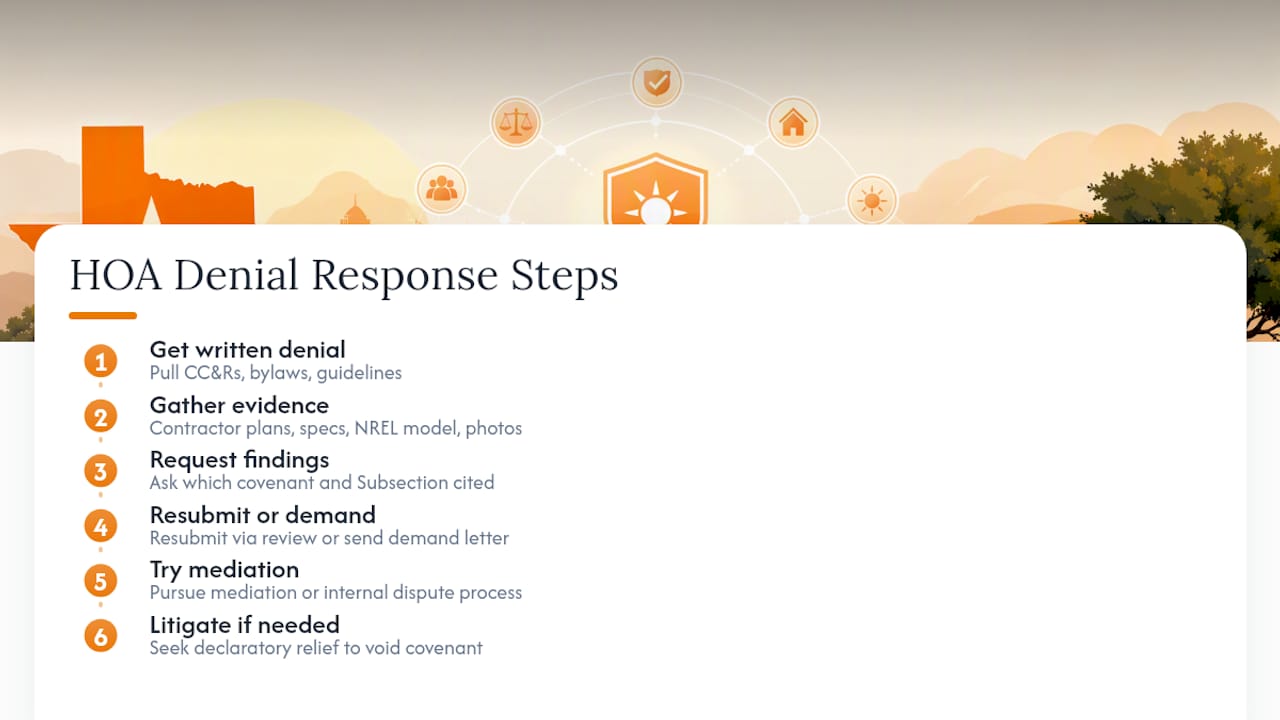
Start with your paperwork, not your temper. Pull your community’s dedicatory instrument (the CC&Rs, bylaws, and any architectural guidelines) and get the denial in writing if you don’t already have it. Verbal pushback from a board member at a meeting isn’t a denial you can act on; you need the HOA’s actual written determination, ideally citing the specific covenant or Subsection (d) exception it’s relying on.
Build your evidence file before you resubmit. Gather your contractor’s installation plans, equipment specifications, and, if the dispute involves placement, NREL production modeling showing expected output. If your installation is standard rooftop placement with wiring that matches your roof color, take dated photos. Under §202.010(e), if you can show that your local utility or a majority of homeowners on adjoining properties have approved similar installations, that serves as prima facie evidence that your device conforms to the same standards, which shifts real weight in your favor.
Request specific written findings. If the architectural review committee’s denial is vague (“does not meet community standards”), send a written request asking exactly which covenant provision and which Subsection (d) exception the denial relies on. Boards that can’t answer that question directly usually don’t have a valid basis for the denial in the first place.
Send a formal resubmission or demand letter. If your first application was informal, resubmit through the HOA’s actual architectural review process with full documentation attached. If you’ve already gone through that process and still been denied without a valid statutory basis, a demand letter, ideally drafted or reviewed by an attorney, citing §202.010’s void-provision language, moves the conversation from a neighborly dispute to a legal one the board’s own counsel will need to weigh in on.
Consider mediation before litigation. Many Texas HOA disputes go through informal mediation or the HOA’s own internal dispute resolution process before anyone files suit. It’s faster and cheaper, and boards facing a clearly documented §202.010 violation often prefer to fold rather than pay for a losing legal argument.
Know when litigation is the real option. If mediation fails and the HOA continues enforcing a void provision, homeowners can pursue declaratory relief in court, asking a judge to formally declare the restrictive covenant void and unenforceable. Courts have limited discretion here because the statute’s language is direct: a violating provision simply doesn’t have legal effect. That said, litigation costs money and time, so it tends to be the last step, not the first.
Know where administrative complaints fit. If your dispute involves a solar retailer’s sales conduct or contract terms rather than the HOA itself, a complaint to TDLR under the new residential solar retailer rules may be the more appropriate and faster route than a lawsuit. If it’s purely a permitting delay with your city or county, local code enforcement is usually the right first call rather than your HOA at all.
Talk to an attorney when the dollar amount or the principle justifies it. Most homeowners can handle the documentation and resubmission steps alone. Once you’re drafting demand letters or considering a declaratory judgment action, a real estate attorney familiar with Texas HOA law becomes worth the consultation fee, if only to confirm your evidence file is airtight before you escalate.
What New Solar Contract Protections Exist in Texas?
Texas passed significant new consumer protection rules for residential solar sales through Senate Bill 1036, known as the Residential Solar Retailer Regulatory Act, which creates Occupations Code Chapter 1806 and puts the Texas Department of Licensing and Regulation in charge of enforcement. This isn’t about your right to install solar against HOA objections; it’s about protecting you from bad sales practices once you’ve decided to go forward.
Registration for residential solar retailers becomes required beginning September 1, 2026, with TDLR enforcement actions following on that timeline according to the agency’s own program summary.
That registration requirement means homeowners can, and should, check whether a solar company is actually registered with TDLR before signing anything. A retailer operating without registration after the deadline is a red flag worth walking away from.
The enrolled bill text also spells out specific contract provisions every residential solar agreement in Texas must include going forward:
- The name and license number of the electrical contractor who will perform or oversee the installation
- Clear terms on who is responsible for pulling permits and filing interconnection paperwork with your utility or co-op
- A written right-to-cancel clause giving homeowners five business days to cancel the contract without penalty
- An additional cancellation clause tied to financing, when the purchase involves a solar loan or lease
- Disclosure of warranty terms and what installation practices might affect them
The law also outlines prohibited acts, things like misrepresenting savings, pressuring same-day signatures without disclosure, or omitting required contract terms, and gives TDLR administrative authority to investigate and penalize violations. Industry groups have noted this framework arrived alongside related 2025 legislation, including permitting-streamlining and consumer protection bills passed in the same legislative session, suggesting Texas lawmakers were responding to a broader pattern of aggressive sales tactics in the residential solar market.
For homeowners, the practical takeaway is simple: before you sign anything, ask the retailer for their TDLR registration number and verify it directly on the agency’s site rather than taking their word for it. A legitimate, established installer won’t hesitate to provide it.
Pre-Installation Checklist: What to Confirm Before You Sign
Getting your legal rights straight is only half the battle. The other half is making sure your paperwork and permitting hold up so the HOA has nothing legitimate to challenge.
- Confirm local permitting requirements first. Most Texas cities and counties require a building permit for solar installation, and your utility or electric cooperative requires a separate interconnection agreement before your system can be turned on. Permitting and interconnection timelines vary by jurisdiction, so ask your contractor for a realistic estimate rather than assuming it happens overnight.
- Review the contract against the Chapter 1806 checklist. Confirm it names your licensed electrical contractor with license number, states clearly who’s responsible for permits and interconnection filing, and includes your five-business-day cancellation window in writing.
- Ask for proof of insurance and warranty terms in writing. Get clarity on what installation practices might void your equipment warranty before work begins, not after.
- Document your roofline and wiring plan for the HOA file. If your community has aesthetic guidelines around wiring color or roofline extension, get your contractor’s written specifications in advance so you can submit them proactively with your architectural review application instead of waiting for the board to ask.
- Request modeling data if you’re considering a non-roof placement. If a ground mount or alternate location is even a possibility, ask your contractor to run NREL-based production modeling before you submit anything to the HOA. Walking in with the 10% threshold already documented saves weeks of back-and-forth.
Pro Tip: Keep every document, permit application, contractor communication, and HOA email in one folder from day one. If a dispute ever escalates to a demand letter or mediation, the homeowners who win fastest are the ones who can hand over a complete paper trail without scrambling to reconstruct it after the fact.
A written site assessment and modeling output from your contractor isn’t just useful for your own planning. It’s exactly the kind of documentation an architectural review committee expects to see, and it’s the same evidence a mediator or court would want if the dispute goes further.
Do Local City or County Ordinances Also Apply?
State law under §202.010 governs what HOAs can restrict, but it doesn’t override local permitting authority. Cities and counties across Texas still set their own building permit requirements, inspection standards, and, in some cases, additional setback or height rules for ground-mounted systems.
San Antonio and surrounding Bexar County jurisdictions each maintain their own permit review processes, and requirements can shift slightly between a city permit office and an unincorporated county area. Some municipalities have adopted expedited or streamlined solar permitting to reduce delays, following a broader statewide push toward faster approval timelines. Others still process solar permits alongside general electrical and building permits with no special track at all.
The practical difference for you is timing, not legality. Local ordinances can’t ban solar installation outright; §202.010 and its interaction with local governmental authority don’t allow a city to simply prohibit rooftop solar the way an HOA covenant historically tried to. But a local jurisdiction can absolutely require inspections, set specific electrical code standards, or add a few weeks to your timeline compared to a neighboring county with a faster process.
Before you finalize a contract, ask your installer directly which jurisdiction your permit falls under and what their average turnaround has been recently in that specific office. That answer tells you more about your realistic installation timeline than anything in the state statute itself.
Do Renters and Leased Systems Have the Same Protections?
Texas solar rights law is written around property ownership, and that distinction matters a lot for renters. Section 202.010 protects a “property owner” from HOA restrictions, which means tenants generally don’t have an independent statutory right to install solar devices on a property they’re leasing. That right, and that decision, belongs to the landlord.
If you rent in an HOA-governed community and want solar, your path runs through your landlord, not the HOA directly. A landlord who owns the property can invoke §202.010 protections against the HOA on their own behalf, but a tenant typically has no standing to force the issue independently.
Leased solar systems, meaning the equipment itself is leased or financed through a third party rather than owned outright, follow a different logic. The statute’s void-provision protection still applies because it protects the installation, not the ownership structure of the equipment. An HOA can’t use a “you don’t own the panels” argument to sidestep §202.010, since the statute focuses on whether a solar energy device is being installed on the owner’s property, not on who holds title to the hardware.
Where this gets more complicated is when a home under an active solar lease or power purchase agreement gets sold. Buyers should confirm during due diligence whether the seller’s HOA approvals and any lease terms transfer cleanly, since an unresolved HOA dispute over an existing installation can follow the property into a sale.
How Much Weight Do HOA CC&Rs Really Carry?
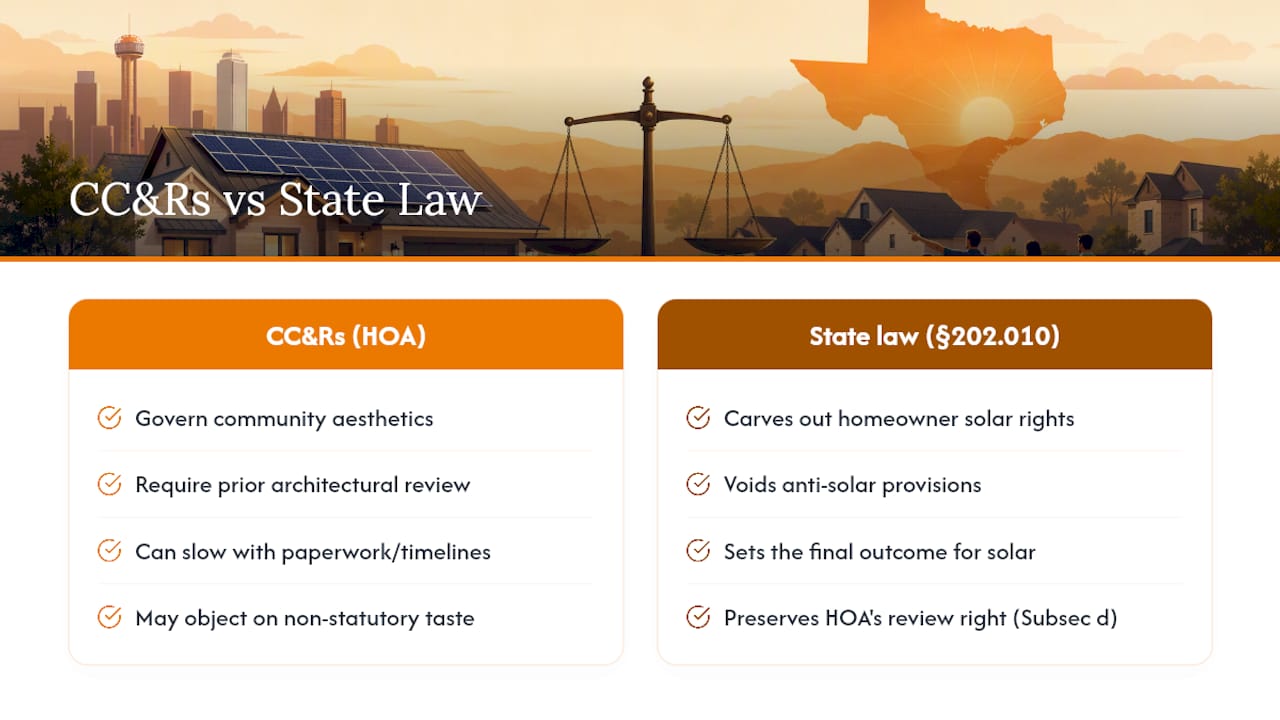
Covenants, conditions, and restrictions, the dedicatory instrument that governs most Texas HOA communities, still matter enormously day to day. They control paint colors, landscaping, fence styles, and dozens of other aesthetic and structural details that state law never touches. Solar is the narrow area where the legislature decided homeowner energy rights outweigh HOA aesthetic control, but that carve-out doesn’t erase the CC&Rs’ authority over everything else.
This creates a common point of confusion. Homeowners sometimes assume that because §202.010 voids anti-solar provisions, their CC&Rs are irrelevant to the process entirely. They’re not. The prior-approval exception under Subsection (d) specifically preserves the HOA’s right to require you to go through its normal architectural review process before installing. Skip that process, and the HOA has legitimate grounds to object, even though it couldn’t have blocked the installation on the merits.
The smartest way to think about it: your CC&Rs still set the procedure. State law sets the outcome. An HOA board can slow you down with paperwork requirements, aesthetic guidelines within the statute’s limits, and its review timeline, but it can’t use those same documents to reach a final “no” once your installation meets the statutory conditions. Reading your specific CC&Rs before you apply, rather than assuming state law makes the process automatic, saves most homeowners real friction later. If your HOA committee raises objections that sound more like personal taste than a documented Subsection (d) concern, that’s worth flagging directly in your written response, since taste alone isn’t one of the eight statutory exceptions.
Why Legal Clarity and a Licensed Contractor Go Together
Most of the solar disputes that end up costing homeowners real time and money aren’t really disputes about whether solar is legal in Texas. They’re disputes that started because nobody documented anything properly at the outset. A homeowner who understands the Subsection (d) exceptions and shows up to an architectural review meeting with NREL modeling data and a written contractor plan almost never ends up needing an attorney. A homeowner who assumes “the HOA can’t say no” and skips the approval process entirely hands the board a legitimate procedural objection it wouldn’t otherwise have had.
That’s why the choice of contractor matters as much as the choice to go solar in the first place. Chapter 1806’s requirement that your contract name a licensed electrical contractor isn’t bureaucratic box checking. It’s the mechanism that ensures someone with real accountability signs off on interconnection and code compliance, which is exactly what utilities, permitting offices, and HOA committees are all separately checking for. When that piece is solid, the rest of the process tends to move faster with far less friction.
Homeowners who treat the legal groundwork and the contractor selection as two separate problems usually end up solving both badly. Treat them as one decision, and most HOA friction disappears before it starts.
— Anthony
Get a Compliant Solar Installation Without the HOA Headaches
A practical alternative to navigating Texas solar rights law includes having a team that builds the documentation into the process from day one, includes a licensed electrical contractor named on the contract, manages permit and interconnection paperwork, and has system specifications ready for HOA review before the board asks a question.

Alpha Solar Solutions serves homeowners and business owners throughout San Antonio and the surrounding area with residential solar installation, EV charger installs, solar panel cleaning, and panel removal and reinstallation when roof work or an HOA-mandated appearance change requires it. Every project starts with a site assessment and a transparent contract review, so you know exactly what’s required for permits, interconnection, and any HOA documentation before work begins. If your community has aesthetic guidelines around roofline or wiring, that gets addressed in the planning stage, not after installation. Businesses considering commercial solar can start the same way.
Ready to see what a compliant installation looks like for your property? Schedule a residential solar consultation and get a straightforward plan built around your HOA’s actual requirements, not guesswork.
This article is general information, not a substitute for advice from a qualified lawyer. Consult a qualified legal professional about your own circumstances before acting on anything here.
Sources
- Texas Property Code §202.010 — Regulation of Solar Energy Devices
- 89® SB 1036 – Enrolled version (Capitol/Texas Legislature)
- Residential Solar Retailers Information (TDLR)
- Solar Rights & Regulations | goSolarTexas
FAQ
Can You Legally Cancel a Solar Contract in Texas?
Yes. Under Occupations Code Chapter 1806, residential solar contracts must include a right-to-cancel clause giving homeowners five business days to cancel without penalty, and financed purchases carry an additional lender cancellation clause.
What Is the 10% Rule for Solar Panel Placement in Texas?
Under §202.010(d)(5), an HOA can require rooftop placement over an alternate location like a ground mount unless the homeowner shows, using a publicly available modeling tool such as those from NREL, that the alternate placement produces at least 10% more energy.
Is Plug-In Solar Legal in Texas?
Plug-in solar devices aren’t specifically addressed by §202.010, which focuses on installed solar energy devices covered under the Tax Code definition; homeowners considering plug-in or portable solar setups should check local electrical code and utility interconnection rules separately, since those devices raise different safety and code questions than a permitted rooftop system.
Does Texas Have More Solar Capacity Than California?
Solar capacity rankings shift year to year and vary depending on whether the comparison covers utility-scale generation or residential rooftop installations specifically; homeowners deciding whether to go solar in Texas should focus on their own home’s numbers, contractor quotes, and Texas-specific permitting and HOA rules rather than state-versus-state rankings.
Can an HOA Deny Solar Panels Entirely in Texas?
No, not outright. An HOA can only restrict solar installation under one of the eight narrow exceptions in §202.010(d), such as common-property placement or a lack of prior architectural review approval; a blanket “no solar” rule is void under state law.