
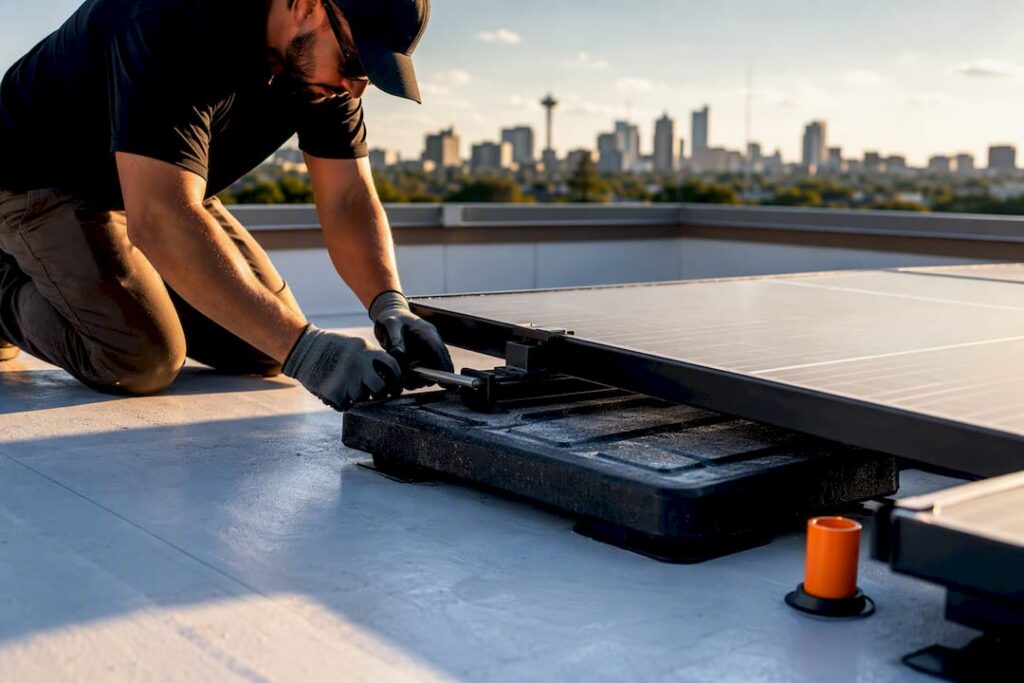
Yes, you can install solar on a flat roof, and for many homes it works as well as a pitched-roof system. The right approach depends on picking the correct mounting style (ballasted, mechanically attached, or hybrid), confirming your roof can carry the load, and accounting for wind exposure before you sign a contract. Get those three things right, and flat roof solar delivers reliable power for decades.
TL;DR:
- Flat roof solar systems require careful selection of mounting type based on membrane age, type, and wind exposure, with ballast, mechanical, or hybrid options suited to specific conditions.
- Proper site evaluation, including membrane integrity and structural capacity, is critical to avoid future roof and system issues, especially in high-wind or heavily obstructed areas.
- Wind zones defined by ASCE 7-22 significantly influence design choices, with edge and corner zones requiring additional ballast or anchors for long-term stability.
- Flat roof installations tend to be more expensive due to specialized racking, ballast weight, structural surveys, and access considerations, often increasing costs by mid-single digits percentage-wise.
- Long-term durability depends on correct system engineering, proper sealing, and drainage planning, with documented anchor points and future re-roofing considerations essential to protect investment.
Table of Contents
- Which Mounting Option Is Right for Your Flat Roof Solar Setup?
- Tilt, Row Spacing, and Layout: What Actually Changes Your Output
- What to Check on Your Roof Before You Get a Quote
- How Wind Codes Shape Flat Roof Solar Design
- Why Flat-Roof Installs Usually Cost More
- From Site Survey to Power-On: What the Installation Timeline Looks Like
- Keeping Solar and Your Roof Working Together Long-Term
- How Alpha Solar Solutions Approaches Flat-Roof Projects
- Do Flat Roofs Produce Less Solar Energy Than Pitched Roofs?
- Where Should Inverters and Electrical Equipment Go on a Flat Roof?
- How Does Shading Affect Flat Roof Solar Differently Than Pitched Roofs?
- Will Flat Roof Solar Hold Up Long-Term Against Weather?
- A Straight Answer on What Actually Protects Your Investment
- Ready for a Flat-Roof Solar Assessment in San Antonio?
- Sources
Which Mounting Option Is Right for Your Flat Roof Solar Setup?
Every flat roof solar installation uses one of three mounting families, and picking the wrong one causes leaks, warranty disputes, or wind damage down the road.
Ballasted systems hold panels in place with weighted trays instead of drilling into your roof. No penetrations means no new leak points, which is why ballast is the default choice on roofs with newer membranes or limited remaining warranty. The tradeoff: ballasted systems add real dead load, which caps how much tilt you can safely use.
Mechanically attached systems bolt racking directly into the roof deck. They handle wind uplift far better than ballast alone, but every penetration has to be flashed and sealed to the roof manufacturer’s specifications or you risk voiding your membrane warranty.
Hybrid systems combine both: ballast across the low-pressure interior of the roof, anchors at the perimeter and corners where wind uplift concentrates. This is often the most cost-effective answer on exposed roofs.
Signals that point you toward one option or another:
- Newer TPO or PVC membrane with years of warranty left → ballast favored
- Older membrane, EPDM, or roof nearing replacement → mechanical attachment may make more sense
- High wind exposure or a corner/edge-heavy roof shape → hybrid is usually smarter
- Concrete or built-up roof (BUR) with high load capacity → either option can work
Tilt, Row Spacing, and Layout: What Actually Changes Your Output
Flat roof panels are never installed dead flat. Most flat roof solar options use a low tilt angle generally recommended to balance energy yield and wind resistance, with a moderate tilt often striking the best balance, according to EnergySage. Flatter panels shed less rain and collect more debris; steeper panels catch more wind and cast longer shadows on the row behind them.
Row spacing is the quiet variable that decides how many panels actually fit on your roof.
- Tighter spacing packs in more modules but increases self-shading between rows, especially in winter when the sun sits lower.
- Wider spacing protects winter output but eats into your usable roof area.
- An east-west split layout, where half the array faces east and half faces west, flattens your production curve across the day instead of peaking hard at noon.
Statistic Callout: Pairing a low-tilt east-west layout with battery storage can increase the number of modules that fit on a given roof while smoothing generation across the day, which improves how much of your own solar power you actually use rather than exporting it.
What to Check on Your Roof Before You Get a Quote
This is the step homeowners skip, and it is the one that causes the most expensive regrets. Before any flat roof solar installation moves forward, run through this sequence.
- Confirm remaining membrane life. Installing panels on a roof with five years left on its warranty means paying to remove and reinstall the entire array when that roof needs replacing. Ask for the membrane’s installation date and warranty documents up front.
- Identify the membrane type. TPO, PVC, EPDM, built-up roofing, and concrete decks each interact differently with racking hardware and each carries its own warranty language about penetrations.
- Bring in a structural engineer. A ballasted array adds distributed dead load across the whole roof plus concentrated point loads under every ballast tray. A structural engineer has to verify the deck can carry both, plus snow or standing water where that applies.
- Get the roofing contractor and solar installer talking early. Looping in the roofing contractor before racking design is finalized preserves your membrane warranty and avoids finger-pointing later if a flashing detail fails.
Pro Tip: Ask any installer for the roof’s remaining warranty term in writing before you sign anything. If they don’t ask for it themselves, that’s a red flag, not a good sign.
If your roof needs work first, our guide on roof preparation for solar walks through what that prep typically costs.
How Wind Codes Shape Flat Roof Solar Design
Wind is the single biggest engineering variable in flat roof solar design, and it’s governed by uplift zones defined in ASCE 7-22, the wind-load standard most installers design against.
- Interior zones see the lowest uplift pressure, which is why ballast alone often works fine there.
- Edge zones see noticeably higher pressure and usually need extra ballast weight or partial anchoring.
- Corner zones face the highest uplift of all, and installers typically need anchors or substantially heavier ballast to keep panels secured.
In high-velocity hurricane zones or other extreme wind sites, ballast-only designs often become impractical, and mechanical attachment or a heavily reinforced hybrid becomes the safer call.
Why Flat-Roof Installs Usually Cost More
Flat roof solar installation typically runs higher than an equivalent pitched-roof job, and the reasons are mechanical, not arbitrary.
- Racking kits and ballast trays cost more than simple rail systems used on sloped roofs.
- Ballast itself, usually concrete blocks or pavers, adds material and labor to haul and place.
- A structural survey is frequently required before design work can even start.
- Scaffold or lift access can run higher depending on building height and roof access points.
Statistic Callout: Flat-roof installations commonly carry a premium in the single-digit to mid-teens percent range compared to pitched-roof equivalents, driven mainly by racking, ballast, and specialized labor.
That premium climbs further if your roof needs replacement before installation, or if high-wind anchoring adds engineered attachment points across the array.
From Site Survey to Power-On: What the Installation Timeline Looks Like
A professional flat roof solar installation moves through a predictable sequence.
- Site survey, where the installer measures your roof, checks access, and photographs membrane condition.
- System design, sizing the array and choosing the mounting approach based on your roof and local wind zone.
- Structural review, confirming the deck can handle the added load.
- Physical installation, typically the fastest phase once permits clear.
- Electrical commissioning and inspection, connecting the system and verifying it meets code.
- Utility interconnection and paperwork, including permits and any required certificates before you’re cleared to operate.
Timelines vary based on permit turnaround and whether a structural engineer’s report is needed before design can finalize.
Keeping Solar and Your Roof Working Together Long-Term
Panels typically outlast a single roofing cycle, so plan for re-roofing from day one.
- Leave documented walkways and clearance zones for maintenance and cleaning access.
- Ask your installer to record every anchor and ballast location in writing.
- Favor racking that can be unbolted and reset rather than systems that require full teardown.
Pro Tip: Removable ballast trays with logged locations can cut your future removal and reinstallation cost significantly compared to an undocumented system. Our removal and reinstallation guide breaks down what that process typically involves. If your roof is approaching replacement age, check our roof coordination resources before committing to a mounting plan.
How Alpha Solar Solutions Approaches Flat-Roof Projects
We treat every flat roof solar project as a roof project first and a solar project second. Before we finalize any design, our process includes:
- Membrane review to confirm type, age, and warranty status
- Structural referral when ballast or point loads require engineer sign-off
- Wind exposure assessment against local code requirements
- Coordination with your roofing warranty to avoid coverage disputes
Alpha Solar Solutions handles residential and commercial flat-roof installations across San Antonio with this same checklist every time.
Do Flat Roofs Produce Less Solar Energy Than Pitched Roofs?
Not necessarily, though the comparison depends on tilt and layout choices more than the roof shape itself. A well-designed flat roof solar array using a 10 to 15 degree tilt can come close to matching a moderately pitched roof’s annual output, especially in southern latitudes where the sun tracks high overhead for much of the year.
Where flat roofs sometimes lose ground is in winter, when low sun angles make row-to-row shading more noticeable on flatter arrays. Pitched roofs facing south at their optimal angle, usually somewhere between 30 and 40 degrees depending on latitude, capture slightly more winter sun without extra spacing.
Flat roofs make up that gap in a different way: they offer flexibility pitched roofs don’t. You can orient panels in any direction regardless of how the building itself sits, which matters if your roof faces east-west instead of north-south. An east-west split layout, mentioned earlier for its battery benefits, also tends to flatten seasonal swings in production compared to a single steep, south-facing pitched array that peaks hard in summer and drops off in winter.
The bigger output differences usually come down to row spacing and shading management rather than the flat-versus-pitched distinction alone. A tightly packed flat array with poor row spacing will underperform a well-spaced one by a wider margin than flat roofs typically underperform pitched ones.
Where Should Inverters and Electrical Equipment Go on a Flat Roof?
Flat roofs actually give you more placement flexibility for inverters and electrical gear than pitched roofs do, since you’re not constrained by a steep slope or limited attic access.
Most installers mount string inverters and combiner boxes on the roof itself, tucked near the array’s edge, or route conduit down to ground-level or wall-mounted equipment near the electrical service panel. Ground or wall placement tends to simplify future maintenance since technicians don’t need roof access for routine inverter checks.
A few placement details matter more on flat roofs specifically:
Equipment mounted on the roof deck needs its own structural consideration, since inverters and combiner boxes add point loads just like ballast trays do. They also need clearance from ponding water zones, which flat roofs are more prone to than sloped ones. Conduit runs across a flat roof should be secured and routed to avoid creating new penetration points beyond what the racking already requires, and any roof-mounted enclosure needs a rating suited to direct sun and standing moisture exposure.
Shading from equipment enclosures themselves is a minor but real consideration. A combiner box or inverter placed carelessly near the array can cast a shadow across a corner of panels for part of the day. Good installers position electrical equipment along walkways or roof edges specifically to avoid this.
How Does Shading Affect Flat Roof Solar Differently Than Pitched Roofs?
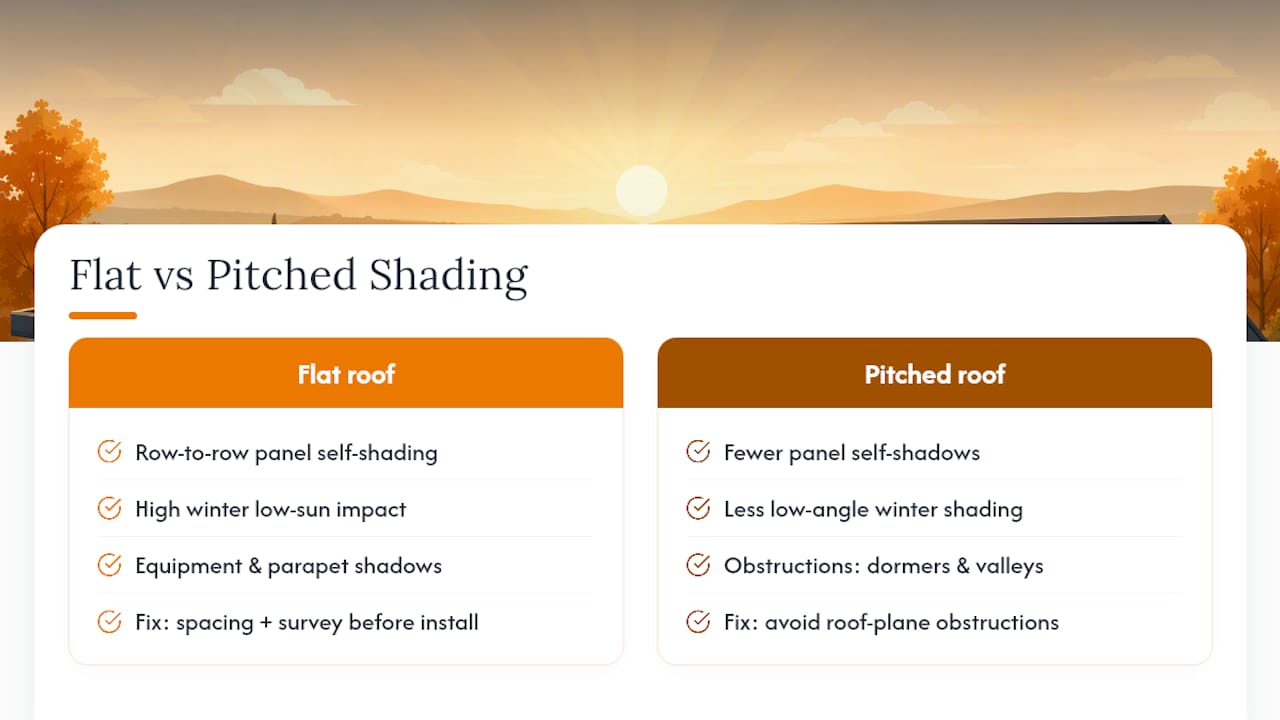
Shading works differently on a flat roof because the panels themselves, not just nearby trees or chimneys, can shade each other.
Row-to-row self-shading is the defining shading issue in flat roof solar design. Because panels sit at a shallow tilt on racking that raises the back edge, each row can cast a shadow onto the row behind it, particularly during winter months when the sun sits low on the horizon. This is exactly why row spacing calculations matter so much in the design phase covered earlier: too little spacing and you lose production every morning and afternoon during the shorter days of the year.
Rooftop equipment adds a second shading layer that pitched roofs mostly avoid. HVAC units, vent stacks, skylights, and parapet walls common on flat roofs all cast shadows that shift throughout the day and across seasons. A good site survey maps these obstructions and accounts for their shadow paths before finalizing panel placement, not after installation.
Parapet walls deserve special attention. A raised edge around a flat roof can block low-angle morning or afternoon sun from reaching panels near that wall, especially in winter. Panels placed too close to a tall parapet may lose meaningful production for a portion of the day regardless of how well the rest of the array is designed.
The upside: flat roofs are usually free of the roof-plane obstructions that complicate pitched installations, like dormers or roof valleys. Once row spacing and equipment placement are handled correctly, flat-roof shading tends to become a solved problem rather than an ongoing headache.
Will Flat Roof Solar Hold Up Long-Term Against Weather?
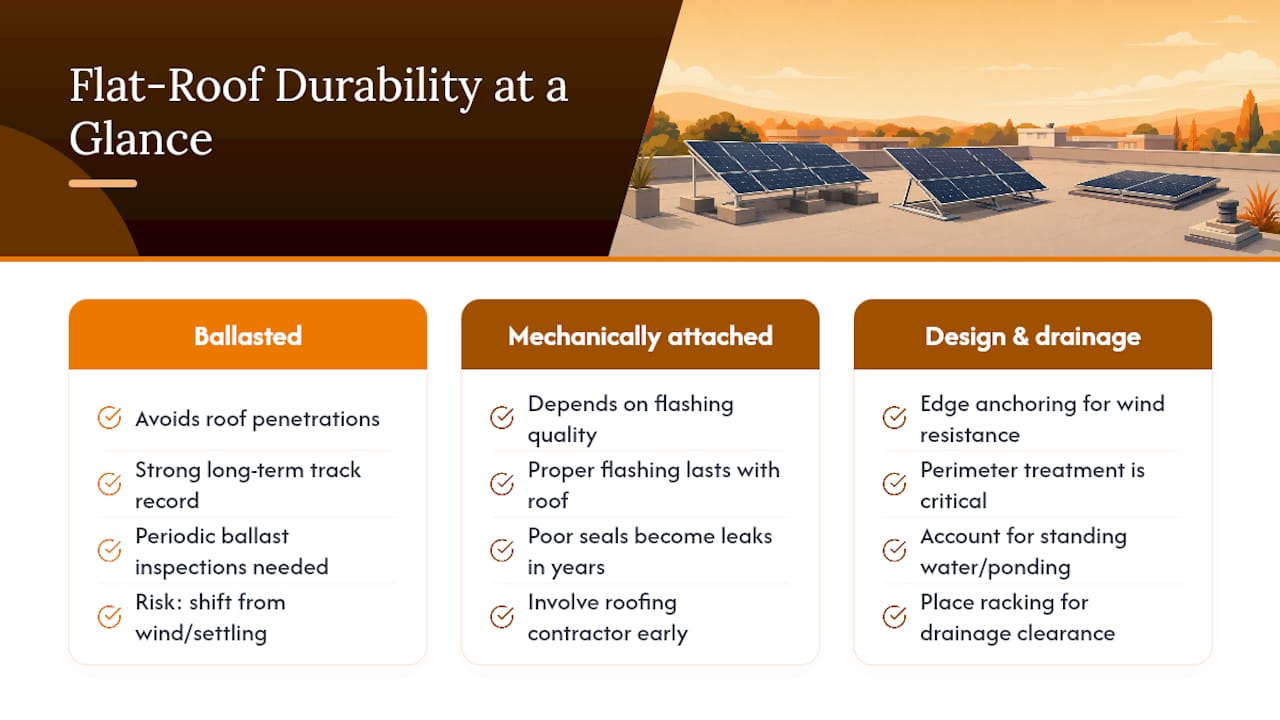
A properly engineered flat roof solar system holds up as well over time as a pitched-roof system, provided the mounting choice matched the site conditions from the start.
Ballasted systems have a strong long-term track record specifically because they avoid roof penetrations that degrade over decades of thermal cycling and UV exposure. The tradeoff is that ballast components themselves, usually concrete or specialized weighted trays, need periodic inspection to confirm they haven’t shifted from wind events or settling.
Mechanically attached systems face a different long-term question: the quality of the original flashing and seal work. A properly flashed penetration, installed to the membrane manufacturer’s specifications, can last as long as the roof itself. A poorly sealed one becomes a leak point within a few years, which is why bringing the roofing contractor into the design process, as covered earlier, matters so much for durability.
Wind resistance over time comes back to the uplift zone design discussed in the ASCE 7-22 section. Systems designed with adequate anchoring or ballast weight at edges and corners tend to weather storm seasons without incident. Systems that cut corners on perimeter treatment are the ones that show up in post-storm damage reports.
Standing water and ponding are the other long-term durability factor specific to flat roofs. Racking and electrical enclosures need placement and drainage clearance that account for water pooling after heavy rain, something structural engineers factor into their load calculations alongside snow where applicable.
A Straight Answer on What Actually Protects Your Investment
Homeowners get sold on price per watt when they should be asking about roof life and documentation. A cheap flat roof solar quote that skips the structural report or leaves ballast locations unrecorded isn’t actually cheap. It’s a deferred bill waiting for your next roof replacement.
I’d rather see a homeowner pay slightly more for a written structural report and a clear removal and reinstall plan than save a few hundred dollars upfront and get blindsided in eight years. Ask for both before you sign, and treat any installer who resists as a signal to look elsewhere.
— Anthony
Ready for a Flat-Roof Solar Assessment in San Antonio?
Alpha Solar Solutions is the direct route to a flat roof solar system built around your actual roof, not a generic racking package. We run the membrane review, structural referral, and wind exposure check as standard practice, and we document every ballast and anchor location so future re-roofing doesn’t turn into a surprise expense.
Whether you’re working with a residential rooftop or a larger commercial flat roof, our team designs the mounting approach around your building’s actual load capacity and local wind zone, not a one-size-fits-all layout. If a future roof replacement is on your radar, we also handle panel removal and reinstallation as a standalone service, so you’re never stuck choosing between a new roof and keeping your solar system.
Schedule a residential site assessment with Alpha Solar Solutions, and get a written structural and roof-condition review before you commit to a design.
Sources
- Solar panels for flat roofs: Are they right for you? — EnergySage
- Flat Roof Solar Design 2026: Ballasted vs Attached Systems | SurgePV
- Solar Racking Design for Flat Roofs: Ballast, Attachment, and Wind-Load Basics
- Flat-roof structural considerations (ballasted vs attached) — Solar Permit Solutions