
TL;DR:
- Modern solar inverters convert DC from panels into AC and manage system safety, monitoring, and optimization. They support features like MPPT, grid synchronization, fault protection, and real-time data sharing, ensuring maximum efficiency and safety. Choosing the right inverter depends on roof type, shading, future storage plans, and efficiency needs.
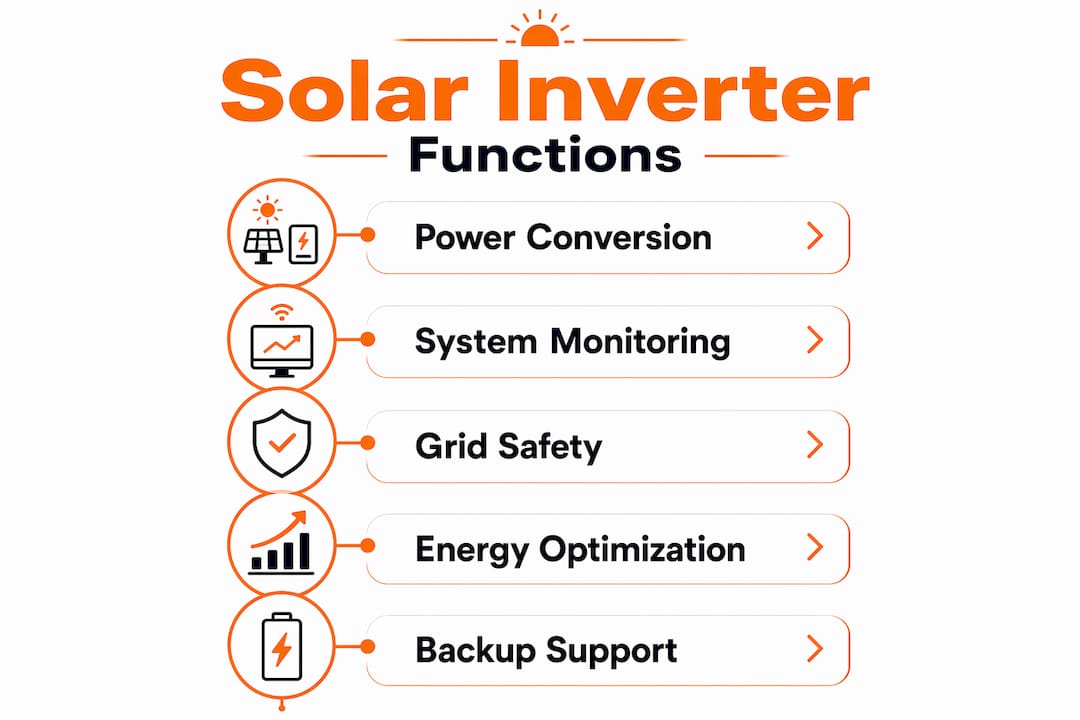
A solar inverter is defined as the device that converts raw DC electricity from your solar panels into the AC electricity that powers your home and connects to the electrical grid. Without it, your panels produce power you cannot use. The role of inverters in solar systems goes well beyond that single conversion step. Modern inverters from brands like Enphase, SolarEdge, and SMA also manage energy optimization, safety protection, and real-time system monitoring. Technologies like Maximum Power Point Tracking (MPPT) and Silicon Carbide (SiC) semiconductors have turned today’s inverter into the true control center of any solar installation.
What is the role of inverters in solar systems?
The primary role of a solar inverter is converting the DC electricity your panels generate into the AC electricity your appliances actually run on. Solar panels produce direct current, which flows in one direction. Your home, and the utility grid, run on alternating current, which cycles back and forth. The inverter bridges that gap every second your system is running.

Beyond conversion, the inverter acts as the brain of your solar setup. It tracks how much power your panels are producing, checks that output against what your home needs, and adjusts in real time. A well-chosen inverter protects your investment and keeps your system running at its best for 10 to 15 years or more.
What are the key functions of solar inverters beyond power conversion?
Modern inverters handle several critical jobs that most homeowners never see but benefit from every day.
- Maximum Power Point Tracking (MPPT): MPPT is an algorithm that constantly adjusts the electrical load on your panels to pull the maximum available power at any given moment. Cloud cover, temperature shifts, and panel angle all change how much power is available. MPPT captures as much of that power as possible.
- Grid synchronization: The inverter matches its AC output to the grid’s voltage, frequency, and phase before feeding power in. This keeps your system stable and prevents damage to appliances.
- Fault detection and anti-islanding protection: If the grid goes down, your inverter must shut off within milliseconds. This protects utility workers who may be repairing lines nearby. Anti-islanding protection is a legal requirement in every grid-tied system in the United States.
- Real-time monitoring: Smart inverters send live data to apps on your phone, showing production, consumption, and any fault alerts. You can catch a problem before it costs you money.
- Reactive power control: Advanced inverters support grid stability by managing reactive power, a feature that is becoming standard in 2026-grade systems.
Pro Tip: Set up your inverter’s monitoring app on day one. Checking production weekly takes two minutes and helps you spot shading issues, dirty panels, or equipment faults before they compound.
How do different solar inverter types compare?
Four main solar inverter architectures exist for residential and commercial use: string inverters, microinverters, hybrid inverters, and power optimizers. Each suits a different roof type, budget, and long-term goal.
| Inverter type | Best for | Energy yield benefit | Upfront cost |
|---|---|---|---|
| String inverter | Simple, unshaded roofs | Baseline | Lowest |
| Microinverter | Shaded or complex roofs | 10–25% gain in shade | Highest |
| Power optimizer | Partial shade, single inverter preferred | 10–25% gain in shade | Mid-range |
| Hybrid inverter | Battery storage now or later | Reduces conversion losses | Mid to high |
String inverters connect all your panels in a series circuit and convert power at one central unit. They are cost-effective and reliable, but shading on one panel reduces output for the entire string. Microinverters, made popular by Enphase, attach to each panel individually. Microinverters convert DC to AC at the panel level, so shading on one panel does not affect the others. They also provide panel-level monitoring, which is useful for diagnosing performance issues.
Power optimizers, used in SolarEdge systems, sit at each panel and condition the DC power before sending it to a central inverter. They deliver similar shade tolerance to microinverters at a lower total cost. Hybrid inverters manage both your solar array and a battery bank from a single unit. They handle charge and discharge on the DC side, which reduces conversion losses compared to adding a separate battery inverter later.
Pro Tip: If you are not adding a battery today but think you might in the next three to five years, a hybrid inverter now saves you the cost and complexity of retrofitting later.
What factors influence solar inverter efficiency?
Inverter efficiency determines how much of the power your panels produce actually reaches your home. Tier 1 solar inverters achieve a European-weighted efficiency near 99%, which is the industry benchmark for quality systems. SiC-based inverters can push that ceiling even higher, approaching 99.5% efficiency.
The efficiency number on a spec sheet reflects peak conditions. Your system rarely runs at peak. Partial-load efficiency is the figure that matters most day to day, since your panels produce varying amounts of power throughout the morning and evening hours. An inverter that performs well at 20–50% of its rated capacity will outperform a higher-rated unit that only shines at full load.
SiC MOSFET-based inverters offer up to 50% lower switching losses and up to 80% weight reduction compared to older IGBT-based units. That weight reduction matters for rooftop or wall-mounted installations where space is limited. The tradeoff is a higher purchase price, but the long-term energy gains often justify the cost for larger systems.
Oversizing your inverter relative to your array is a common mistake. A large inverter running a small array spends most of its time at low load, where efficiency drops. Matching inverter capacity to your expected daily load profile keeps the unit operating in its most efficient range.
| Efficiency metric | What it measures | Why it matters |
|---|---|---|
| Peak efficiency | Best-case conversion rate | Sets the ceiling for performance |
| European weighted efficiency | Average across load levels | Reflects real-world daily output |
| Partial-load efficiency | Performance at 20–50% load | Most relevant for typical home use |
| CEC efficiency | California Energy Commission standard | Used for U.S. incentive qualification |
How do inverters keep your solar system safe on the grid?
Grid safety is one of the most underappreciated inverter functions in solar. The inverter synchronizes its AC output to the grid’s voltage, frequency, and phase at all times. When those parameters drift outside acceptable limits, the inverter detects the fault and shuts down within milliseconds.
This millisecond shutdown prevents a condition called islanding, where your system continues generating power into a grid that utility workers believe is de-energized. Islanding is a serious safety hazard. Anti-islanding protection is a legal requirement for every grid-tied solar system in the United States, and your inverter must pass certification testing to prove it works.
Advanced inverters now go further with grid-forming capabilities and fault-ride-through functions. These features allow the inverter to stay connected and support the grid during minor disturbances rather than disconnecting immediately. Reactive power control and dynamic response capabilities are becoming standard in 2026-grade inverters, enabling grid stability services that benefit the broader network.
For homeowners enrolled in net metering programs, a properly synchronized inverter is what makes the arrangement possible. Your inverter feeds surplus power back to the grid in a form the utility can accept, and your meter credits you for it.
Practical tips for choosing and maintaining your solar inverter
Choosing the right inverter is as important as choosing the right panels. These steps help you make a decision you will not regret five years from now.
- Match inverter type to your roof. A simple south-facing roof with no shade is a strong candidate for a string inverter. A roof with multiple angles, dormers, or nearby trees benefits from microinverters or power optimizers.
- Size the inverter to your load profile. Work with your installer to size the inverter based on your typical daily consumption, not just your panel array’s peak output. Matching inverter size to load keeps the unit in its most efficient operating range.
- Plan for battery storage now. If there is any chance you will add a battery like a Tesla Powerwall or Franklin Electric APsystems battery in the future, choose a hybrid inverter from the start.
- Check local service availability. A brand with no local service network in San Antonio means longer wait times and higher repair costs if something goes wrong. Ask your installer who handles warranty claims and how quickly they can respond.
- Use the monitoring app consistently. Real-time data from your inverter is the fastest way to catch a failing panel, a loose connection, or a shading problem that crept in as a nearby tree grew.
Pro Tip: Ask your installer for the inverter’s weighted efficiency rating, not just its peak efficiency. Weighted efficiency reflects how the unit actually performs across a full day of varying sunlight, which is a much more honest number.
Key takeaways
The inverter is the single component that determines whether your solar system runs efficiently, safely, and at full value over its lifetime.
| Point | Details |
|---|---|
| Core function | Inverters convert DC solar power to usable AC electricity for your home and grid. |
| Beyond conversion | MPPT, fault detection, and monitoring are standard functions in modern inverters. |
| Type selection matters | Microinverters and optimizers improve output by 10–25% in shaded installations. |
| Efficiency at partial load | Weighted efficiency is a better performance indicator than peak efficiency alone. |
| Grid safety is mandatory | Anti-islanding protection is a legal requirement for all U.S. grid-tied systems. |
Why inverter choice deserves more attention than it usually gets
Most homeowners spend the bulk of their research time comparing solar panels and almost none comparing inverters. I have seen that play out badly more times than I can count. A high-efficiency panel paired with a poorly matched inverter will underperform a mid-tier panel paired with the right inverter every single time.
The shift toward hybrid inverters is the most important trend I have watched develop over the past few years. Homeowners who installed string inverters five years ago and now want to add battery storage are facing a real problem. They either need to replace the inverter entirely or add a separate battery inverter, which adds cost and complexity. Choosing a hybrid inverter upfront costs a bit more, but it keeps your options open.
The technology gap between SiC-based inverters and older IGBT units is also wider than most buyers realize. The weight reduction and efficiency gains are not just marketing claims. For a San Antonio home running air conditioning through a long Texas summer, those efficiency points add up to real dollars over a 15-year system life.
My honest recommendation is to treat the inverter selection conversation with the same seriousness as the panel selection conversation. Ask your installer to walk you through the solar inverter options available for your specific roof and load profile. If they cannot explain the difference between weighted efficiency and peak efficiency, find someone who can.
— Anthony
Alphasolarsa brings inverter expertise to San Antonio homeowners
Choosing the right inverter for your home is not a decision you should make alone. Alphasolarsa designs and installs custom solar systems for San Antonio homeowners and property developers, with deep expertise in inverter selection, hybrid battery integration, and long-term system performance.
Whether you are building a new system from scratch or upgrading an existing one, our team matches your roof layout, energy goals, and budget to the right inverter technology. We handle residential solar installation from initial design through final inspection, and we stand behind every system we install. Businesses looking for commercial-scale solutions can learn more about our commercial solar services. Request a free energy consultation today and find out exactly what your home needs.
FAQ
What does a solar inverter actually do?
A solar inverter converts DC electricity from your solar panels into AC electricity that powers your home and feeds into the utility grid. Modern inverters also handle MPPT, fault detection, and real-time monitoring.
Which solar inverter type is best for a shaded roof?
Microinverters or power optimizers are the best choice for shaded roofs. They improve energy output by 10–25% compared to string inverters in shaded conditions by optimizing each panel independently.
What is anti-islanding protection in a solar inverter?
Anti-islanding protection shuts your inverter down within milliseconds if the grid loses power. This is a legal requirement for all U.S. grid-tied solar systems and protects utility workers from live lines.
How do I know if my inverter is performing well?
Use your inverter’s monitoring app to track daily production against expected output. A consistent drop in production compared to similar weather days is a reliable early warning sign of a problem.
Should I choose a hybrid inverter if I do not have a battery yet?
Yes. A hybrid inverter costs more upfront but makes adding battery storage later far simpler and less expensive. It eliminates the need to replace or supplement your inverter when you are ready to expand.