
TL;DR:
- Solar power involves onsite electricity generation from sunlight using photovoltaic panels, contrasting with centralized grid power supplied through utility infrastructure. On-grid systems connect to the utility, offering lower costs and billing credits, while off-grid systems rely solely on batteries, providing full independence. Over the long term, solar offers significant savings, environmental benefits, and property value increases compared to traditional grid electricity.
Solar power is defined as electricity generated onsite from sunlight through photovoltaic (PV) panels, while grid power is electricity produced at centralized plants and delivered to your home through utility infrastructure. The core difference between solar and grid power comes down to where your electricity originates, who controls its price, and how resilient your supply is when things go wrong. Solar systems come in two main configurations: on-grid systems that connect to the utility network, and off-grid systems that operate independently with battery storage. Understanding both helps you make a confident, informed decision about your home’s energy future.
How do on-grid and off-grid solar systems differ?
On-grid and off-grid solar represent two fundamentally different relationships with your utility company. Each has real advantages depending on your goals, budget, and location.
On-grid solar systems connect directly to the utility grid. Your panels generate electricity during daylight hours, and any excess power flows back to the grid. Many utilities credit you for that exported power through a program called net metering, which reduces your monthly bill. On-grid systems are the most common choice for homeowners because they cost less upfront and still deliver meaningful savings.
Off-grid solar systems operate with zero connection to the utility network. They rely entirely on battery storage to supply power at night or during cloudy periods. Off-grid setups work well for rural properties where grid connection is expensive or unavailable, but they require careful system sizing and a larger investment in batteries.
Hybrid systems blend both approaches. You get battery backup for outages and the option to draw from the grid when your storage runs low. Hybrid setups are growing in popularity because they offer the best of both worlds without the full cost of going completely off-grid.
Here is a quick comparison of the three system types:
- On-grid: Lower upfront cost, net metering credits, no power during outages without storage
- Off-grid: Full energy independence, higher battery investment, no utility bills
- Hybrid: Battery backup plus grid access, most flexibility, moderate to high cost
Pro Tip: If you live in San Antonio and your utility offers net metering, an on-grid system will almost always deliver the fastest return on your investment. Check your CPS Energy rate schedule before sizing your system.
What are the cost differences between solar and grid power?
Cost is where the solar vs. grid energy conversation gets most interesting for homeowners. The numbers strongly favor solar over the long run.

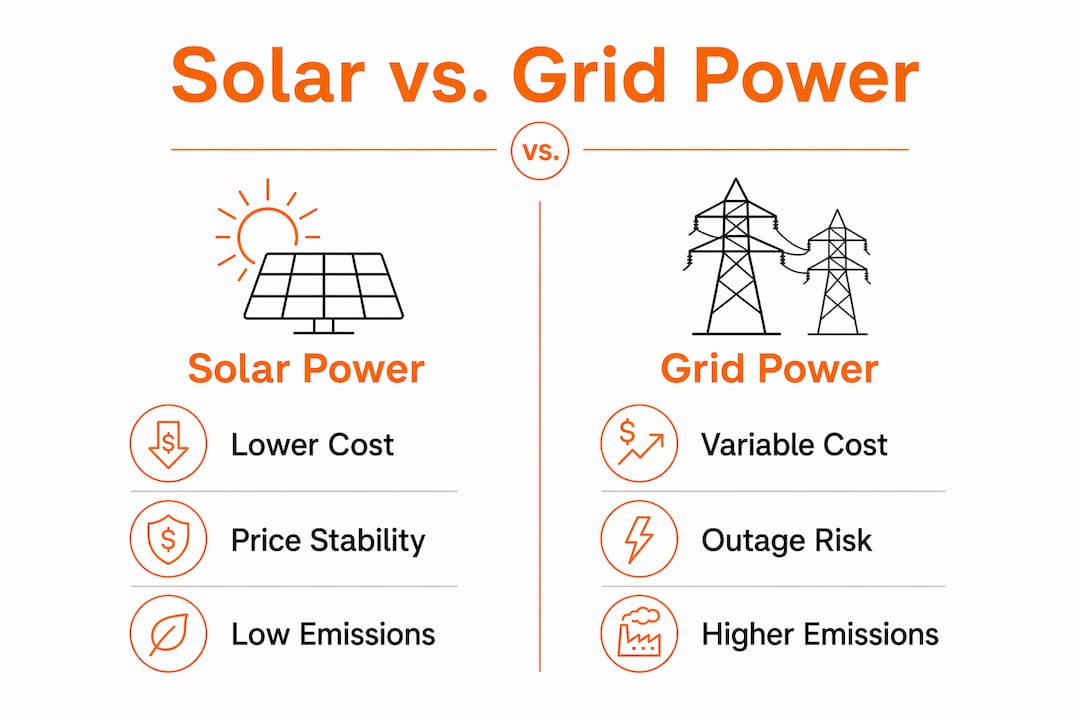
As of Q1 2026, U.S. residential grid electricity averages $0.165 per kilowatt-hour (kWh), with rates rising at roughly 3.4% per year. Solar’s Levelized Cost of Energy (LCOE), which is the true cost per kWh over a system’s lifetime, runs about $0.06 to $0.11 per kWh after available incentives. That gap is significant and it widens every year grid rates climb.
Most homeowners think about solar as a large upfront purchase. The smarter way to evaluate it is through LCOE over 25 years, where solar consistently outperforms grid power on a per-kWh basis. Your solar cost is locked in at installation. Your utility rate is not.
The savings add up fast. Homeowners who go solar save $90 to $125 monthly and up to $1,500 annually on electricity bills. Over 20 years, total savings can reach $20,000 to $50,000 depending on your location and system size. That is real money staying in your household budget.
| Cost Factor | Grid Power | Solar Power |
|---|---|---|
| Average cost per kWh | $0.165 (rising ~3.4%/yr) | $0.06–$0.11 (fixed at install) |
| Monthly bill impact | Varies, trends upward | Reduced or near zero |
| 20-year savings potential | None | $20,000–$50,000 |
| Price predictability | Low | High |
Local net metering policies play a major role in how quickly you recoup your investment. States and utilities with strong net metering programs let you earn credits for every kWh you export, which shortens your payback period considerably. The economic viability of solar depends heavily on these local rules, so researching your specific utility’s policy is a critical first step.
Pro Tip: Ask your solar installer to run a 25-year cash flow projection using your actual utility rate and your local net metering credit rate. That single document will tell you more than any general estimate.
Solar also acts as a financial hedge against utility volatility since its cost is fixed post-installation. Grid rates, by contrast, are subject to fuel prices, infrastructure costs, and regulatory changes. Locking in your energy cost today protects you from whatever happens to utility rates over the next two decades. You can read more about this protection at rising energy costs.
How do solar and grid power compare on reliability and environment?
The difference between solar and conventional power goes well beyond your monthly bill. Reliability and environmental impact are two areas where the comparison is especially clear.
Grid reliability and blackout risk
Grid electricity is convenient and always available under normal conditions. The problem is that centralized grids are vulnerable to weather events, equipment failures, and demand spikes. When the grid goes down, your home loses power regardless of how reliable your utility has been in the past. Texas homeowners learned this lesson during the 2021 winter storm, when millions of households lost power for days.
Solar panels paired with battery storage provide power during grid outages. Grid-tied solar without storage, however, shuts down automatically during blackouts for safety reasons. This is a critical distinction. If outage protection matters to you, battery storage is not optional. It is the feature that transforms solar from a bill-reduction tool into a genuine resilience asset.
“A solar system with battery storage transforms solar into a strategic asset requiring active management, unlike the set-it-and-forget-it nature of grid power.” — Solar Panel Benefits, Sustainable Scale
Environmental impact
The environmental advantages of solar energy over grid electricity are substantial. Solar power operates with near-zero emissions during its working life, unlike grid electricity from fossil fuels, which produces significant CO2 and other pollutants. Better air quality and reduced public health costs follow directly from that difference.
Over a full life cycle, solar energy reduces greenhouse gas emissions by 91% compared to natural gas and 96% compared to coal. Those figures come from NREL research and represent the most thorough accounting of solar’s environmental footprint, including manufacturing and disposal.
Solar and home value
Solar panels increase your property value. Homebuyers pay a premium for homes with owned solar arrays, treating them similarly to other major upgrades like a finished basement or updated kitchen. Solar installations increase property values by 4–6% on average. One important note: third-party owned systems, where you lease the panels rather than own them, typically do not deliver the same resale benefit. Ownership matters.
What should homeowners consider before choosing solar?
Choosing between solar and grid power is not a one-size-fits-all decision. These are the practical factors that should shape your evaluation.
-
Assess your sunlight and roof suitability. Solar panels perform best on south-facing roofs with minimal shading. A roof in good condition with 10 or more years of life remaining is ideal. If your roof needs replacement soon, coordinate that work before installation.
-
Understand your financing options. Residential solar systems under $20,000 are common, and financing options include cash purchase, solar loans, and property-assessed clean energy (PACE) financing. Each option has different implications for ownership, savings, and home resale value.
-
Know your maintenance expectations. Solar panel maintenance is minimal. It mostly involves periodic panel cleaning and annual inspections. Battery systems add a small amount of additional maintenance, but nothing close to what a gas generator requires.
-
Factor in local incentives and grid policies. Texas offers property tax exemptions on the added home value from solar installations. Local solar incentives and CPS Energy programs in San Antonio can further improve your economics. Research what applies to your address specifically.
-
Consider your lifestyle and energy goals. If energy independence and outage protection are priorities, plan for battery storage from the start. If your primary goal is reducing your monthly bill, an on-grid system without storage may be the most cost-effective starting point.
For Texas homeowners specifically, the 2026 solar savings guide from Alphasolarsa covers local incentives, utility policies, and system sizing in detail.
Key takeaways
Solar power delivers lower long-term energy costs, greater price stability, and meaningful environmental benefits compared to grid electricity, making it the stronger financial choice for most homeowners over a 25-year horizon.
| Point | Details |
|---|---|
| Source and control | Solar generates power onsite; grid power comes from centralized utility plants you don’t control. |
| Cost advantage | Solar LCOE runs $0.06–$0.11/kWh versus $0.165/kWh for grid electricity, with grid rates rising annually. |
| Reliability and resilience | Battery-paired solar maintains power during outages; grid-tied solar without storage does not. |
| Environmental impact | Solar reduces lifecycle greenhouse gas emissions by 91–96% compared to fossil fuel grid power. |
| Home value | Owned solar systems increase property values by 4–6% on average. |
The honest case for solar over grid power
I have worked with hundreds of San Antonio homeowners who came to us with the same question: is solar actually worth it, or is it just a trend? My honest answer is that solar is worth it for most homeowners, but not for the reasons people usually expect.
The monthly bill savings are real and they matter. But the bigger story is what happens in years 10, 15, and 20. Grid rates keep climbing. Your solar cost stays fixed. That gap compounds quietly in your favor every single year. Homeowners who installed systems a decade ago are now paying almost nothing for electricity while their neighbors absorb rate increases year after year.
Where I push back on conventional solar enthusiasm is on battery storage. Too many people treat batteries as optional. They are not, especially in Texas. If you go solar without storage, you are still completely dependent on the grid the moment the sun goes down or a storm rolls through. A system with battery backup is a genuinely different product. It gives you control. That control has real financial and practical value that does not show up in a simple payback calculation.
My advice: do not let the upfront cost be the only number you focus on. Run the 25-year math. Factor in your local utility’s rate trajectory. And if outage protection matters to your family, budget for storage from day one rather than adding it later at higher cost.
— Anthony
Ready to see what solar can do for your home?
Alphasolarsa helps San Antonio homeowners design and install custom solar systems that fit their energy goals and budget. Whether you are comparing your first solar quote or ready to move forward, our team walks you through every step with clear numbers and no pressure.
From system design to installation to ongoing maintenance, Alphasolarsa handles it all locally. Our residential solar installation service is built specifically for homeowners who want predictable energy costs and long-term ownership. Contact us today for a personalized solar assessment and find out exactly what your home qualifies for in 2026.
FAQ
What is the main difference between solar and grid power?
Solar power is generated onsite from sunlight through photovoltaic panels, while grid power is produced at centralized plants and delivered through utility lines. The key distinction is source, cost structure, and price control.
Does solar power work during a power outage?
Grid-tied solar without battery storage shuts down automatically during outages for safety. Solar systems paired with battery storage continue to supply power to your home when the grid goes down.
How much can a homeowner save by switching to solar?
Homeowners typically save $90 to $125 per month and up to $1,500 annually. Over 20 years, total savings can reach $20,000 to $50,000 depending on system size and location.
Does solar increase home resale value?
Yes. Owned solar installations increase property values by 4–6% on average. Leased systems generally do not deliver the same resale benefit, so ownership structure matters.
Is solar power better for the environment than grid electricity?
Solar power produces near-zero emissions during operation and reduces lifecycle greenhouse gas emissions by 91% compared to natural gas and 96% compared to coal, according to NREL data.