
TL;DR:
- Most solar power myths stem from outdated information, as modern technology and costs have significantly improved.
- Today, solar panels produce meaningful energy on cloudy days, last over 25 years, and offer substantial long-term savings.
If you’ve been sitting on the fence about solar, there’s a good chance a persistent myth or two is holding you back. Solar power myths explained clearly and honestly reveal that most of the fears homeowners carry about cost, reliability, and performance are based on outdated information. The technology has changed dramatically. The economics have shifted in your favor. And the common solar energy misconceptions that once had some basis in reality simply don’t reflect what solar looks like today.
Table of Contents
- Key takeaways
- Myth 1: Solar only works on sunny days
- Myth 2: Solar is too expensive to be worth it
- Myth 3: Solar panels degrade quickly
- Myth 4: You’ll have no power at night or during storms
- Myth 5: You need a perfect roof and a large upfront investment
- My honest take on solar hesitation
- Ready to see what solar can do for your home?
- FAQ
Key takeaways
| Point | Details |
|---|---|
| Panels work in cloudy weather | Solar panels produce 10-25% of rated power on overcast days, making annual output the real measure. |
| Solar costs have dropped sharply | Solar PV costs fell over 40% since 2010, making solar competitive with or cheaper than most energy sources. |
| Panels last 25 or more years | With degradation rates around 0.5% per year, most panels retain strong output well past their warranty period. |
| Grid-tied systems keep you powered | Most home solar stays connected to the grid, so you have electricity day and night without issue. |
| Roof orientation is flexible | East and west-facing roofs produce roughly 80-85% of what south-facing panels generate, still a strong return. |
Myth 1: Solar only works on sunny days
This is probably the most stubborn myth in the entire solar conversation. People see a cloudy sky and assume their panels are doing nothing. That’s simply not how solar works.
Modern panels generate electricity from diffuse light, which is the scattered sunlight that reaches your roof even when clouds block direct sun. Panels on overcast days produce 10-25% of their rated power, which is meaningful output over the course of a full day. Germany, one of the cloudiest countries in Europe, is consistently among the world’s top solar energy producers. That fact alone should put this myth to rest.
What matters more than any single day’s weather is your system’s annual production. Solar is an annual production story; good summer days offset slower winter ones, and your utility bill reflects what happens over twelve months, not twelve hours. When you look at total yearly output, the occasional gray week barely moves the needle.
Here’s what you should know about solar and weather:
- Panels use both direct and diffuse sunlight to generate power
- High temperatures can actually reduce panel efficiency, so mild, partly cloudy days sometimes outperform scorching ones
- Rain naturally rinses dust off panels, which improves performance afterward
- Your solar installer will calculate annual output estimates based on your specific location’s weather data
Pro Tip: Ask your installer to show you a production estimate based on 12-month averages for your zip code, not just peak summer output. That number tells you the real story.
Myth 2: Solar is too expensive to be worth it
Solar used to be expensive. That’s fair. But that was a different era. Solar PV costs dropped 41% since 2010, and the drop hasn’t stopped. Today, 91% of new renewable energy projects cost less than the cheapest new fossil fuel option available in the same market.
For a typical San Antonio homeowner, a residential solar system pays for itself within 7 to 10 years, depending on system size and energy usage. After payback, you’re generating power for close to nothing. Compare that to a utility bill that keeps creeping higher every year with no ceiling in sight.

| Factor | Solar energy | Traditional utility power |
|---|---|---|
| Cost trend | Declining year over year | Rising unpredictably |
| Payback period | 7-10 years for most homes | No payback, ongoing cost |
| Price predictability | Fixed after installation | Subject to market volatility |
| Long-term savings | Significant after year 10 | None |
The financial case for solar isn’t just about saving money month to month. It’s about owning your energy instead of renting it. Every dollar you pay to the utility is gone. Every kilowatt your panels produce is yours. That shift from renter to owner is what makes solar a genuinely smart financial move for most homeowners in 2026.
Pro Tip: When comparing solar costs, look at the cost per kilowatt-hour your system will produce over its 25-year life. That number is often far lower than what your utility charges today, and utility rates only go up.
Myth 3: Solar panels degrade quickly
The concern here is understandable. People worry they’ll spend thousands of dollars on a system that loses most of its power output in five or ten years. The reality is far more reassuring.
The industry average degradation rate is approximately 0.5% per year. That means after 20 years, a standard panel still produces around 90% of its original output. Premium panels do even better. N-type TOPCon modules degrade at only 0.3-0.4% per year, retaining over 90% output well past the 25-year mark.
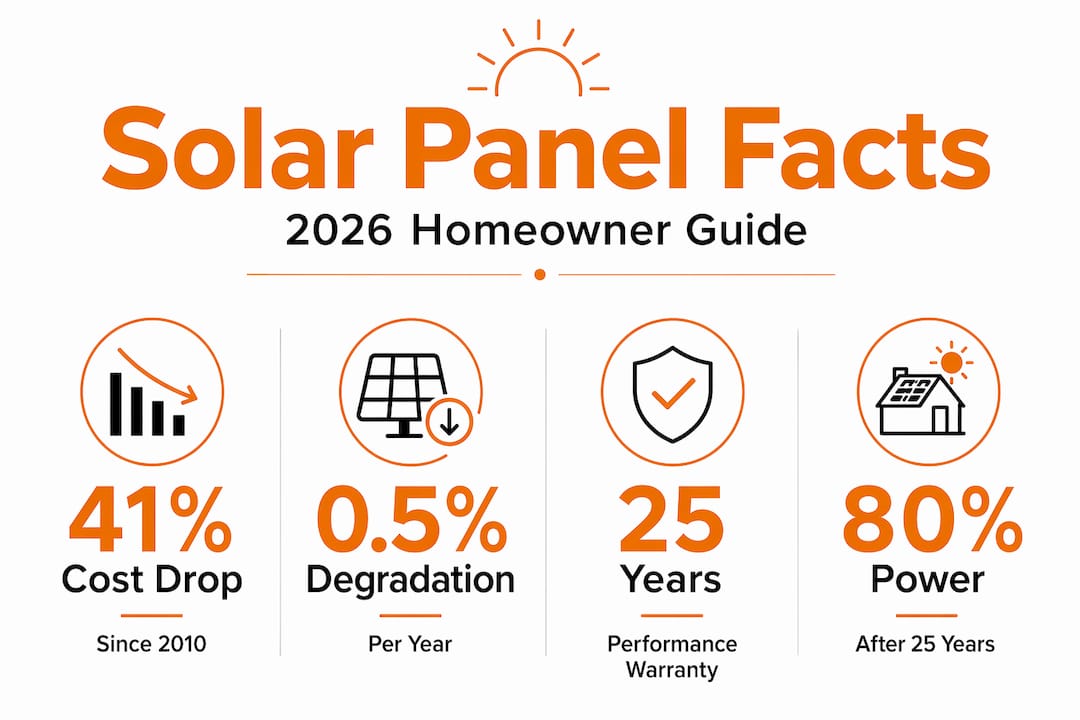
| Panel type | Annual degradation | Output after 25 years |
|---|---|---|
| Standard panels | ~0.5% per year | ~87-88% |
| Premium N-type TOPCon | 0.3-0.4% per year | Over 90% |
Most manufacturers back this up with 25-year performance warranties, guaranteeing that panels will produce at least 80% of their rated output through the warranty period. That’s a manufacturer putting real money behind the promise. Older stories about panels failing in 10 years come from early-generation technology that no longer represents what’s installed today.
There’s another piece to this worth noting. Solar panels require very little maintenance. No moving parts means almost nothing to break or replace. Occasional cleaning and visual inspections are usually all it takes to keep a system running at full capacity for decades.
Pro Tip: When choosing panels, ask specifically about the degradation rate in the manufacturer’s warranty documentation, not just the years covered. A 25-year warranty with a 0.3% annual degradation guarantee is worth more than one with a 0.7% rate.
Myth 4: You’ll have no power at night or during storms
This myth makes sense on the surface. Panels need light. What happens when there’s no light? The answer depends on how your system is set up, and for most homeowners, the answer is simple.
Grid-tied systems draw from the utility grid automatically when your solar panels aren’t producing enough power. You don’t flip a switch or call anyone. The transition happens instantly and invisibly. At night, your home runs on grid power just like it always did. During a storm, same thing.
Grid-tied solar stabilizes household power use, making fears about losing electricity at night completely unwarranted for most residential installations. When your panels produce more than you need during the day, that excess energy flows back to the grid. Your utility credits you for it through a program called net metering. You’re essentially banking energy during the day and drawing from that credit at night.
Battery storage is a separate option that changes the equation further. With a home battery system:
- You store excess solar energy produced during the day
- Your home runs on stored battery power after dark
- During a grid outage, your battery keeps critical loads running
- Battery storage costs have fallen 93% since 2010, making this option increasingly practical
Battery storage isn’t required for solar to work well. But if energy independence or backup power during outages matters to you, it’s a technology that has become genuinely affordable and worth serious consideration. You can learn more about battery storage longevity to see whether it fits your situation.
Myth 5: You need a perfect roof and a large upfront investment
Two separate myths wrapped into one, and both deserve a clear answer.
On roof orientation: south-facing is optimal in the Northern Hemisphere, but it’s far from the only option that works. East and west-facing panels produce 80-85% of south-facing output, which is still a very strong return on your investment. Many homes have split roof sections facing different directions, which actually helps spread production more evenly across the day. Ground-mount systems and panels with adjustable tilt angles solve orientation challenges entirely for homes with limited roof space or poor angles.
On upfront cost: solar panel costs have dropped over 90% since 2010, and the entry points today are dramatically more accessible than most people expect. Beyond full system installs, options include:
- Plug-in solar systems that start at a few hundred dollars and can pay back in just a few years
- Solar financing through loans, leases, or power purchase agreements that allow $0 down installation
- Phased installations where you start with a smaller system and expand it over time
Microinverter technology and plug-in solar panels have made smaller, non-full-home installations practical for the first time. You don’t have to go all in on day one. For homeowners who want to test the waters, a smaller plug-in setup can demonstrate real savings before you commit to a full residential system.
Pro Tip: If your roof faces east or west, request a production comparison from your installer. The difference from a south-facing roof is usually small enough that the financial case still works, especially in high-sun regions like San Antonio.
My honest take on solar hesitation
In my experience working with homeowners, most people who delay going solar aren’t doing it because they’ve done the math and it doesn’t add up. They’re delaying because they heard something negative years ago and never updated that information.
I’ve seen this pattern repeatedly. A homeowner heard that panels fail in ten years, or that cloudy weather makes solar useless, or that it only works for people with perfect south-facing roofs. None of those things are true by today’s standards, and all of them keep real people from making a decision that would genuinely improve their financial situation.
What I’ve found is that when homeowners actually look at current data, the hesitation dissolves quickly. The technology is better, the costs are lower, and the payback timelines are shorter than most people expect. The solar energy truths available today tell a very different story from the rumors that have been circulating for years.
My honest advice: don’t let a myth you heard five years ago cost you ten years of energy savings. Get a quote based on your actual home, your actual roof, and your actual energy usage. The numbers will do the convincing.
— Anthony
Ready to see what solar can do for your home?
If reading through these myths has shifted your thinking, the next step is getting a clear picture of what solar looks like for your specific home. At Alphasolarsa, we design custom solar systems built around your energy needs, your roof, and your budget. No guesswork.
Our team handles residential solar installation in San Antonio from the first consultation through final inspection. We also offer battery storage solutions for homeowners who want backup power and full energy independence. And once your system is installed, our solar panel cleaning services keep it producing at peak efficiency year after year. Whether you’re ready to install now or just want honest answers, we’re here to help. Reach out to Alphasolarsa and find out what owning your energy actually looks like.
FAQ
Do solar panels work when it’s cloudy?
Yes. Solar panels produce 10-25% of their rated power on cloudy days using diffuse light, and annual production averages smooth out any weather-related dips.
How long do solar panels actually last?
Most solar panels carry 25-year performance warranties and degrade at roughly 0.5% per year, meaning they still produce around 87-90% of their original output after 25 years.
Will I have electricity at night with solar panels?
Yes. Grid-tied solar systems automatically draw from the utility grid at night. Adding battery storage lets you run on stored solar power after dark without relying on the grid at all.
Does my roof need to face south for solar to work?
Not necessarily. East and west-facing roofs produce 80-85% of south-facing output, which is typically enough for solar to make strong financial sense, especially in sunny regions like San Antonio.
Is solar still worth it financially in 2026?
Absolutely. With solar costs down over 40% since 2010 and utility rates continuing to rise, most homeowners see a payback period of 7 to 10 years, followed by years of near-free electricity from their own system.