

TL;DR:
- Choosing an experienced local installer who manages every project phase in-house is crucial to avoid hidden fees and delays.
- Preparing your energy data, roof details, and goals ensures accurate quotes and successful system design.
You’re ready to stop watching your CPS Energy bill climb every summer, and solar feels like the right move. But here’s the uncomfortable truth: picking the wrong installer can cost you more than sticking with the utility company. Poor system design, surprise fees, and installers who disappear after the panels go up are real problems San Antonio homeowners face every year. This guide walks you through every step, from getting organized before your first call to asking the questions that separate trustworthy installers from ones you’ll regret hiring.
Table of Contents
- What to prepare before contacting solar installers
- How to compare solar installer quotes: what matters most
- Vetting your solar installer: critical questions to ask
- Common pitfalls and smart shortcuts for San Antonio homeowners
- Our take: what most solar shoppers miss when choosing an installer
- Ready to choose with confidence? Connect with trusted solar experts
- Frequently asked questions
Key Takeaways
| Point | Details |
|---|---|
| Standardize quote comparisons | Always compare at least three standardized quotes so you understand design, equipment, and terms. |
| Confirm installer credentials | Demand proof of licensing, insurance, and ask for references from recent jobs in your area. |
| Beware of lead generators | Verify who is responsible for installation and support, not just who sells you the system. |
| Get everything in writing | Avoid vague promises—secure warranties, costs, and timelines in documented proposals. |
What to prepare before contacting solar installers
Now that you know why a careful choice matters, get organized so you’re ready to engage installers efficiently. Walking into your first conversation prepared puts you in control and saves everyone time.
Start with your energy usage. Pull your last 12 months of utility bills and look for your monthly kilowatt-hour (kWh) usage. A kilowatt-hour is simply the unit your utility uses to measure how much electricity your home consumes. Knowing your annual total helps installers design a system that actually fits your home, not just a generic package. If you’re curious about the math behind it, sizing your solar system is a great place to start before you reach out to anyone.
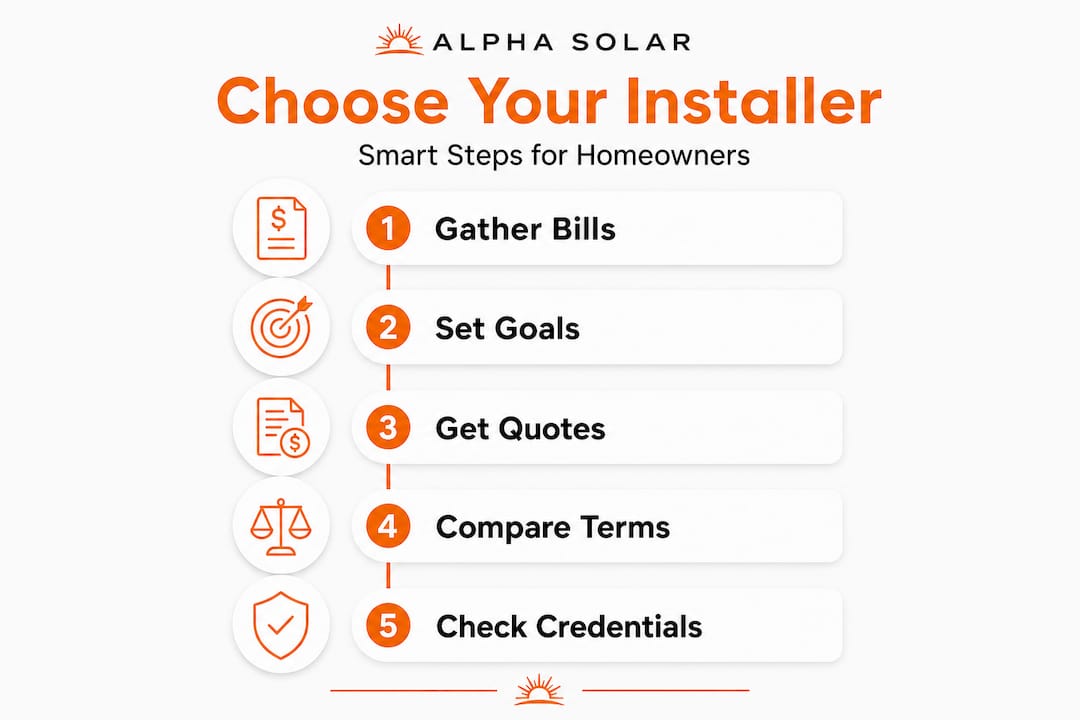
Assess your roof honestly. How old is your roof? Does it get full sun most of the day, or do large trees shade it in the afternoon? A reputable installer will want to know this. If your roof is more than 10 years old, you may want a roofer’s inspection before solar panels go up, because removing and reinstalling panels later adds cost.
Define your goals clearly. Every homeowner has slightly different priorities. Write yours down before you start calling around:
- Lower monthly electricity bills
- Backup power during outages (battery storage)
- Preparing for an EV charger installation
- Long-term home value increase
- Reducing your carbon footprint
Knowing your goals helps you filter out installers who only offer one-size-fits-all systems.
Gather your documents. Here’s a quick reference for what to have ready:
| Document | Why you need it |
|---|---|
| 12 months of utility bills | Establishes baseline energy usage |
| Roof age and material info | Helps assess compatibility and prep work |
| HOA rules (if applicable) | Some HOAs have solar panel guidelines |
| Property survey or plot plan | Useful for roof layout and shading analysis |
| Current mortgage or loan info | Relevant if you plan to finance the system |
Pro Tip: Compare multiple quotes and standardize what you’re comparing, including system design, equipment, warranties, and financing terms, before you sign anything. Having your documents ready makes this comparison much faster and more accurate.
Being this organized before your first installer call signals that you’re a serious buyer. Installers respond to that with more detailed, accurate proposals.
How to compare solar installer quotes: what matters most
With your prep work complete, you’re ready to collect and compare quotes using a clear system. Most homeowners make the mistake of comparing only the total price. That’s like comparing two cars by sticker price alone without looking at what’s under the hood.
Standardize every proposal. Ask each installer to include the same categories in their quote so you can compare apples to apples:
- Panel brand and model: Not all solar panels perform equally. Tier-1 manufacturers like Qcells, REC, and Jinko Solar have established track records. Ask about efficiency ratings and degradation rates (how much output the panel loses per year).
- Inverter type: String inverters are common and cost-effective. Microinverters or power optimizers cost more but improve performance when shading is an issue.
- Warranty coverage: Look for at least a 25-year panel performance warranty and a 10-year workmanship warranty from the installer.
- Estimated annual production: This number, measured in kWh, tells you how much electricity the system should generate each year. Compare it against your current usage.
- Installation timeline: How long from signed contract to system activation?
Here’s a simple comparison framework you can use:
| Category | Installer A | Installer B | Installer C |
|---|---|---|---|
| System size (kW) | 8 kW | 8 kW | 7.5 kW |
| Panel brand/warranty | Qcells / 25 yr | Unknown brand / 10 yr | REC / 25 yr |
| Inverter type | String | Microinverter | String |
| Workmanship warranty | 10 years | 2 years | 5 years |
| Financing APR | 5.99% | 9.99% | 6.49% |
| Who handles service calls | In-house | Third party | In-house |
Watch the financing terms carefully. A lower monthly payment can hide a much higher interest rate or a longer loan term that costs you thousands more over time. Identifying hidden fees early in the process protects your budget. Also ask whether the quoted price includes all electrical work, permitting, and utility interconnection fees. These are common places where costs get added after you’ve already signed.

Confirm who handles post-install support. This is critical. Some companies sell you a system and then hand off service calls to a third-party warranty company you’ve never heard of. Understanding solar pricing strategies helps you recognize when a low quote is hiding a weak support structure.
Pro Tip: Ask each installer directly, “If my system underperforms in year three, who do I call, and what happens next?” Their answer tells you a lot about how they operate after the sale.
Vetting your solar installer: critical questions to ask
Once you’ve narrowed your top candidates, it’s time to dig into who’s really behind the quote and what long-term support you’ll receive. This step separates the professionals from the sales operations.
One important thing to understand: some installers are brokers or lead generators, not actual installation companies. They collect your information, sell it to a subcontractor, and take a cut. That subcontractor may have little accountability to you. Always confirm who is actually responsible for design, permitting, installation labor, and post-install service before you sign anything.
Here are the questions to ask every installer you’re seriously considering:
- Are you licensed and insured in Texas? Ask for their Texas electrical contractor license number and proof of general liability insurance. A legitimate company will provide this without hesitation.
- Who designs the system and pulls the permits? Some companies outsource permitting to third parties, which can slow down your project and create accountability gaps.
- Who physically installs the panels? In-house crews typically produce more consistent quality than rotating subcontractors.
- Can you provide three references from San Antonio installs completed in the last 12 months? Recent local references are more relevant than a list of five-star reviews from three years ago.
- Do you have experience working with CPS Energy’s interconnection process? Local utility knowledge matters. Delays in interconnection approval can push back your system activation by weeks.
- What is your cancellation policy before and after installation begins? Know your rights before you’re locked in.
- How are warranty claims handled, and what is the escalation process? You want a clear path, not a phone tree that leads nowhere.
“Treat your installer search the way you’d vet a contractor for a major home renovation. Ask for credentials, check references, and get everything in writing. The solar industry has both excellent professionals and aggressive sales operations, and the difference isn’t always obvious from a website.”
When you ask about uncovering hidden fees in the contract, pay attention to how the installer responds. Confident, transparent companies welcome the question. Evasive answers are a warning sign.
Common pitfalls and smart shortcuts for San Antonio homeowners
Even with solid candidates, the home stretch has traps and time-saving tricks. Here’s how to handle the final mile with confidence.
Pitfalls to avoid:
- Signing under pressure. Any installer who tells you the price is only good “today” is using a sales tactic, not giving you a real deadline. Take the time you need.
- Skipping the permit verification. In San Antonio, solar installations require permits through the city and interconnection approval through CPS Energy. Confirm your installer handles both, and ask for proof when permits are pulled.
- Ignoring the utility rebate process. CPS Energy offers rebates for qualifying solar installations. If your installer isn’t familiar with the current rebate structure, you could leave money on the table.
- Choosing based on price alone. The cheapest quote often reflects cheaper panels, shorter warranties, or a company that won’t be around in five years when you need service.
- Not getting everything in writing. Verbal promises about system performance, rebate handling, or installation timelines mean nothing if they’re not in the contract.
Smart shortcuts for San Antonio homeowners:
- Use your 12 months of utility bills to get accurate quotes. Installers who don’t ask for this are guessing at your system size.
- Schedule your installation consultation during spring or fall when installer schedules are less packed than peak summer months.
- Ask your installer to walk you through the local solar sizing tips specific to your neighborhood’s sun exposure and roof orientation.
- Request a copy of the final permit and inspection report for your own records. This matters when you sell your home.
Pro Tip: Before signing, compare quotes for transparency and make sure every question you have is answered in writing. If an installer can’t or won’t answer a reasonable question, that’s your signal to move on.
The San Antonio solar market is active and competitive. That’s good news for you as a buyer, because it means you have real options. Use that leverage.
Our take: what most solar shoppers miss when choosing an installer
Here’s a candid perspective based on years in the San Antonio solar market: most homeowners focus almost entirely on price and panel brand when they’re comparing installers. Those things matter, but they’re not what determines whether your solar experience is a success or a headache.
The real differentiator is follow-through. An installer who designs a great system but has a disorganized permitting team, or who hands off your service calls to a third party after installation, will cost you more in time and frustration than a slightly higher upfront price from a company that manages everything in-house.
We’ve seen it happen repeatedly. A homeowner gets a great deal from a company that turns out to be a broker. The actual installation crew is a subcontractor who’s never worked with CPS Energy’s interconnection process before. Permits get delayed. The system activation is pushed back two months. The homeowner calls the original company and gets a runaround because the sales team and the service team are completely separate.
The fee transparency pitfalls in solar contracts are real, but the accountability gaps between sales, permitting, and labor teams are just as costly and far less visible. Ask specifically who owns each phase of your project and what happens if something goes wrong in each phase.
Homeowners who press for local service references consistently report fewer warranty headaches. A company with a strong local reputation has something to protect. They’re not going to disappear after your install because their next customer might be your neighbor.
Our honest advice: treat vetting your installer the way you’d treat hiring a long-term home partner. You’re not just buying hardware. You’re entering a relationship that could last 25 years or more. The right installer earns your trust before you sign, not after.
Ready to choose with confidence? Connect with trusted solar experts
If you’re ready to make your solar project worry-free, here’s the best way to put this guide into action.
Alpha Solar Solutions is a full-service solar and battery installation company built specifically for San Antonio homeowners. We handle everything in-house, from custom system design and permitting to installation and long-term aftercare. No brokers, no subcontractor surprises. Our certified team works directly with CPS Energy’s interconnection process and stays current on available rebates so you capture every dollar of savings. If you’re weighing whether to add backup power, our battery storage analysis can help you decide. When you’re ready to take the next step, explore our residential solar installation page and schedule your no-obligation site visit and quote.
Frequently asked questions
How do I know if a solar installer is reputable in San Antonio?
Check for a valid Texas electrical contractor license, proof of insurance, and recent local references. Confirm that the company handles installation and aftercare directly, not through a third-party broker, to ensure clear accountability from start to finish.
How many solar quotes should I collect before deciding?
Collect at least three quotes so you have a real basis for comparison. Standardizing your quotes by equipment, warranty, and financing terms makes the comparison meaningful rather than just a price race.
What are common hidden fees to watch out for in solar proposals?
Watch for costs that aren’t itemized up front, including electrical panel upgrades, city permit fees, utility interconnection charges, and extended warranty add-ons. Always ask for a fully itemized quote before signing.
Are there specific benefits to choosing a local San Antonio solar company?
Yes. Local installers know CPS Energy’s interconnection requirements, are familiar with current Texas rebate programs, and can provide faster, more reliable service for maintenance and warranty support. A local company also has a community reputation to uphold, which tends to translate into better accountability.