

TL;DR:
- Texas homeowners should consider long-term modeling and utility-specific factors to accurately evaluate solar payback. Incentives like the federal tax credit and property tax exemptions can significantly reduce costs, while utility rates and tariffs influence the timeline and savings. Evaluating system performance, degradation, and resilience needs ensures a comprehensive understanding beyond simple payback calculations.
Most Texas homeowners assume solar payback is simple math: divide your system cost by your monthly savings, and you get the number of years until you break even. That’s a reasonable starting point, but it leaves out the factors that actually determine whether your solar investment performs well over time. Long-term solar economics are better understood through detailed modeling that accounts for system performance, degradation, incentives, and your specific utility rates. This guide walks you through what payback really means, how Texas conditions shape it, and what to consider before making your decision.
Table of Contents
- What solar payback really means
- How Texas tariffs and incentives shape your solar payback
- The battery question: Backup, storage, and changing payback
- Beyond the numbers: What most payback calculators miss
- Our take: The uncomfortable truths and overlooked wins with Texas solar payback
- Ready to unlock your Texas solar payback advantage?
- Frequently asked questions
Key Takeaways
| Point | Details |
|---|---|
| Payback is more than break-even | True value analysis goes beyond simple payback years and considers lifetime cost and all savings. |
| Incentives change outcomes | Texas incentives like the property tax exemption can greatly reduce your solar payback time. |
| Batteries add more than savings | Adding battery storage may lengthen payback but offers critical backup and energy independence. |
| Tariffs shape your results | Local utility rate structures and rules significantly impact how quickly your solar system pays for itself. |
| Model, don’t guess | Personalized modeling is essential for realistic expectations and maximizing investment benefit in Texas. |
What solar payback really means
The term “payback period” refers to how many years it takes for your solar energy savings to equal what you paid for the system upfront. Simple enough. But here’s the problem: that single number doesn’t tell you much about the financial value you’re actually getting.
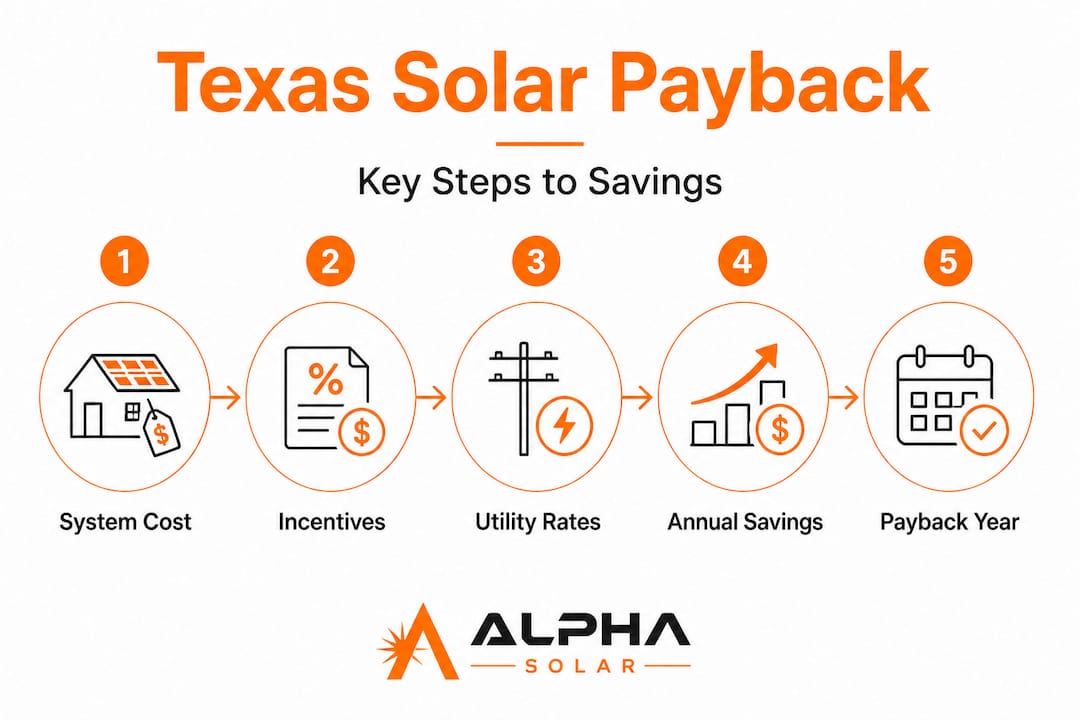
Think about it this way. Two Texas homeowners each have a 10-year payback period. One has a system that lasts 30 years and keeps performing well. The other has a system that degrades faster and faces rising maintenance costs. Same payback number, very different outcomes.
That’s why energy analysts use two more precise measures:
- Levelized Cost of Energy (LCOE): The average cost of each kilowatt-hour (kWh) your solar system produces over its entire lifetime, including upfront costs, financing, and maintenance. If your LCOE is lower than what your utility charges, you’re winning financially.
- Levelized Cost of Solar-plus-Storage (LCOSS): The same concept applied to a solar system paired with a battery. This accounts for the added cost of storage against the added value it provides.
As NREL explains, a more rigorous approach to solar economics involves modeling long-term costs with explicit assumptions about performance, degradation, discount rate, and system lifetime. That’s a more honest picture than a simple breakeven calculation.
The real question isn’t just “when do I break even?” It’s “how much value does this system create over 25 or 30 years, and does that value justify the investment today?”
Several factors shift your real payback in meaningful ways:
- Upfront system cost: Larger systems cost more but often produce better long-term value. Understanding solar panel cost in your area is a critical first step.
- System performance and yield: Texas sunshine is abundant, which works in your favor. But shading, roof angle, and panel quality all affect how much energy your system actually generates.
- Degradation rate: Most panels lose about 0.5% of output per year. Over 25 years, that adds up. Quality panels from reputable brands degrade more slowly.
- Discount rate: If you finance your system, the cost of that money affects your real return. Cash purchases typically yield better long-term value.
- Incentives: The federal solar tax credit currently covers 30% of your system cost. That single factor can cut years off your payback period.
Understanding solar calculations explained in detail helps you ask better questions when you’re getting quotes. Don’t just ask “what’s my payback?” Ask for a full 25-year projection.
How Texas tariffs and incentives shape your solar payback
Understanding basic payback calculation isn’t enough. Here’s how Texas-specific factors come into play and why they matter more than most homeowners realize.
Your utility’s rate structure has a huge effect on how fast solar pays off. Texas has several major utilities and co-ops, each with different billing structures:
| Rate type | How it affects solar payback |
|---|---|
| Flat rate | Predictable savings; easier to model payback |
| Time-of-use (TOU) | Solar earns more value when produced during peak hours |
| Demand charges | Battery storage can help reduce peak demand fees |
| Net metering policies | Varies by utility; affects how excess solar is credited |
Texas’s solar economics are strongly shaped by utility tariffs and compensation rules, meaning two homeowners in different Texas cities can have very different payback timelines even with identical systems.
Here’s a real-world example. A San Antonio homeowner on a flat CPS Energy rate might see steady, predictable savings. A homeowner in a deregulated Texas market with a TOU plan could see faster payback if their solar production aligns with high-rate hours, typically midday and early afternoon.
Key Texas incentives that directly reduce your payback time include:
- Federal Investment Tax Credit (ITC): A 30% credit on your total system cost, applied directly to your federal tax bill. On a $20,000 system, that’s $6,000 back.
- Texas property tax exemption: This is a big one. Texas law allows homeowners to exclude the added appraised value from a solar installation when calculating property taxes. That means your home can be worth more without your property tax bill going up.
- Local utility rebates: Some Texas utilities offer additional cash rebates for solar installations. These vary by provider and availability.
Pro Tip: The Texas property tax exemption is not automatic. You must file Form 50-123 with your county appraisal district by April 30 to qualify. Many homeowners miss this step and end up paying higher property taxes unnecessarily. Learn more about Texas solar incentives that can meaningfully reduce your costs.
Why does payback vary so much across Texas? A homeowner in El Paso, which has some of the highest solar irradiance in the country, will produce more energy per panel than someone in Houston, where cloud cover is more frequent. Add in different utility rates, different local rebates, and different financing options, and you can see why a one-size-fits-all payback estimate is rarely accurate.
The best thing you can do is get a personalized solar savings estimate that factors in your actual utility bills, your location, and your roof characteristics. That’s the foundation of a real payback analysis. Explore what solar savings for Texans looks like in practice before committing to any system size or configuration.
The battery question: Backup, storage, and changing payback
Let’s see how adding batteries affects your solar investment in Texas. This is where the conversation gets more nuanced, and more interesting.
Adding a home battery system like the Tesla Powerwall or Enphase IQ Battery changes your solar economics in two important ways. First, it increases your upfront cost, which extends the payback period. Second, it adds value that a simple payback calculation often misses entirely.
Here’s a side-by-side comparison:
| Factor | Solar only | Solar + battery |
|---|---|---|
| Upfront cost | Lower | Higher (typically $8,000 to $15,000 more) |
| Payback period | Shorter | Longer |
| Grid outage protection | None | Yes |
| Self-consumption rate | Moderate | Higher |
| TOU rate optimization | Limited | Strong |
| Long-term energy independence | Partial | Greater |
Battery storage economics are driven by self-consumption optimization, including time-of-use shifting and peak demand shaving, as well as resilience value. That resilience piece is critical in Texas.

After Winter Storm Uri in 2021, thousands of Texas homeowners lost power for days. Homeowners with solar-plus-battery systems kept their lights on, their heat running, and their pipes from freezing. That’s a value that doesn’t show up in a standard payback spreadsheet, but it’s very real.
NREL research indicates that average residential battery payback can run about 11 years in modeled scenarios, and backup power value is identified as a key driver of whether battery storage makes financial sense for individual homeowners.
Here’s how to think through the battery decision:
- Check your utility’s rate structure. If you’re on a TOU plan with high evening rates, a battery lets you store cheap midday solar and use it when rates are highest. That improves your financial return.
- Assess your outage risk. If you work from home, have medical equipment, or simply can’t afford to lose power, the value of backup goes beyond dollars saved.
- Consider your self-consumption goals. If your utility pays low rates for excess solar sent to the grid, keeping that energy in a battery and using it yourself is often more valuable.
- Factor in solar battery lifespan. Most lithium batteries are rated for 10 years or more. Understanding how long your battery will perform at full capacity affects your long-term financial picture.
Pro Tip: Don’t evaluate batteries purely on energy savings. In Texas, the peace-of-mind value during grid events is a legitimate financial benefit, especially if an outage would cost you in spoiled food, hotel stays, or lost work.
Beyond the numbers: What most payback calculators miss
Numbers only go so far. Here’s what can make or break the real-world returns on your solar investment, and why a standard online calculator often gives you an incomplete picture.
System degradation over time. Most online calculators assume flat performance for 25 years. In reality, panels lose a small percentage of output each year. A quality system with a 0.5% annual degradation rate will produce about 12% less power in year 25 than in year one. That affects your cumulative savings. Cheaper panels can degrade at 1% or more per year, which compounds significantly over time.
Changing tariff structures. Your utility’s rate plan today may look very different in five years. Texas has seen significant changes in how utilities structure rates, especially as more solar enters the grid. If your utility shifts to a TOU structure or reduces net metering credits, your payback assumptions need to be updated. Revisiting your model every few years is smart financial management.
Home value impact. Solar panels increase your home’s market value. Studies show that homes with solar sell faster and at a premium. That added value, combined with the solar impact on home value from improved energy ratings, is rarely captured in a standard payback calculation but represents real financial gain if you sell your home.
Property tax exposure. As mentioned earlier, Texas property tax rules can materially affect payback if you don’t file the exemption properly. Failing to file Form 50-123 means your property taxes could increase based on the solar-added value of your home. That’s an ongoing cost that erodes your savings year after year.
Key factors that standard calculators often ignore:
- Inflation protection: Locking in your energy cost today shields you from future utility rate increases, which have historically trended upward in Texas.
- Financing costs: If you take a solar loan, the interest paid over time reduces your net savings. Cash purchases or low-interest financing make a meaningful difference.
- Maintenance and monitoring: Quality systems require minimal maintenance, but cleaning, inverter replacements, and monitoring add small costs over time.
- Resilience value: As noted above, the financial value of avoiding a multi-day outage is real and quantifiable for many Texas households.
Pro Tip: Ask your solar installer for a detailed 25-year cash flow projection, not just a payback number. A good projection will show year-by-year savings, account for degradation, and reflect your specific incentives. That’s the document you want to evaluate. Explore long-term solar savings strategies that go well beyond the basic breakeven calculation.
Our take: The uncomfortable truths and overlooked wins with Texas solar payback
Here’s our hard-won wisdom after years in the Texas solar industry. We’ve seen homeowners make great decisions and we’ve seen them make costly mistakes, and the difference usually comes down to how they frame the question.
The most common mistake is treating payback as the primary metric. Payback tells you when you stop paying for the system. It says nothing about how much wealth you build after that point. A system with a 9-year payback on a 30-year roof still generates 21 years of essentially free electricity. That’s tens of thousands of dollars in value that a payback-focused mindset completely ignores.
The second uncomfortable truth: most payback calculators dramatically undervalue backup power. In Texas, grid reliability is a genuine concern. The financial exposure from a major outage, lost food, hotel costs, remote work disruption, or medical equipment failure, can easily run into thousands of dollars. NREL’s REopt modeling makes clear that for Texas battery decisions, the real question is whether your specific tariff, your ability to self-consume, and your resilience needs make battery cycling economically justified. For many San Antonio homeowners, the answer is yes, but not purely on energy savings alone.
Third, policy and tariff changes are real risks that smart homeowners plan for. Texas has seen utility rate restructuring, changes to net metering policies, and ongoing legislative discussions about solar compensation. The homeowners who fare best are those who design their systems for strong self-consumption from day one, reducing dependence on favorable export rates that may not last.
What wise Texas homeowners focus on that others miss: they look at solar panels as a long-term asset, not a short-term expense to be recovered. They model multiple scenarios. They file their property tax exemption. They choose quality equipment with strong degradation warranties. And they revisit their assumptions every few years as conditions change.
Payback is a useful starting point. But return on investment over 25 years, combined with energy security and protection from rising rates, is the real story.
Ready to unlock your Texas solar payback advantage?
If this guide has shown you anything, it’s that solar payback in Texas is about far more than a single number. It’s about designing a system that works with your utility rates, maximizes your incentives, and gives you the energy security your household needs.

At Alpha Solar Solutions, we help Texas homeowners build that complete picture. From custom-designed residential solar installation to fully integrated backup power solutions, our team models your actual savings based on your real utility bills, your roof, and your goals. We handle the paperwork, including your property tax exemption filing, so you don’t miss a single dollar of savings. If you’re ready to move from confusion to clarity on your solar investment, we’re here to walk you through every step.
Frequently asked questions
How long is the average solar payback period for Texas homes?
In Texas, payback periods vary based on system size, incentives, and utility rates, but NREL modeling indicates average residential payback for solar-plus-storage runs about 11 years in projected scenarios. Solar-only systems typically pay back faster.
Does installing batteries always improve payback?
Not always. Batteries extend the upfront payback period but can be financially justified when you’re on TOU rates or need backup power, since NREL’s REopt model shows batteries earn value through time-of-use shifting, demand shaving, and resilience.
What incentives help Texas homeowners reduce solar payback time?
The federal 30% Investment Tax Credit, the Texas property tax exemption, and local utility rebates can all significantly reduce your effective system cost and shorten your payback timeline.
How do changing energy tariffs affect solar payback?
Texas solar economics are strongly affected by utility tariff structures, so a shift from flat rates to time-of-use billing can either speed up or slow down your payback depending on when your system produces energy relative to peak pricing hours.
Is the property tax exemption for Texas solar automatic?
No. You must file Form 50-123 with your county appraisal district by April 30 each year to qualify, and missing this deadline means your solar-added home value will be included in your taxable assessment.
Recommended
- Solar energy guide: Texas homeowner savings in 2026
- Texas solar savings: your complete guide for long-term success
- Home Solar Power Guide: San Antonio Homeowners’ Roadmap
- Solar energy savings workflow for Texas homes: 5 steps
- SAP Calculation Demystified: London Homeowner’s Guide to Energy Ratings – Complete EPC