
TL;DR:
- High temperatures and deep discharges accelerate solar battery degradation in San Antonio.
- Installing batteries indoors and managing depth of discharge can significantly extend lifespan.
- Lithium iron phosphate batteries offer the best long-term performance and heat resistance for Texas homeowners.
Most San Antonio homeowners assume their solar battery will quietly do its job for a full decade. That assumption can be costly. Summer temperatures here regularly push past 100°F, and that heat quietly chips away at battery capacity year after year. The good news is that with the right setup and a few smart habits, you can significantly extend your battery’s useful life and protect your solar investment. This guide breaks down how battery lifespan is actually measured, what causes batteries to wear out faster in our climate, and exactly what you can do to keep yours running strong for years to come.
Table of Contents
- How solar battery lifespan really works
- The silent killers: What degrades your solar battery fastest
- Lithium-ion vs. lead-acid: Which battery lasts longer in Texas?
- Practical steps to extend your solar battery’s lifespan
- What most homeowners miss about solar battery lifespan in Texas
- Get expert help maximizing your solar battery investment
- Frequently asked questions
Key Takeaways
| Point | Details |
|---|---|
| Heat halves battery life | San Antonio’s high temperatures can dramatically shorten solar battery lifespan unless properly managed. |
| LFP lithium-ion is best | Lithium-iron-phosphate batteries offer 10-20 year service with lower maintenance than lead-acid for Texas homes. |
| Shallow use extends life | Avoiding deep discharges and indoor installation significantly slow battery aging. |
| Actions protect investment | Regular monitoring, proper setup, and local expert support can add years to your solar battery’s value. |
How solar battery lifespan really works
When people talk about solar battery lifespan, they usually mean one of two things: how many years a battery will last or how many charge and discharge cycles it can handle before it loses too much capacity. Both measures matter, but cycles often tell a more honest story than calendar years.
A cycle is one full charge and discharge. Most lithium-ion solar batteries are rated for 3,000 to 10,000 cycles depending on chemistry and usage. But here’s where it gets interesting: batteries don’t just stop working one day. They gradually hold less energy over time. This is called capacity fade.
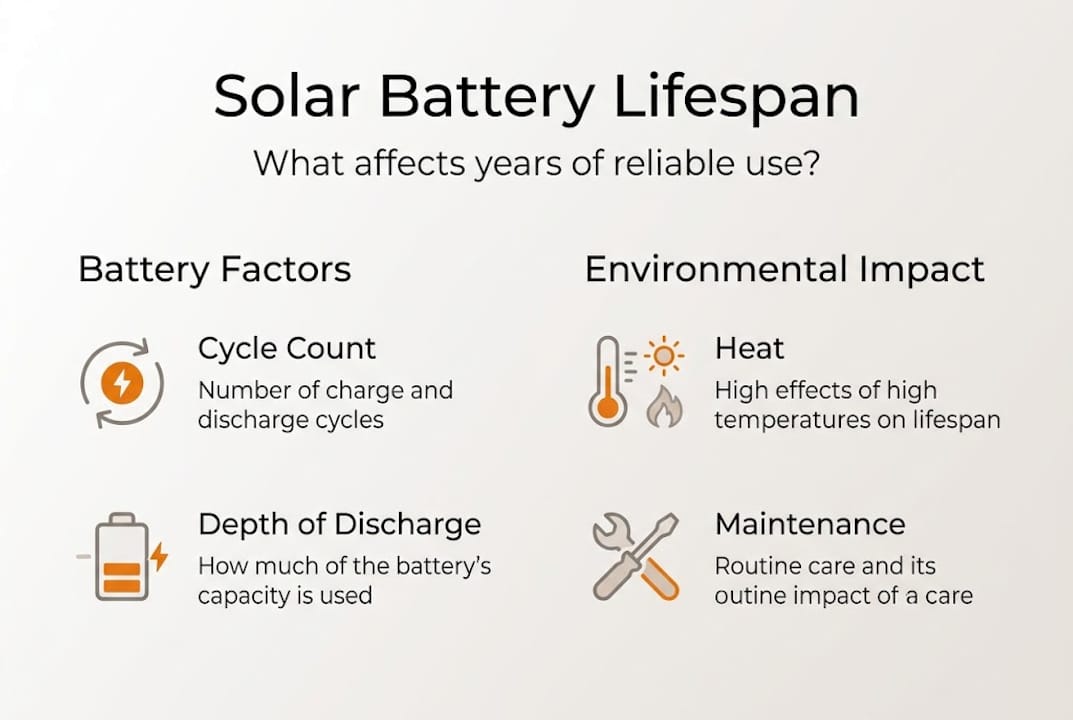
Manufacturers typically define “end of life” as the point when a battery holds 80% or less of its original capacity. So a 10 kWh battery at end of life stores about 8 kWh. It still works, just with reduced output. Understanding this helps you set realistic expectations rather than thinking your battery will perform at 100% forever.
For a deeper look at your options, the solar battery storage guide from Alpha Solar Solutions walks through how different storage setups affect your long-term value.
Main battery types and their expected lifespans:
| Battery Type | Expected Lifespan | Maintenance Level | Heat Resistance |
|---|---|---|---|
| Lithium iron phosphate (LFP) | 10 to 20 years | Very low | Good |
| Standard lithium-ion (NMC) | 8 to 12 years | Low | Moderate |
| Lead-acid | 3 to 7 years | High | Poor |
| Flow batteries | 20+ years | Moderate | Good |
LFP batteries dominate the residential solar market for good reason. Lithium battery experts confirm that LFP offers the best combination of longevity and safety for home use. And according to recent research, LFP cells show 1 to 4% annual capacity fade, with field studies indicating roughly 15% loss after 7 years or 7,500 cycles under real-world conditions. That’s a manageable decline if you plan for it.
Lead-acid batteries, on the other hand, are cheaper upfront but cost more in the long run. They need regular maintenance, degrade faster in heat, and don’t handle deep discharges well. For San Antonio homeowners thinking long-term, LFP is the clear starting point.
The silent killers: What degrades your solar battery fastest
Knowing that batteries fade over time is one thing. Understanding what speeds that process up is what gives you control over your battery’s future.
Two factors cause the most damage: Depth of Discharge (DoD) and heat. And San Antonio has both working against you.
Depth of Discharge refers to how much of your battery’s total capacity you use in a single cycle. Using 90% of the battery every day is hard on it. Keeping usage between 20% and 80% (a shallow DoD) dramatically slows wear. Think of it like a phone battery: always running it to 0% and charging to 100% wears it out faster than keeping it between 20% and 80%.
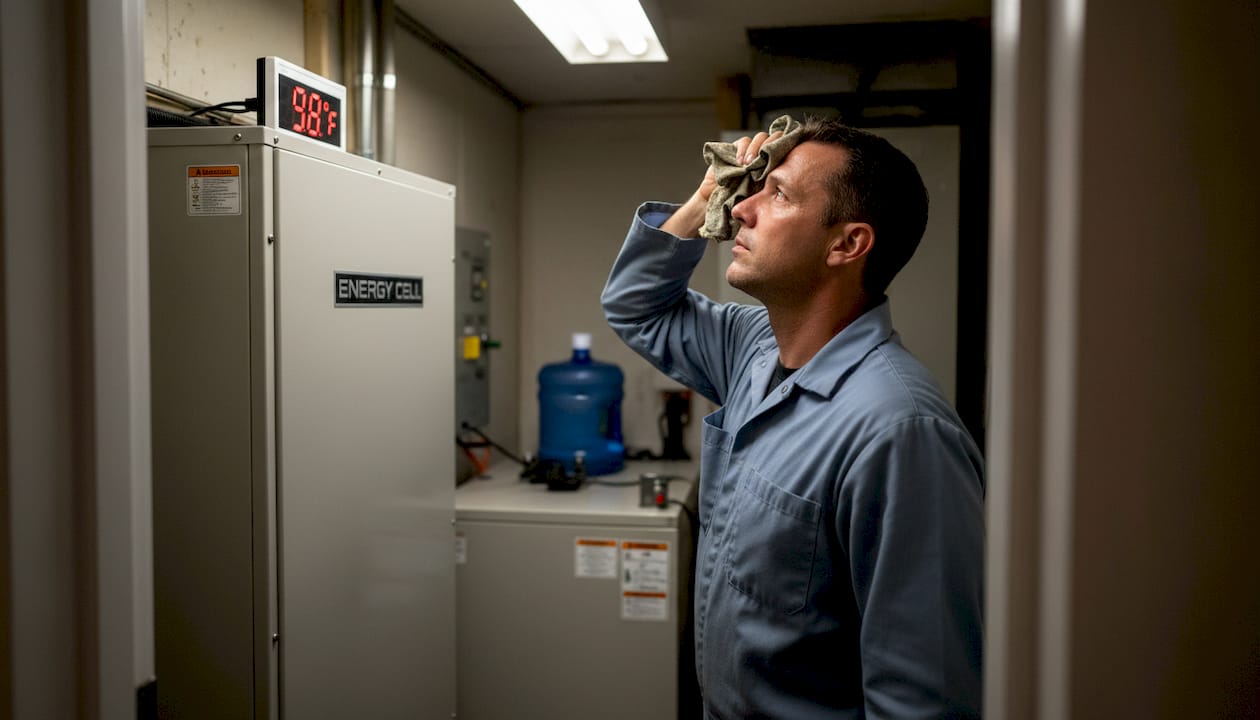
Heat is the other major factor. San Antonio summers can push temperatures to 35 to 50°C (95 to 122°F) outdoors, and batteries installed in garages or outdoor enclosures experience the full force of that heat. The data is stark: high DoD and high temperature double the rate of battery degradation compared to moderate conditions.
Battery degradation by temperature and DoD:
| Condition | Estimated Annual Capacity Loss |
|---|---|
| Moderate temp, shallow DoD | 1 to 2% |
| Moderate temp, deep DoD | 2 to 4% |
| High temp (35°C+), shallow DoD | 3 to 5% |
| High temp (35°C+), deep DoD | 5 to 8%+ |
“Batteries exposed to sustained heat above 35°C lose capacity at roughly twice the rate of those kept in temperature-controlled environments. In climates like San Antonio, this is the single biggest factor most homeowners overlook.”
To maximize San Antonio savings, smart battery management paired with proper installation location makes a real difference.
Pro Tip: Install your battery indoors, ideally in a climate-controlled space like a utility room. This alone can cut thermal degradation in half and add years to your battery’s effective life.
One common misconception: warranties don’t equal performance. A 10-year warranty guarantees the battery won’t fail outright, but it doesn’t mean it will hold 90% capacity for all 10 years. Real-world heat and heavy usage can bring capacity below 80% well before the warranty expires.
Lithium-ion vs. lead-acid: Which battery lasts longer in Texas?
If you’re still weighing battery options, this comparison should make the decision straightforward for most San Antonio homeowners.
Side-by-side battery comparison:
| Feature | LFP Lithium-Ion | Lead-Acid |
|---|---|---|
| Lifespan | 10 to 20 years | 3 to 7 years |
| Cycle count | 3,000 to 10,000+ | 300 to 1,200 |
| Heat resistance | Good | Poor |
| Maintenance | Minimal | Regular watering/checks |
| Upfront cost | Higher | Lower |
| Long-term cost | Lower | Higher |
| DoD capability | Up to 80 to 100% | 50% recommended |
LFP lithium-ion batteries, including popular models like the Tesla Powerwall and Enphase IQ, offer a 10 to 20 year lifespan while lead-acid options fall significantly shorter. In Texas, that gap widens because heat hits lead-acid chemistry especially hard.
Key advantages of LFP for Texas homeowners:
- Stable chemistry that resists thermal runaway even in high heat
- Tolerates deeper discharges without accelerating wear
- Requires no water top-offs or periodic equalization charges
- Software-based monitoring gives you real-time health data
- Better long-term value when you factor in replacement costs
Lead-acid does have its place: off-grid cabins, backup systems with minimal use, or tight budget situations where upfront cost is the only priority. But for a San Antonio home running on solar daily, LFP wins on every measure that matters.
For a broader picture of how the right battery chemistry plays into your Texas solar long-term savings, it’s worth thinking beyond purchase price and calculating total cost over 15 to 20 years.
Practical steps to extend your solar battery’s lifespan
Here’s exactly what you can do to protect your battery and get the most years out of your investment.
-
Keep your DoD between 20% and 80%. Avoid fully draining your battery every day. Most modern systems let you set charge limits in the app or inverter settings. Use them.
-
Install your battery indoors. Installing batteries indoors counters heat exposure and should be a priority for any San Antonio home. A utility closet or conditioned garage space works well.
-
Size your system correctly from the start. An undersized battery that gets drained to near zero daily will wear out far faster than one sized to meet your actual needs with room to spare.
-
Schedule annual system checkups. A quick review of your battery’s state of health (reported in your monitoring app) lets you catch degradation early and adjust usage patterns before real damage sets in.
-
Keep panels clean for consistent charging. Dirty panels charge your battery unevenly and can cause unnecessary stress cycles. Regular clean solar panels maintenance keeps charging smooth and efficient.
Pro Tip: Most modern battery systems come with a smartphone app that shows capacity, cycle count, and health percentage. Check it monthly. If health drops faster than expected, it’s a sign your battery is working too hard or staying too warm.
These steps don’t require a technical background. They’re practical habits that, taken together, can realistically add 3 to 5 years to your battery’s effective lifespan. For more ways to protect your investment, the solar benefits for homeowners guide lays out what smart solar ownership looks like in practice.
What most homeowners miss about solar battery lifespan in Texas
Here’s something we’ve seen repeatedly: homeowners spend a lot of time comparing battery brands and warranty lengths, and then install the battery in a hot garage and run it to zero every night. The brand barely matters at that point. The conditions do.
Warranties and manufacturer specs are written for average conditions. Texas is not average. No spec sheet accounts for 45°C attic temperatures or back-to-back grid outages that drain a battery completely three nights in a row.
The real secret to battery longevity in Texas isn’t which brand you pick. It’s how you install and manage the system after it’s in place. Indoor installation, conservative charge settings, and monthly monitoring will outperform an expensive battery that’s treated carelessly every single time.
We also see homeowners treat solar as a “set it and forget it” investment. That mindset works fine for solar panels, but batteries respond to active management. A few minutes a month reviewing your practical solar storage tips and app data can catch problems early and keep your system performing at its best for far longer than the warranty promises.
Get expert help maximizing your solar battery investment
If you want your solar battery to actually deliver on its 10 to 20 year potential here in San Antonio, setup and strategy matter as much as the hardware itself.

At Alpha Solar Solutions, we design and install residential solar installation systems built specifically for San Antonio’s climate, not generic one-size-fits-all setups. From choosing the right battery chemistry to optimizing your charge settings and finding the best indoor install location, we handle every detail. We also offer a battery storage analysis to help you understand exactly how long your current or planned system should last under real Texas conditions. Reach out today and let’s make sure your investment works hard for you for years to come.
Frequently asked questions
How long does a lithium-ion solar battery last in San Antonio?
Modern LFP batteries typically last 10 to 20 years with proper management, but 15% capacity loss after 7 years is common in harsh conditions, making indoor installation essential for San Antonio homes.
Does the San Antonio heat really affect battery lifespan that much?
Yes. High temperatures above 35°C double capacity loss through lithium inventory degradation, and hot climates like San Antonio can accelerate degradation by 50% or more compared to cooler regions.
What’s the most important thing I can do to extend my solar battery’s life?
Avoid deep discharges and keep your battery in a cool, indoor space. Shallow DoD and indoor placement are the two highest-impact changes any San Antonio homeowner can make.
Is lead-acid worth considering for solar homes in San Antonio?
Rarely. LFP lithium-ion over lead-acid offers a 10 to 20 year lifespan versus 3 to 7 years for lead-acid, and the heat tolerance difference makes LFP the smarter long-term choice in Texas.
How do warranties compare to actual solar battery lifespan?
A warranty guarantees against failure, not full performance. Deep discharge still accelerates wear even within the warranty period, so how you manage your battery matters more than the warranty length printed on the spec sheet.