
TL;DR:
- Home battery storage is now common for Texas homeowners to cut bills and improve energy control.
- Lithium-iron phosphate batteries are preferred for Texas due to their heat tolerance and safety.
- Incentives like the 30% federal tax credit make residential battery systems a financially smart investment.
Battery storage used to sound like something only off-grid survivalists or tech enthusiasts would bother with. That assumption is now outdated. Today, thousands of Texas homeowners are adding battery systems to their solar setups to cut electric bills, ride out ERCOT outages, and take real control of their energy use. New lithium-iron phosphate (LFP) technology, falling prices, and a 30% federal tax credit have made home battery storage one of the smartest financial moves available to Texas homeowners in 2026. This article breaks down how it all works, what it costs, and why it makes sense for your home.
Table of Contents
- The basics: What is battery storage and how does it work?
- Inside the battery: Lithium-ion vs. flow batteries for Texas homes
- Battery storage in practice: Charging, discharging, and safety
- Costs, savings, and incentives: What Texas homeowners should expect
- The future of battery storage: Trends, challenges, and opportunities in Texas
- Why most advice misses the mark for Texas battery storage
- Ready to unlock the benefits of battery storage?
- Frequently asked questions
Key Takeaways
| Point | Details |
|---|---|
| LFP batteries best for Texas | Lithium iron phosphate batteries handle heat and last longer than alternatives for Texas climates. |
| Strong ROI and incentives | With the 30% Federal Tax Credit, most homeowners recoup costs in under 7 years and may see over 200% ROI. |
| Safety features are robust | Proper installation and active management systems make modern home batteries very safe, even in extreme heat. |
| Integration maximizes savings | Pairing batteries with solar panels lets you use more of your own power and reduce grid dependence for years. |
The basics: What is battery storage and how does it work?
Battery storage captures electricity and holds it until you need it. Think of it like a rechargeable power bank for your phone, only large enough to run your air conditioner, refrigerator, and lights through a Texas summer night. Most home systems today pair directly with solar panels, storing the energy your panels produce during the day so you can use it after the sun goes down.
Modern home batteries rely on lithium-ion chemistry. You can learn more about solar battery storage basics to see how these systems integrate with a full solar setup. At the core, how lithium-ion batteries function involves lithium ions moving between an anode and a cathode through an electrolyte during charge and discharge cycles. When your panels generate power, ions shift one direction to store energy. When you draw power at night, they shift back.
A complete home battery system has four main components:
- Battery cells: The core units that store electrical energy
- Battery management system (BMS): The brain that monitors charge levels, temperature, and cell health
- Inverter: Converts stored DC electricity into AC power your home appliances can use
- Thermal management system: Keeps the battery within safe operating temperatures, which is critical in Texas heat
| Component | Function | Why it matters in Texas |
|---|---|---|
| Battery cells | Store energy | High-capacity cells handle peak summer demand |
| BMS | Monitors and protects | Prevents overheating above 100°F |
| Inverter | Converts DC to AC | Efficiency affects your net savings |
| Thermal management | Regulates temperature | Essential for longevity in hot climates |
A good solar electrical system overview shows how all these components connect in a real home installation.
Pro Tip: When comparing battery brands, ask specifically about the BMS and thermal management specs. A system with active cooling will outperform a passively cooled one during a Texas July.
Inside the battery: Lithium-ion vs. flow batteries for Texas homes
With the basics covered, it’s important to see how different battery chemistries affect performance and suitability for Texas conditions.
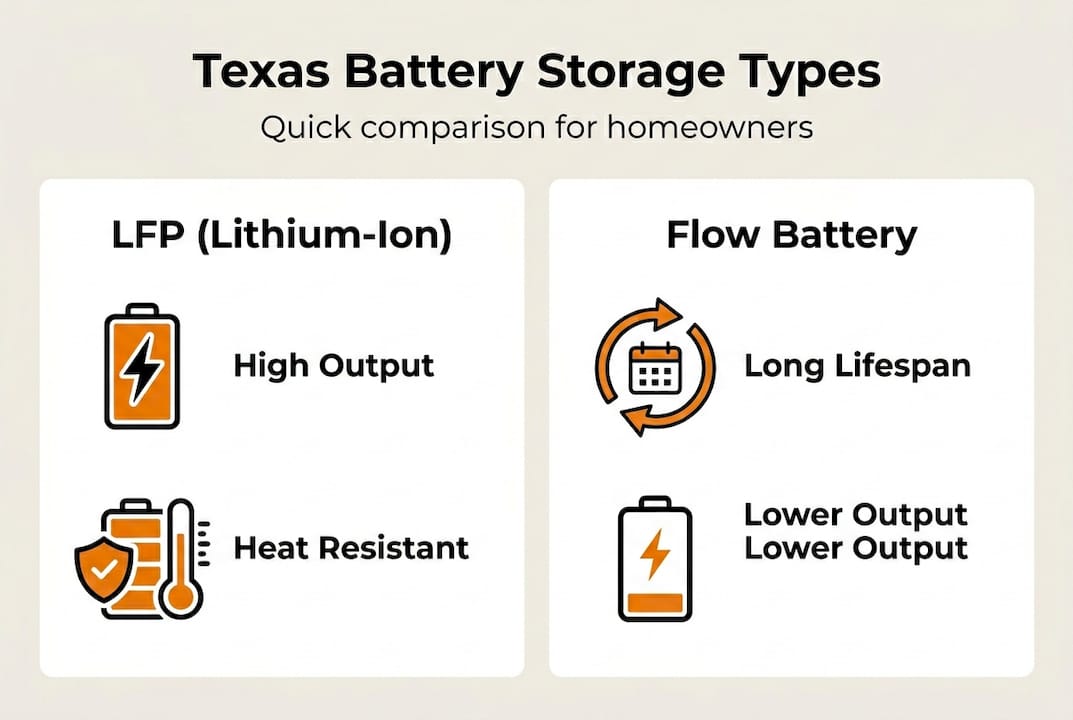
Not all batteries are built the same. Two main types compete for the residential market: lithium-ion (specifically LFP, or lithium iron phosphate) and flow batteries. For most Texas homeowners, LFP wins. Here’s why.
LFP battery advantages include better thermal stability and longer cycle life compared to older NMC (nickel manganese cobalt) lithium-ion chemistries. Texas summers regularly push temperatures past 100°F, and LFP handles that stress far better. Flow batteries, on the other hand, use liquid electrolytes in separate tanks and are extremely safe and long-lived, but they are bulkier and cost significantly more upfront.
“For Texas homeowners, LFP chemistry offers the best balance of heat tolerance, safety, and long-term value. It’s the chemistry we recommend for anyone dealing with extreme summer temperatures.”
| Feature | LFP (Lithium-Ion) | Flow Battery |
|---|---|---|
| Power density | High | Low |
| Upfront cost | Moderate | High |
| Lifespan | 10-15 years | 20+ years |
| Heat tolerance | Excellent | Good |
| Size | Compact | Large |
| Best for | Most Texas homes | Large properties or commercial |
As shown in Li-ion vs flow battery comparisons, lithium-ion batteries offer higher power density and lower cost, while flow batteries trade size and price for superior safety and longevity.
Key considerations when choosing battery storage types for your Texas home:
- Climate fit: LFP performs reliably in high heat without significant degradation
- Space available: Flow batteries need dedicated space; LFP units mount on a wall or floor
- Budget: LFP systems are more accessible for most homeowners
- Cycle life: LFP batteries often exceed 6,000 full charge cycles
Battery storage in practice: Charging, discharging, and safety
Knowing which battery to choose is only part of the story. Understanding daily operation and safety helps you maximize benefits and feel confident in your investment.
Here is how a typical Texas home battery system runs through a day:
- Morning (sunrise to midday): Solar panels begin generating power. Your home draws from the panels directly, and excess electricity flows into the battery.
- Midday peak: Panels produce maximum power. Battery reaches full charge. Any remaining surplus may export to the grid.
- Afternoon and evening: Solar output drops. Your home automatically switches to battery power, avoiding expensive peak-rate electricity from the grid.
- Night: Battery supplies your home through the night. If storage runs low, the grid serves as a backup.
- Next morning: The cycle repeats.
Safety is built into every layer of a modern system. The BMS constantly monitors voltage, temperature, and charge state. Battery safety standards such as NFPA 855 set strict installation guidelines that reduce fire and thermal runaway risk to near zero in residential settings. Improved BMS technology and power electronics have made thermal management more reliable than ever, which matters greatly when your garage hits 110°F in August.
For a deeper look at how solar and batteries work together in a complete home system, the solar and battery integration guide walks through real San Antonio installations.
Pro Tip: Keep at least 12 inches of clearance around your battery unit and always use a certified installer. Proper spacing and professional wiring are the two biggest factors in long-term safety and performance.
Costs, savings, and incentives: What Texas homeowners should expect
Understanding how these systems operate leads many Texans to wonder about the bottom line, and the incentives that make battery storage more affordable than ever.
The numbers are genuinely encouraging. A Tesla Powerwall 3 installed in a Texas home runs between $11,500 and $17,000 before incentives. After the 30% federal investment tax credit (ITC), your battery payback and ROI looks like this: net cost drops to roughly $8,000 to $12,000, with a payback period of 3.7 to 6.8 years and a 20-year ROI between 195% and 440%.
| Cost item | Range |
|---|---|
| Installed cost (before ITC) | $11,500 to $17,000 |
| After 30% federal tax credit | $8,000 to $12,000 |
| Payback period | 3.7 to 6.8 years |
| 20-year ROI | 195% to 440% |
“A battery system is not just a backup device. For Texas homeowners on time-of-use rates, it’s an active money-saving tool every single day.”
Key financial benefits to know before you buy:
- 30% federal ITC: Applies to both solar and battery storage installed in 2026
- Texas property tax exemption: Your home’s assessed value does not increase due to solar or battery additions
- Bill reduction: Most homeowners see 20% to 60% lower monthly electric bills
- VPP programs: Virtual power plant (VPP) programs pay you to share stored energy with the grid during peak demand
- Energy independence: You are less exposed to ERCOT price spikes during extreme weather
For a full breakdown of available solar tax incentives and how to claim them, we have a dedicated guide that walks through the process step by step. You can also explore solar savings in Texas to see how battery storage fits into a long-term energy plan.
The future of battery storage: Trends, challenges, and opportunities in Texas
While savings and incentives fuel today’s installations, it’s worth knowing where battery storage in Texas is headed.
Texas is already a national leader. ERCOT battery growth reached 8.6 gigawatts (GW) of battery storage capacity by 2024, making Texas one of the fastest-growing battery markets in the country. That growth is reshaping the grid and creating new opportunities for homeowners who get in early.
Costs are still falling. Utility-scale battery storage is projected to drop to as low as $147 per kilowatt-hour by 2035, which will push residential prices lower too. New hybrid battery chemistries and modular BMS technology are making systems smarter, more efficient, and easier to expand over time.
Opportunities for Texas homeowners right now:
- Property tax exemption: Already in place and saving homeowners money on assessments
- VPP pilot programs: New programs are launching across Texas, paying homeowners for grid participation
- Hybrid storage options: Combining LFP with other chemistries for better performance and longer life
- Modular expansion: Many new systems let you add capacity as your needs grow
- Texas energy trends: Staying informed helps you time upgrades and incentive claims strategically
The one challenge to watch: as more batteries flood the ERCOT grid, revenues from grid programs may decrease due to market saturation. That makes acting sooner rather than later a smart financial move.
Why most advice misses the mark for Texas battery storage
After exploring the technical and economic sides, let’s cut through common myths and share a perspective grounded in local Texas experience.
Most national battery storage guides are written for California or the Northeast. They focus on net metering, mild weather, and utility structures that simply do not apply here. Texas runs on ERCOT, a grid that operates independently from the rest of the country and experiences some of the most extreme price swings in the nation. Generic advice about battery sizing or chemistry selection often leads Texas homeowners to underbuy or choose the wrong system entirely.
We have seen it firsthand. Homeowners who installed NMC batteries based on national brand recommendations found that performance dropped noticeably after two or three Texas summers. LFP chemistry, active cooling, and proper thermal design are not optional upgrades here. They are baseline requirements.
Local incentives are another blind spot. VPP programs and the Texas property tax exemption are rarely mentioned in national guides, yet they can meaningfully improve your return on investment. Working with an installer who knows these programs is not a luxury. It’s a financial advantage.
For real examples of how battery storage performs in Texas homes, the real Texas battery case studies on our site show actual results from local installations.
Pro Tip: Ask any installer you interview how many Texas summer cycles their recommended battery has completed. If they cannot answer that, keep looking.
Ready to unlock the benefits of battery storage?
At Alpha Solar Solutions, we design battery storage systems specifically for Texas homes, not generic installs copied from a national template. We know the heat, the ERCOT grid, and the local incentives that make a real difference in your payback timeline.

Whether you are starting fresh or adding storage to an existing solar system, our team will walk you through every option and build a solution that fits your home and budget. Explore our residential solar installation services or dive into our detailed battery lifespan analysis to see what kind of long-term performance you can realistically expect. Contact us today for a free home energy assessment.
Frequently asked questions
How long will a typical home battery last in Texas?
Most lithium-ion home batteries last 10 to 15 years, with LFP models often exceeding 6,000 full charge cycles, making them well-suited for Texas’s demanding climate. Li-ion battery lifespan data confirms this range for residential use.
Are battery storage systems safe during Texas summers?
Yes. Properly installed LFP batteries with robust thermal management handle temperatures above 100°F safely, and no Texas home incidents from battery storage have been reported as of 2026. LFP thermal stability is a key reason this chemistry is recommended for hot climates.
What incentives or tax credits apply for Texas homeowners?
The 30% federal investment tax credit applies to home battery installations in 2026, and Texas-specific programs include a property tax exemption and emerging VPP payment opportunities.
How much can I really save with home battery storage in Texas?
Most Texas homeowners see bill reductions of 20% to 60%, and battery ROI data shows payback in as little as 3.7 years with a 20-year return of up to 440%.