
TL;DR:
- Solar systems of 9 to 11.5 kW can nearly eliminate most San Antonio households’ electricity bills.
- Hybrid systems with battery backup are recommended for resilience during outages and future growth.
- The typical payback period for a solar investment in San Antonio is 7 to 11 years, with long-term savings.
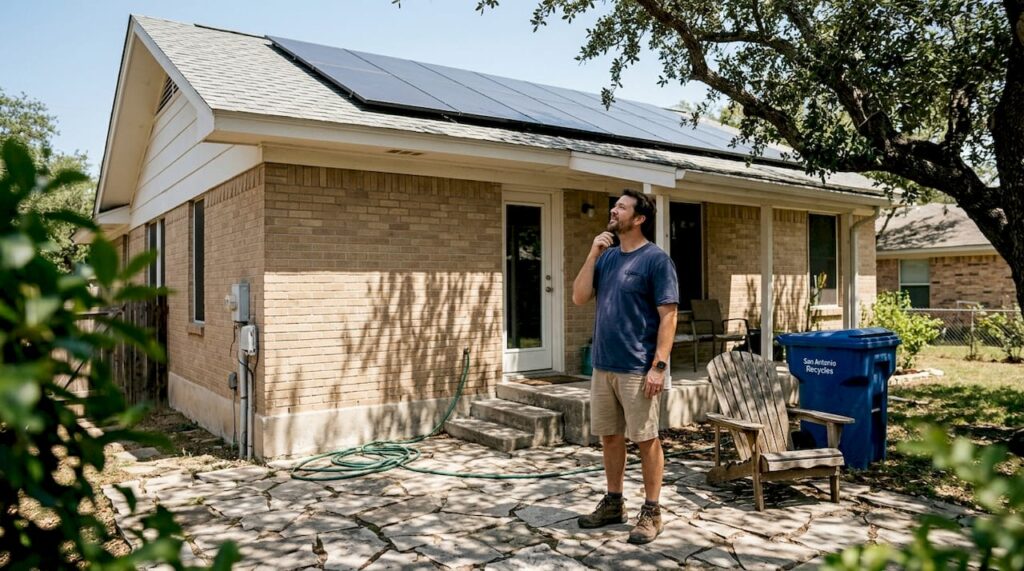
San Antonio homeowners using around 11 kW solar systems can offset most of their monthly electricity use, yet many still hesitate because they assume the upfront cost is too high or the technology too complicated. The reality is that solar has become more accessible and more financially rewarding than ever, especially in a sun-rich city like San Antonio. This guide walks you through every key piece of a solar electrical system, from panels and batteries to EV charging integration, so you can make a confident, well-informed decision about your home’s energy future.
Table of Contents
- What makes up a solar electrical system in San Antonio?
- Comparing system types: Grid-tied, hybrid, and off-grid options
- Understanding costs, incentives, and payback in 2026
- Battery backup and resilience: Why add storage?
- Integrating EV charging and special considerations for San Antonio homes
- Our perspective: The real reason most homeowners wait too long
- Ready to design your San Antonio solar system?
- Frequently asked questions
Key Takeaways
| Point | Details |
|---|---|
| San Antonio advantage | Abundant sunshine and high rates make solar systems highly effective for most homes. |
| Hybrid is best | Hybrid systems with batteries provide backup for storms and maximize self-consumption of solar power. |
| Strong ROI | Despite no rebates, the 30% federal tax credit and rising rates deliver quick payback and substantial savings. |
| Plan for EV charging | Future-proof your installation by sizing the system and panel for potential home EV charging needs. |
| Not all homes qualify | Homes with heavy shading, small roofs, or very low usage may see poor returns on solar investment. |
What makes up a solar electrical system in San Antonio?
Now that you know solar can significantly reduce your bills, let’s look at what actually makes up a solar electrical system for homeowners in San Antonio.
A residential solar system is made up of several interconnected components, each playing a specific role in turning sunlight into usable electricity for your home. Here’s a quick breakdown:
- Photovoltaic (PV) panels: These are the panels mounted on your roof. They absorb sunlight and convert it into direct current (DC) electricity.
- Inverter: This device converts DC electricity into alternating current (AC), which is what your home appliances actually use.
- Battery bank (optional but recommended): Stores excess solar energy for use at night or during outages.
- Grid connection via CPS Energy: Allows you to draw power when solar output is low and send excess power back for net metering credits.
| Component | Role | Typical spec for SA homes |
|---|---|---|
| PV panels | Generate electricity from sunlight | 9 to 11.5 kW total capacity |
| String/microinverter | Convert DC to AC power | Matched to panel output |
| Battery storage | Store excess energy | 10 to 20 kWh per unit |
| Grid tie | Backup supply and net metering | CPS Energy interconnect |
Systems averaging 9 to 11.5 kW can offset nearly all monthly usage for typical San Antonio homes consuming 1,100 or more kWh per month. That’s a meaningful reduction in what you pay CPS Energy every single month.
One thing worth knowing: solar panels do lose a small amount of efficiency over time. Most quality panels degrade to about 92% efficiency after 20 years, but they continue to offset substantial grid use throughout their lifetime. That’s still a strong performer for a long-term investment.
For proper solar system sizing in San Antonio, you need to factor in your current monthly usage, roof orientation, shading, and any planned changes like adding an EV or a pool pump.
“Getting the sizing right from day one is the single most important step in a solar installation. A system that’s too small leaves money on the table; one that’s too large wastes your budget.”
Pro Tip: If you’re planning to add an EV charger in the next few years, size your system slightly larger now. Adding capacity later costs significantly more than building it in from the start.
Comparing system types: Grid-tied, hybrid, and off-grid options
With the main components understood, it’s crucial to select the right type of solar system for your home’s needs and local conditions.
Not all solar systems are built the same. The three main types each serve different goals, and choosing the wrong one can mean paying too much or getting too little protection during outages.
Grid-tied systems connect directly to the utility grid with no battery storage. They’re the most common and lowest-cost option, but they shut down automatically during a grid outage for safety reasons. That means no power for you during a storm, even if the sun is shining.
Hybrid systems add a battery bank to a grid-tied setup. They prioritize using your own solar power first, store the rest in batteries, and can even integrate a generator for extended outages. This is increasingly the preferred choice in San Antonio.

Off-grid systems operate completely independent of the utility. They require a much larger battery bank and oversized PV array to cover every cloudy day. In urban San Antonio neighborhoods, this setup is rare and expensive.
| Feature | Grid-tied | Hybrid | Off-grid |
|---|---|---|---|
| Outage protection | None | Yes, with battery | Yes, full |
| Upfront cost | Lowest | Moderate | Highest |
| Battery required | No | Yes | Yes (large) |
| Best for SA homes | Budget-focused | Most homeowners | Rural only |
As noted in hybrid solar system comparisons, grid-tied is most common nationally, but hybrid systems are gaining fast because they add the backup protection that Texas weather demands.
Here’s a quick summary of what each system does best:
- Grid-tied: Lowest cost, simplest setup, no outage protection
- Hybrid: Best balance of savings and resilience for urban SA homes
- Off-grid: Maximum independence, highest cost, not practical for most city lots
For a full look at how these choices affect your wallet, the solar power cost breakdown for San Antonio homeowners is a great next read.
Pro Tip: Given San Antonio’s history with storm-related outages, we consistently recommend hybrid systems for homeowners who want both savings and peace of mind.
Understanding costs, incentives, and payback in 2026
Having compared system types, the next step is to understand the true financial investment, savings, and incentives available for San Antonio residents.
Solar is an investment, and like any investment, the numbers need to make sense. The good news is that in 2026, they really do.
Installation costs run $2.50 to $3.00 per watt, meaning a typical 11 kW system costs $28,000 to $36,000 before incentives. After applying the federal Investment Tax Credit (ITC) of 30%, your net cost drops to roughly $20,000 to $25,000. That’s a significant reduction just from one federal program.
Here’s how to calculate your payback period step by step:
- Estimate your system cost: Get quotes for a properly sized system (typically 9 to 11.5 kW for most SA homes).
- Apply the 30% federal ITC: Subtract 30% from your total installation cost.
- Calculate your annual savings: Multiply your monthly bill reduction by 12. Most SA homeowners save $150 to $250 per month.
- Divide net cost by annual savings: This gives you your payback period, typically 7 to 11 years.
- Project your lifetime ROI: Over 25 or more years, total savings can reach $32,000 to $95,000 depending on system size and rising utility rates.
The CPS Energy rebate program ended in 2026, but net metering remains available. That means any excess power your system sends to the grid earns you bill credits, which still adds up meaningfully over time.
For a deeper look at available solar tax credits and how to claim them, we’ve covered that in detail. You can also review our full cost breakdown guide for itemized pricing.
Pro Tip: Utility rates in San Antonio have risen steadily over the past decade. Every time CPS Energy raises rates, your solar system’s return on investment gets stronger automatically.
Battery backup and resilience: Why add storage?
To take full advantage of your solar investment, especially during storms or outages, consider the critical value of adding battery backup to your system.
Solar panels only produce power when the sun is shining. Batteries solve the two biggest gaps: nighttime usage and grid outages. In Texas, where storms can knock out power for hours or even days, that matters a lot.
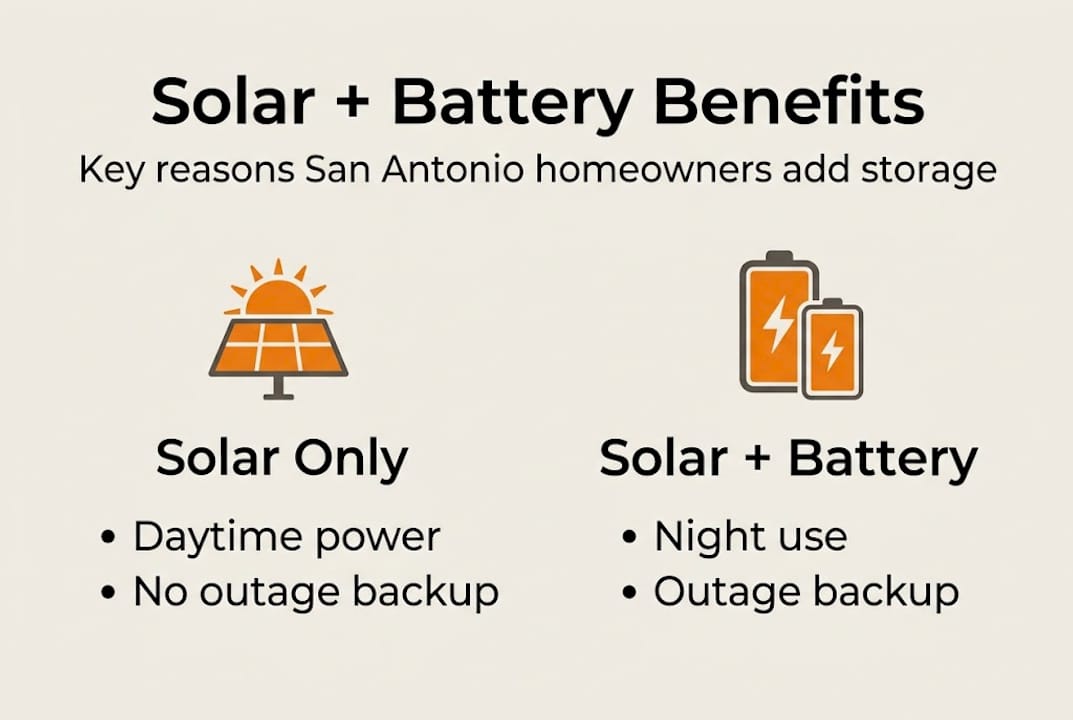
The most recommended battery chemistry right now is LiFePO4 (lithium iron phosphate). These batteries are safer, more stable at high temperatures (important in San Antonio summers), and last significantly longer than older lead-acid options. As detailed in battery storage for solar systems, LiFePO4 batteries add resilience during outages, store excess for night use and EV charging, and typically last 10 to 15 years.
Here’s how the layers of your energy system work together:
- Daytime: Solar panels power your home directly and charge the battery.
- Nighttime: Battery discharges to cover your home loads without drawing from the grid.
- Extended outage: A generator can recharge the battery if solar alone isn’t enough.
Top 3 reasons San Antonio homeowners add battery storage:
- Resilience: Keep essential loads running during CPS Energy outages caused by storms.
- Self-consumption: Use more of your own solar power instead of selling it back at lower net metering rates.
- Future-proofing: Ready your home for EV charging, smart appliances, and expanding energy needs.
For a realistic look at solar battery longevity and what to expect over time, we’ve put together a thorough analysis.
“Texas storms are unpredictable. Battery backup can keep the lights and fridge on when your neighbors are in the dark.”
Pro Tip: When sizing your battery, aim for enough capacity to cover your basic home loads (refrigerator, lights, phone charging, a fan) for 8 to 12 hours as a starting point. You can always add more later.
Integrating EV charging and special considerations for San Antonio homes
With resilience addressed, let’s turn to a fast-growing San Antonio trend: using your solar system to power an electric vehicle at home, and what to watch out for.
More San Antonio homeowners are buying EVs, and pairing them with solar is one of the smartest financial moves you can make. Charging your car with free solar power instead of paying CPS Energy rates can save you hundreds of dollars per year on top of your regular solar savings.
The most common setup is Level 2 AC-coupled charging, which uses a 240-volt outlet and can fully charge most EVs overnight. As covered in solar and EV charging integration, Level 2 AC-coupled EV charging is common but may need panel upgrades, and both grid and solar must be sized appropriately.
Here are the steps to make sure your home is ready:
- Check your electrical panel: Most EV chargers require a 50-amp dedicated circuit. Older panels may need an upgrade.
- Verify your solar system size: Adding an EV increases your monthly usage by 300 to 500 kWh. Your system needs to account for this.
- Review local code requirements: San Antonio follows NEC 690, 705, 625, and 706 standards. Systems that backfeed more than 120% of panel capacity require specific upgrades.
- Plan your charging schedule: Pairing a smart charger with your solar and battery system lets you charge during peak solar hours for maximum savings.
A few other considerations for San Antonio homes specifically:
- Shading: Trees or neighboring structures that shade your roof reduce output and affect ROI calculations.
- Roof size and condition: Smaller or older roofs may limit how many panels you can install.
- Low baseline usage: If your current electricity bill is very low, the payback period extends. Solar works best for homes using 800 kWh or more per month.
For full details on EV charger installation alongside your solar system, we walk you through the entire process.
Pro Tip: If you’re planning to add an EV charger, tell your solar installer before the system is designed. Adding extra capacity upfront is far cheaper than upgrading later.
Our perspective: The real reason most homeowners wait too long
After working with hundreds of San Antonio homeowners, we’ve noticed a consistent pattern. Most people who delay going solar don’t do it because they’ve done the math and decided it doesn’t work. They delay because the decision feels complicated, and complicated feels risky.
But here’s what we’ve seen again and again: the homeowners who waited five years to go solar didn’t save money by waiting. They lost it. Every month they stayed on the grid, utility rates crept higher, and the savings they could have been banking went straight to CPS Energy instead.
The conventional wisdom says “wait for prices to drop more.” The reality is that panel prices have largely stabilized, the 30% federal ITC is still available now but could change, and your electricity bill is going up regardless. Waiting is not a neutral choice. It has a real cost.
We also see homeowners undersize their systems to save money upfront, only to wish they had added more capacity when they buy an EV two years later. The most financially sound approach is to design your system around where your life is going, not just where it is today.
The homeowners who feel best about their solar investment are the ones who went in with a full plan: right-sized system, battery backup, and EV-ready wiring. They’re not just saving money. They own their energy.
Ready to design your San Antonio solar system?
If this guide has helped clarify what a solar electrical system actually involves, the next step is getting a design built around your specific home, usage, and goals.
At Alpha Solar Solutions, we custom-design every system for the homeowner in front of us, not a generic template. Whether you’re starting with solar panels and a battery, adding an EV charger installation, or just trying to figure out what size system makes sense, we’re here to walk you through it. We also offer solar panel cleaning and detach and reattachment services to keep your investment performing at its best. Reach out to us at alphasolarsa.com and let’s build your energy plan together.
Frequently asked questions
What size solar system do I need for an average San Antonio home?
Most homes using 1,100 or more kWh per month need a 9 to 11.5 kW system to offset nearly all of their usage. Your installer should verify this against your actual CPS Energy bills.
How long does it take to pay off a solar system in San Antonio?
Typical payback runs 7 to 11 years after applying the 30% federal ITC, with lifetime savings potentially reaching $95,000 depending on system size and future utility rate increases.
What are the main benefits of adding batteries to my solar setup?
Batteries provide backup power during outages, allow you to use solar energy at night, and help you charge your EV when grid rates are at their highest.
Can I power my home and EV with solar alone?
Yes, with a properly sized system and battery storage you can power both, but you may need an upgraded electrical panel to safely support the added load.
Does CPS Energy still offer solar rebates in 2026?
No, CPS Energy rebates ended in 2026, but net metering is still available, meaning you can still earn bill credits for excess power your system sends to the grid.
Recommended
- alphasolar, Author at Alpha Solar Solutions, LLC
- Solar power benefits for San Antonio homeowners in 2026
- How to size a solar system for your home: San Antonio
- Solar Panels Archives – Alpha Solar Solutions, LLC
- Solarstrom im Münsterland: 5 Tipps für mehr Ersparnis
- Stap voor stap zonnepanelen installeren voor maximaal rendement – Holland Electric Duurzaam