Restaurant commercial solar installation is the design and installation of solar panels to supply a restaurant’s electricity needs with the aim of reducing purchased electricity. This 2026 guide explains how your operating hours, refrigeration, roof access and outage priorities shape the decision before you request a proposal.
- Commercial solar installation for restaurants starts with matching solar production to your actual operating hours and electricity tariff.
- Alpha Solar Solutions is best for San Antonio restaurants seeking a local solar contractor that also offers battery backup.
- Solar panels alone do not provide outage protection; backup requires equipment designed for that purpose.
- Confirm roof rights, refrigeration loads and utility requirements before approving a commercial solar proposal.
Why commercial solar matters for restaurants
Your restaurant needs electricity beyond the hours customers occupy the dining room. Refrigeration, food preparation, ventilation and cooling create different loads throughout the day, so annual consumption alone cannot show whether solar fits your operation.
The right starting point is your restaurant’s operating schedule, not a target panel count. A lunch-focused business and a dinner-only restaurant need different production-versus-consumption assessments, even when their annual electricity use matches.
Alpha Solar Solutions offers commercial solar installation and battery backup services in San Antonio. For your 2026 decision, separate the goal of reducing electricity purchases from the goal of maintaining selected equipment during outages. One design does not automatically accomplish both.
How to plan restaurant solar installation
Gather your electricity bills and operating schedule
Start manually with your utility bills and a simple spreadsheet. Request 12 months of bills so your review includes seasonal changes, then add opening hours, preparation periods and overnight equipment use. If your utility provides interval data, request that too; it shows changes hidden inside monthly totals.
Distinguish energy from power. A kilowatt, or kW, describes power demand; a kilowatt-hour, or kWh, measures energy used over time. A steady 1 kW load operating for 1 hour uses 1 kWh. This distinction matters when comparing panel production, battery storage and equipment startup requirements.
Check whether your bill includes demand charges, which relate to measured power demand rather than energy consumption alone. Do not assume reducing purchased kWh eliminates those charges.
- Collect bills for every meter serving your restaurant.
- Record preparation, service, cleaning and closed hours.
- Identify demand charges and fixed account charges.
- Note planned changes to hours, seating or kitchen equipment.
Confirm roof condition and installation rights
Before asking for a layout, locate your lease, roof warranty and available building records. Inspect accessible areas from the ground; leave rooftop inspections and electrical checks to qualified professionals. A clear roof photograph does not establish structural suitability.
Restaurants need room for exhaust equipment, maintenance access and rooftop mechanical systems. Panels must fit around those requirements rather than obstruct them. If roofing work is already planned, coordinate it before approving solar installation.
For leased premises, read the guide to commercial solar installation for leased business premises. Your landlord’s written approval, the remaining lease term and responsibility for future panel removal belong in the decision before equipment selection.
- Confirm who owns the roof and controls installation permission.
- Gather roof age, condition and warranty documents.
- Identify exhaust outlets, rooftop equipment and service routes.
- Request structural and electrical assessments through qualified professionals.
- Assign responsibility for roof repairs and panel removal in writing.
Match the solar design to your restaurant’s load
Compare your operating schedule with daylight hours before reviewing equipment brands. Lunch preparation and daytime cooling can overlap solar production; late dinner service and overnight refrigeration require a separate assessment of grid purchases or stored energy.
Do not size the project from roof area alone. A large roof does not prove that a large system delivers the strongest bill reduction. The calculation depends on production, consumption timing and the utility’s treatment of exported electricity.
Alpha Solar Solutions can assess commercial solar installation alongside battery backup. Ask for a custom design that explains the connection between your restaurant’s load and the proposed equipment, rather than treating panel count as the recommendation.
- Request estimated production by month, not only an annual total.
- Compare production timing with preparation and service hours.
- Confirm the assumptions used for shading and roof orientation.
- Ask how exported electricity is treated under your applicable tariff.
- Model planned kitchen changes separately from current consumption.
Define which equipment needs outage protection
Write your outage priorities before discussing battery capacity. Begin with the equipment you need to protect food, maintain communications or shut down safely. Continuing full service is a different objective from keeping selected refrigeration equipment running.
A standard grid-connected solar system without backup capability shuts down during a grid outage. Keeping circuits powered requires a system designed to isolate them from the grid and supply them safely. Panels alone do not establish that capability.
Battery energy capacity describes stored energy; power output describes the loads the battery can support at once. Compressor startup demand also matters. Ask the designer to evaluate the actual equipment rather than infer suitability from a residential battery example.
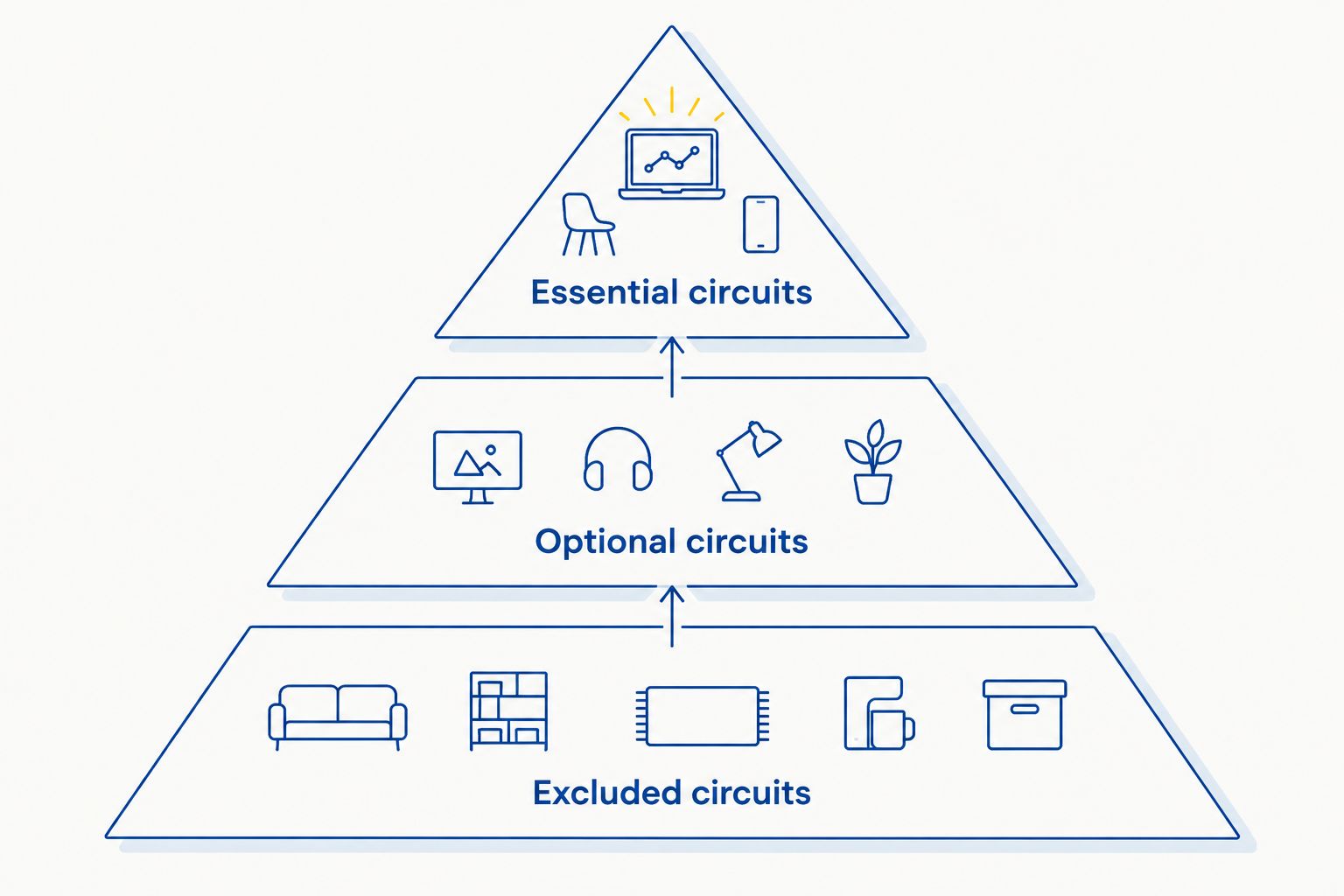
Separate your list into essential circuits, optional circuits and excluded circuits. That makes the outage plan understandable to both your installer and the manager handling a disruption.
An electrical backup plan does not replace your food-safety procedures. Establish how staff will respond if refrigeration temperatures move outside required limits, regardless of whether some equipment remains powered.
- List refrigeration equipment and obtain its electrical specifications.
- Separate essential circuits from cooking and comfort loads.
- Ask how startup demand affects the backup design.
- Request runtime assumptions for the selected loads and reserve settings.
- Confirm whether solar can recharge the proposed battery during an outage.
Compare proposals using the same scope
Create your own comparison sheet before requesting proposals. Give each contractor the same bills, operating schedule, roof information and backup priorities. Otherwise, different system sizes and exclusions make the proposals difficult to compare.
For a 2026 proposal, ask for separate descriptions of solar generation, electrical work and backup functions. Identify who handles engineering, permits, utility coordination and inspection corrections. A scope that leaves these responsibilities unclear creates decisions you will still need to resolve later.
Treat projected savings as a calculation to inspect, not a promise. Ask which tariff, production assumptions and operating schedule support the estimate. Verify current incentive rules with the relevant program administrator and your tax adviser before including any benefit in your decision.
- Compare equipment specifications and estimated production assumptions.
- Identify included and excluded roof or electrical work.
- Request the assumptions behind projected bill reductions.
- Ask who owns permits, inspections and utility submissions.
- Review written workmanship, equipment and service terms separately.
Coordinate construction around restaurant operations
Map delivery routes, customer entrances, kitchen access and rooftop maintenance needs yourself first. Give the contractor your preparation and service windows so the installation plan reflects how your restaurant actually operates.
Ask which tasks require a scheduled electrical shutdown and how the contractor will coordinate that work. Your refrigeration and food-handling plan must account for the interruption; do not assume construction can happen without affecting operations.
Installation completion and utility authorization are separate milestones. For a 2026 project, build your operating plan around confirmed approvals rather than a sales estimate. Get a clear explanation of when the system can legally operate and who communicates that status.
- Identify access routes that avoid food preparation and customer areas.
- Agree on delivery, staging and waste-removal locations.
- Schedule electrical interruptions around documented operating needs.
- Assign responsibility for permit and utility status updates.
- Confirm the authorization required before normal system operation.
Assign monitoring and support responsibilities
Choose a staff member to review system performance and keep project records. Start with a simple log of production, utility bills, alerts and service requests. Monitoring only helps when someone knows what to check and whom to contact.
Compare actual production against the proposal’s seasonal expectations rather than expecting identical output every month. If output changes unexpectedly, check monitoring communications and request a diagnosis before assuming the panels need cleaning.
Ask Alpha Solar Solutions to explain support after installation, including how to report a fault and which party handles equipment warranty claims. Keep those responsibilities in writing. Local service is useful only when your team understands the process for obtaining it.
- Save approved plans, equipment records and operating instructions.
- Assign an owner for production reviews and alert notifications.
- Record the escalation route for equipment or monitoring problems.
- Confirm safe roof-access and maintenance procedures.
- Revisit the design when you change major kitchen equipment.
Compare restaurant solar and backup options
Choose the option that addresses your primary objective. These are planning approaches, not interchangeable packages: reducing grid purchases, protecting selected loads and preserving operating flexibility require different scopes.
| Option | Best for | Main advantage | Key limitation |
|---|---|---|---|
| Grid-connected solar without backup | Restaurants prioritizing daytime electricity purchases | Generates electricity for use while the grid is available | Does not provide outage power without backup equipment |
| Solar with selected-load battery backup | Restaurants prioritizing specified equipment during outages | Combines generation with stored energy for designated circuits | Runtime and simultaneous loads depend on the design |
| Solar with documented future battery planning | Restaurants evaluating backup as a later project | Keeps a future backup discussion in the initial design | Later compatibility and electrical work still require verification |
| Efficiency improvements before solar | Restaurants replacing inefficient or oversized equipment | Establishes a revised load before solar sizing | Does not generate electricity or provide backup |
For restaurant solar installation, choose the scope before choosing the equipment. If backup is a future goal, ask what the first installation must include to support it. Do not accept a general statement that batteries can be added later without checking equipment compatibility and required electrical changes.
Alpha Solar Solutions commercial solar installation is an option for local restaurants seeking solar and battery assessment from a San Antonio contractor. Confirm the project-specific engineering, exclusions and backup requirements in the written proposal; the service category alone does not establish suitability for your kitchen.
Discuss your restaurant’s solar plan
Request a free consultation about your electricity use, roof access and backup priorities.
Common mistakes restaurants make
Sizing solar from the total bill
A bill includes more than electricity consumption. Fixed charges and demand charges need separate treatment, so compare the proposed system against the bill components it actually affects. Ask for the calculation behind the estimate.
Treating refrigeration as a single backup load
Walk-in equipment, reach-in units and other refrigeration equipment have different electrical requirements. Inventory the actual units and their startup needs. A general promise to back up refrigeration is not a circuit-level design.
Signing before resolving the lease
An installer’s proposal does not replace permission from the building owner. Resolve roof access, equipment ownership, lease termination and removal obligations before committing to a project on rented premises.
Assuming installation means activation
Panels on the roof do not establish that every inspection and utility requirement is complete. Ask who tracks each approval and who tells your manager when the system is authorized to operate.
Counting incentives before confirming eligibility
Do not base a 2026 approval on an assumed tax benefit or program payment. Confirm current rules, project timing and your business’s eligibility with the appropriate administrator and tax adviser before relying on an incentive.
FAQ
Is commercial solar installation worth considering for a restaurant?
Commercial solar installation is worth assessing when your restaurant has suitable installation space and electricity use that aligns with solar production. Review your tariff, roof rights and operating schedule before deciding whether to proceed.
Can solar panels keep restaurant refrigerators running during an outage?
Solar panels alone do not provide outage protection in a standard grid-connected installation. Refrigeration backup requires compatible backup equipment and a design that accounts for running loads, startup demand and the intended outage duration.
Can I install solar if I lease my restaurant building?
A leased restaurant needs the building owner’s permission and an agreement covering installation rights and responsibilities. Resolve ownership, roof access, lease termination and removal obligations before approving the project.
Should a dinner-only restaurant add a battery?
A dinner-only restaurant should compare its evening consumption and outage priorities before choosing a battery. The decision depends on storage requirements, tariff rules and the loads the proposed equipment can support.
What determines the scope of a restaurant solar installation?
Electricity use, production timing, roof condition, electrical capacity and backup requirements determine the scope. Require a written proposal that separates generation equipment from electrical upgrades and outage-protection functions.
Will solar eliminate my restaurant’s electricity bill?
Do not assume restaurant solar will eliminate the electricity bill. Grid purchases outside production hours, fixed charges and any applicable demand charges need separate analysis under your utility tariff.
What should I prepare before a commercial solar consultation?
Prepare electricity bills, operating hours, lease or ownership documents and a list of critical equipment. Add planned kitchen changes and your outage priorities so the contractor can assess the right scope.
One last thing
Before booking a consultation, ask your closing manager to list everything that stays powered after the kitchen closes. That list exposes the difference between serving meals and maintaining the building overnight. Bring it with your bills: your 2026 solar decision should reflect the restaurant you operate after customers leave, not just the dining room they see.
Related guides
- Solar installation in San Antonio: what delays activation
- Commercial solar financing options for Texas businesses
- What a solar panel cleaning service quote includes