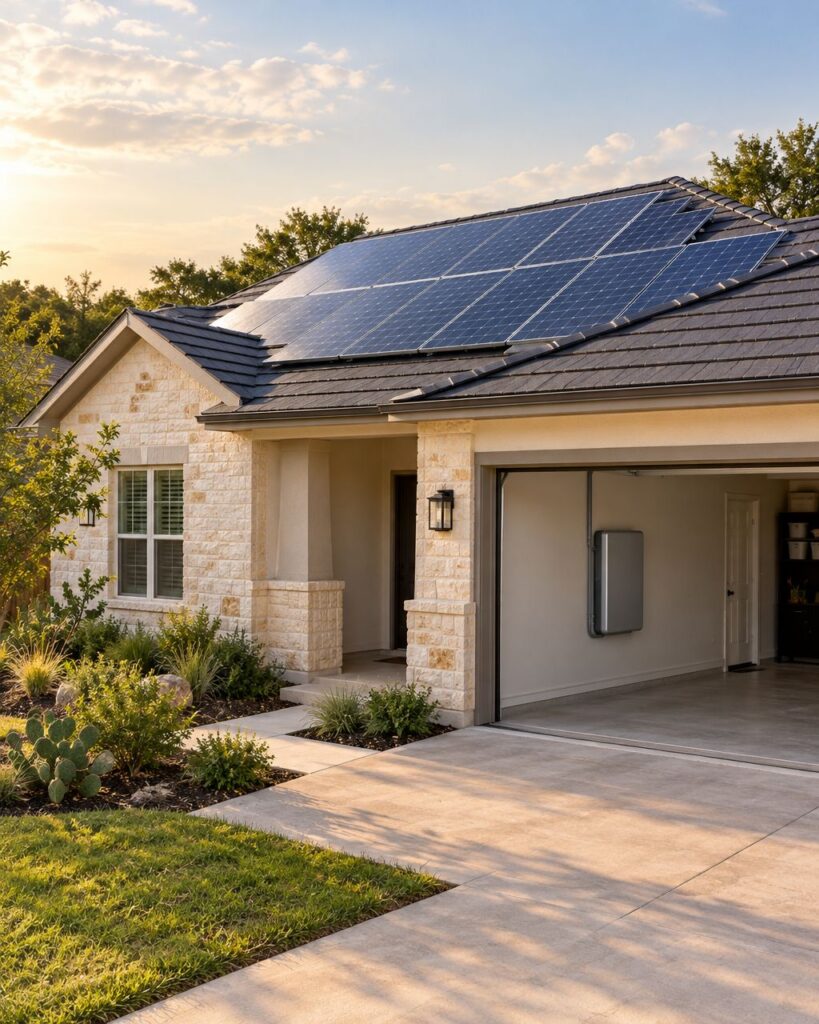
Add a battery with your solar panels if keeping essential appliances running during an outage is a priority today. Install solar first and add storage later if your immediate goal is daytime electricity production and your budget cannot comfortably cover both; the first design should still identify a workable future battery connection.
- For solar panels in San Antonio, add battery backup now when outage protection is an immediate priority.
- Solar panels alone do not guarantee electricity during a grid outage.
- A later battery needs confirmed equipment compatibility, available space and a backup-circuit plan.
- Compare complete installed scopes, not just a battery model or a monthly payment.
A residential solar installation and an outage-backup system solve different problems. This guide helps you decide which project to take on first, what to ask about the other, and how to avoid paying for equipment that does not match your household's needs.
Should you add a battery to solar panels in San Antonio now or later?
Choose solar plus battery now for immediate backup needs; choose solar first for a staged purchase with a documented upgrade path. Neither option guarantees a lower total bill or uninterrupted power. In 2026, the useful comparison is between complete designs for your property, not between generic solar packages.
| Approach | Best for | Main benefit | Main limitation |
|---|---|---|---|
| Solar and battery together | Homeowners who want solar generation and outage protection now | Backup circuits and equipment can be planned as one project | Larger initial project and more decisions before installation |
| Solar first, battery later | Homeowners prioritizing solar generation within a smaller initial budget | You can separate the purchases and reassess storage needs | No battery backup until the second project is installed and commissioned |
| Battery-ready solar design | Homeowners who expect to add storage but have not selected it | Compatibility and installation space are considered early | Preparation is not itself an operating backup system |
The third approach is a design choice, not a substitute for a battery. Ask exactly what the preparation includes and what equipment would still be needed later. A statement that your system is battery-ready is useful only when someone can explain the connection in writing.
Why this matters for your home
The decision starts with your expectations during a power failure. If you expect a refrigerator, internet connection and selected lights to stay on, the proposal needs to name those circuits and explain how the system will supply them. If you expect central cooling and every outlet to operate normally, the design question becomes much bigger.
Electricity generation and backup are separate capabilities. The U.S. Department of Energy's inverter guidance, reviewed for this 2026 guide, explains that solar-plus-storage systems need appropriately designed equipment to operate without grid support. Having panels on your roof does not establish that capability by itself.
For San Antonio homeowners, a local site review also needs to consider the actual utility account, electrical service, roof and battery location. Your neighbor's bill, roof layout and appliance list are not substitutes for your own. Alpha Solar Solutions designs residential solar and battery backup around individual homes rather than assuming the same equipment suits everyone.
Add the battery now when backup cannot wait
Installing solar and storage together is the stronger choice when you already know that outage protection is part of the purchase. The installer can review the solar equipment, battery connection, backed-up circuits and physical layout together. That makes the scope easier to evaluate as one complete system.
Start with a short, ranked appliance list:
- Refrigeration and food storage.
- Selected lighting and household outlets.
- Internet equipment and communications.
- Heating or cooling equipment you want assessed separately.
- Other household devices with a specific backup requirement.
Do not treat each item as automatically included. Ask which circuits will receive backup power, which appliances must remain off, and what happens when demand exceeds the system's power limit.
The benefit of buying together is coordinated planning, not unlimited electricity. Storage has finite energy, and solar production changes with sunlight and conditions. Even a system connected to the entire home can require you to reduce appliance use during an outage.
The drawback is a larger commitment before you have lived with the solar system. You are selecting equipment, backup coverage and operating priorities at once. If the full project would stretch your finances, reduce the backup scope or compare a staged plan instead of assuming the largest package is necessary.
Add the battery later when staging the purchase fits better
Solar first can be a sensible 2026 decision when your priority is generating electricity and storage is not affordable yet. You can learn how your home uses power after installation and revisit which appliances you truly want protected. The important condition is that the original design does not make the later project unnecessarily difficult.
A staged project also has an honest downside: until storage and the necessary backup equipment are installed, your solar system is not a promised outage solution. Do not mentally count a future battery as protection you already have.
Before approving solar-only work, ask for:
- The proposed inverter make and model.
- A description of the intended future battery connection.
- Any equipment that would need replacing or adding.
- A suitable battery location with required access and clearances.
- The anticipated electrical work for selected backup circuits.
A later installation can require another assessment, additional equipment, permitting and electrical work. The exact scope depends on the existing system and local requirements. There is no reliable universal rule that a battery purchased later will be cheaper or that it will need no changes to your original installation.
Alpha Solar Solutions can help you compare residential solar with battery backup against a staged approach. Ask for a written explanation of what the initial project covers and what remains for the second phase; that is more useful than a verbal promise about easy expansion.
What battery-ready should mean in a written proposal
Battery-ready should describe a credible future installation, not simply the possibility that somebody could redesign the system later. Compatibility is the first test. The installer should explain whether the solar equipment and intended battery can work together, and what changes that combination requires.
Next, confirm the physical layout. Battery equipment needs an approved location, accessible disconnects and manufacturer-required clearances. Avoid choosing a corner of the garage merely because it is empty today; installation requirements govern whether it is suitable.
The written proposal should distinguish three things:
- Included now: equipment and preparation actually being installed.
- Required later: battery, backup controls and electrical work not included in the first project.
- Still undecided: decisions that need a future site review or a specific battery selection.
That distinction protects you from assuming that reserved wall space, an empty conduit or a compatible inverter is a complete backup system. Each can be useful preparation. None supplies stored electricity on its own.
Keep copies of the system design, equipment information and commissioning records. They help a future installer understand what exists without relying on memory or an incomplete sales summary. Do not open electrical equipment yourself to collect information; ask the installer for safe photographs and documentation.
Why battery size is not the same as backup duration
Battery capacity tells you how much energy is available. Power output tells you how much equipment can run at once. Both matter when you decide whether storage belongs in your initial purchase.
Tesla's homeowner guidance, reviewed in October 2026, lists 13.5 kWh of usable storage for Powerwall 3. That figure is an energy capacity, not a guarantee of overnight whole-home operation. Actual duration depends on the energy available when the outage begins, appliance demand, system losses and whether solar can recharge the battery.
Here is a deliberately simplified calculation, not a forecast for your home:
- A full 13.5 kWh supply divided by a constant 1 kW demand gives 13.5 hours before allowing for losses.
- The same 13.5 kWh supply divided by a constant 3 kW demand gives 4.5 hours before allowing for losses.
- A partly charged battery starts with less available energy than either full-charge example.
These examples ignore charging, cycling appliances and equipment limits. Their purpose is to show why the appliance list changes the answer so much. Your installer should model the actual equipment you want protected rather than selling a fixed number of backup hours based only on the battery's name.
Central air conditioning also requires a separate assessment of operating demand and startup requirements. A battery that powers lights and internet is not automatically suitable for cooling your home through an extended outage.
What changes the now-versus-later decision?
Several property-specific factors affect the right sequence:
- Urgency of backup: an immediate outage concern favors including protection in the first project.
- Affordable project scope: storage should not turn a manageable purchase into an uncomfortable commitment.
- Existing equipment: an older solar system needs a compatibility assessment before adding a battery.
- Electrical condition: required service or panel work can affect both phases.
- Available installation space: location, access and clearances can limit your options.
- Future household changes: an EV or new cooling equipment can change energy demand and backup priorities.
Savings belong in this assessment, but they need your actual utility rates and usage. For a CPS Energy account, ask the installer to use the current applicable tariff and export-credit terms. Do not assume a national example of expensive evening electricity matches the way your own bill is calculated.
Similarly, avoid choosing a 2026 purchase date from an old incentive claim. Any tax benefit, utility program or eligibility assumption needs a current source and confirmation that it applies to your project. Compare the underlying system even when no incentive is available.
How to compare the two proposals fairly
Ask for a solar-only proposal with documented battery preparation and a solar-plus-backup proposal. Keep the roof layout and solar-generation assumptions comparable, then examine the additional equipment and protected circuits. Otherwise, you can mistake a different solar design for the cost of adding storage.
Each proposal should identify the scope, exclusions, equipment, utility coordination and support responsibilities. For financing, compare the amount financed, payment schedule, total repayment and contract terms rather than the advertised monthly payment alone. A manageable payment does not prove that two offers cover the same installation.
For a staged project, do not demand a guaranteed future price for an unspecified battery. Ask instead which later tasks are already addressed and which remain. That makes the unknowns visible without pretending equipment and installation conditions will never change.
Alpha Solar Solutions is a local option for San Antonio homeowners comparing custom residential solar and battery backup with support after installation. A free consultation is the place to bring your electricity bills, equipment questions and essential-appliance list, not an obligation to select a package before the design is clear.
FAQ
Do solar panels keep working during a San Antonio power outage?
Ordinary grid-connected solar panels do not guarantee power to your home during an outage. Backup operation requires equipment specifically designed to disconnect safely from the grid and support the home’s selected loads.
Can I add battery backup after my solar panels are installed?
Yes, a battery can be added to many existing solar installations, but compatibility and electrical requirements need assessment. Ask which equipment can stay and what must be added before accepting an upgrade proposal.
Is it better to install solar panels and a battery together?
Installing both together is the stronger choice when immediate outage protection is a priority and the complete project fits your budget. Installing solar first is reasonable when you have a documented future battery plan and accept the lack of battery backup in the meantime.
Does battery-ready solar include outage protection?
No, battery-ready preparation does not itself supply stored energy or establish working outage protection. The proposal should identify the battery and backup equipment still required.
Will a home battery run my central air conditioner?
Only if the installed system can meet the air conditioner’s operating and startup requirements. Ask for a model-specific assessment and an energy-use estimate rather than assuming whole-home connection means unlimited cooling.
How much storage does a Tesla Powerwall 3 have?
Tesla lists 13.5 kWh of usable storage for Powerwall 3. That capacity alone does not determine outage duration; appliance demand, available charge and system conditions also matter.
Will a battery automatically lower my CPS Energy bill?
No, a lower bill is not automatic. Any savings estimate needs your current utility tariff, electricity usage, solar production and proposed battery operating settings.
One last thing
Before choosing now or later, ask the installer to explain a nighttime outage using your proposed design. Which circuits stay powered, what must you turn off, and what happens when the battery runs low? A clear answer to that scenario is more valuable than an impressive equipment list.
Buy the backup capability you need, not the assumption that solar panels provide it. Alpha Solar Solutions can discuss the trade-offs without treating a staged installation as a failure or promising that a battery removes every outage risk.
Related guides
- Battery backup options for your San Antonio home
- Choosing essential circuits with a critical load panel
Sources checked for this guide
Technical background was checked in October 2026 against the U.S. Department of Energy's Solar Integration: Inverters and Grid Services Basics and Tesla's Do You Need a Home Battery for Your Solar Panels. Manufacturer specifications describe equipment capability, not guaranteed performance at an individual property.