
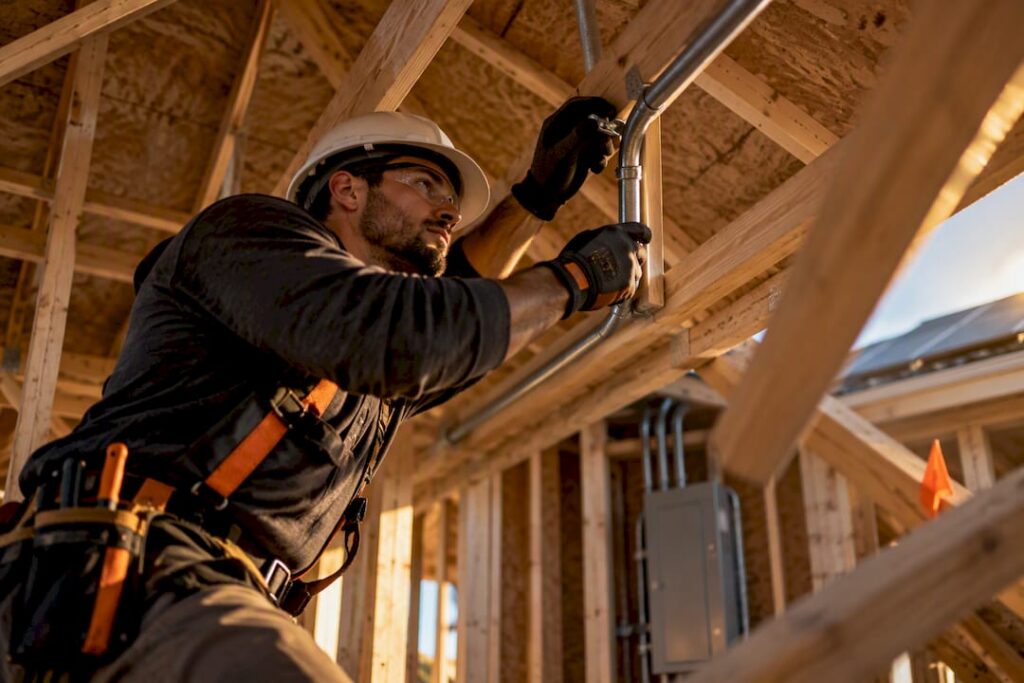
If you’re building a new home in San Antonio and want solar, integrate it before permanent electrical service gets finalized, not after. Coordinate your builder and solar contractor as one team from the start, and hire a locally licensed installer who already knows CPS Energy’s interconnection packet and the City of San Antonio’s plan review checklist. That single decision, made early, is what separates a smooth install from a costly retrofit six months after move-in.
TL;DR:
- Integrate solar before permanent electrical service finalization and coordinate builder and solar contractor early to avoid costly retrofits.
- Design electrical systems around solar during framing and rough-in stages, including conduit runs, breaker spaces, and structural capacity.
- Budget roughly $12,000 to $25,000 for a complete residential solar system, with higher costs for complex roofs or battery backup.
- The CPS Energy interconnection process takes about 7 to 10 business days after submitting a complete packet, and delays often result from incomplete documentation or site issues.
- Keep detailed documentation of permits, interconnection approval, equipment specifications, and warranties for warranties, resale, or tax purposes.
Table of Contents
- What Are Your Solar Options for New Construction Solar in San Antonio?
- What Do New Homes in San Antonio Pay for Solar?
- How Do Permits and CPS Energy Interconnection Work for New Homes?
- What Incentives and Documentation Should You Keep?
- Builder and Contractor Coordination Checklist
- Why Early Planning Beats Retrofitting Every Time
- Get Your New Build Solar-Ready From the Start
- Where to Verify Current Rules
- Sources
- FAQ
What Are Your Solar Options for New Construction Solar in San Antonio?
New construction gives you a planning advantage that retrofit projects never get: you can design the electrical system around solar instead of squeezing solar into an existing one. Three basic paths exist for a new build. Owned rooftop photovoltaic (PV) systems remain the most common and cost-predictable choice, since panels mount to standard roof framing and connect through a dedicated breaker. Integrated solar roofing, where the panels double as the roof surface, costs more and suits a narrower set of architectural styles. Battery backup adds a fourth layer: a useful home battery typically starts around 10 kWh of usable capacity, enough to run refrigeration, lighting, and a few circuits during an outage, though whole-home backup during a multi-day outage requires larger or multiple units.
The decisions that matter most happen at the framing and rough-in stage, not at final walkthrough. Ask your builder to include these in the electrical plan:
- Conduit runs from the roof penetration point to the main panel location, sized for future panel additions.
- Reserved breaker spaces in the main panel and, if you’re adding battery backup, a subpanel for critical loads.
- Planned roof penetrations grouped in one area rather than scattered, which simplifies flashing and inspection.
- EV charger rough-in wiring to the garage, even if you’re not installing a charger on day one.
- Structural review confirming the roof decking and rafters can handle panel loads, especially on tile or metal roofs.
San Antonio averages peak sun hours per day suitable for solar generation, based on figures commonly cited in local solar guides. That number changes month to month, and the PVWatts calculator from NREL will model your specific roof pitch, azimuth, and shading to give you a realistic monthly production estimate rather than a rough annual average.
Pro Tip: Ask your builder to walk the lot with your solar contractor before the roof trusses go up. A single oak tree or a neighbor’s two-story addition can shade a south-facing roof section enough to change your ideal panel placement.

What Do New Homes in San Antonio Pay for Solar?
Contractors size a system by working backward from your projected household load, not by guessing at panel count. Providing builder’s projected energy usage or a comparable home’s utility bill helps installers model expected consumption more accurately than a square-footage estimate alone.
For new single-family homes in San Antonio, typical residential systems run in a wide range depending on roof complexity, battery inclusion, and any structural reinforcement the roof needs. Alpha Solar Solutions lists residential solar installation pricing between $12,000 and $25,000 for a complete installation, a range that reflects system size, equipment tier, and whether battery backup is included.
Several factors push a quote toward the higher end of that range:
- A complex or multi-plane roof that requires more mounting hardware and labor.
- Battery backup, which adds equipment and a subpanel for critical circuits.
- Structural reinforcement if the roof design wasn’t built with panel loads in mind.
- Meter upgrades or utility line extensions when the site doesn’t already have a nearby power source.
A well-designed 8 to 10 kW system in San Antonio can produce roughly 1,000 to 1,300 kWh per month, though your actual output depends on roof orientation, shading, and panel efficiency. Run your specific address through PVWatts before finalizing system size. Contractors use the same tool internally, so comparing your own estimate against a quote is a fast way to check whether a proposal makes sense for your roof.
How Do Permits and CPS Energy Interconnection Work for New Homes?
This is where new construction solar in San Antonio becomes genuinely complicated because two separate review processes have to run in parallel without stepping on each other’s timeline.
The City of San Antonio requires site plans, construction drawings, an energy report, and sealed foundation plans for new residential permits, and initial plan review typically takes three business days once a complete packet is submitted. Licensed trade contractors registered with the city can pull permits directly on your behalf, which is one reason hiring a registered local installer saves real time compared to managing separate permits yourself.
CPS Energy runs its own interconnection process, and it has to be sequenced correctly:
- Confirm your installer is a registered CPS Energy contractor before signing a contract.
- Submit the interconnection packet: registration form, interconnection application, and engineered electrical drawings.
- Wait for review. A complete packet typically takes about 7 to 10 business days to clear.
- Coordinate the temporary meter loop with your builder’s electrician, since new construction often runs on temporary power before permanent service is set.
- Once CPS Energy approves the interconnection and the city signs off on final electrical inspection, permanent service and solar energization can proceed together.
Delays usually trace back to a handful of predictable problems:
- Incomplete engineered drawings missing a required stamp or signature.
- A site that lacks nearby utility infrastructure, which can trigger a line extension.
- Starting installation before CPS Energy approval, which CPS Energy’s own guidance explicitly warns against.
- Missing documentation on site during inspection, which forces a re-scheduled visit.
Keep a physical or digital folder on site with the interconnection approval letter, the stamped engineered drawings, and the permit card. Inspectors ask for these more often than builders expect.
What Incentives and Documentation Should You Keep?
Federal residential clean energy credit rules changed for systems placed in service after December 31, 2025, so don’t assume the credit that older guides describe still applies to your project. Verify current eligibility directly with a tax professional or the IRS before budgeting around any federal incentive.
Regardless of what federal incentives apply to your installation date, the IRS advises keeping detailed documentation for any residential clean energy property, including:
- Installation invoices showing itemized equipment and labor costs.
- Proof of payment, such as bank or financing statements.
- Manufacturer certifications for panels and, if installed, battery storage rated at 3 kWh or more.
IRS guidance specifically calls out battery storage systems of 3 kWh capacity or larger as eligible equipment, which matters if you’re pairing panels with backup power in your new build.
Beyond federal rules, check for local and utility-specific programs before assuming what’s available. CPS Energy periodically runs its own efficiency and solar programs, and property tax treatment of renewable equipment can vary. Confirm current terms directly with CPS Energy or the Texas Comptroller’s office rather than relying on a blog post.
At handover, collect your signed installation contract, full equipment specs with serial numbers, the final inspection sign-off, the CPS Energy interconnection approval, and manufacturer warranties into a single project file. That file is what you’ll need for warranty claims, resale disclosures, or a future tax question.
Builder and Contractor Coordination Checklist
Solar for new construction works best when it’s mapped to the same phases your builder already tracks. Here’s the sequence that avoids rework:
- Pre-construction. Get a site survey and preliminary solar layout done before the foundation pour. This is when your contractor confirms roof orientation, checks for future shading from nearby structures, and flags any structural reinforcement the framing plan needs.
- Framing and electrical rough-in. Install conduit runs and EV charger wiring rough-in while walls are still open. Your electrician submits solar-ready electrical drawings as part of the city’s plan review packet, not as a change order later.
- Pre-energize. Your solar contractor submits the CPS Energy interconnection application once the site is “ready,” meaning permanent service infrastructure is in place. City and CPS Energy inspections get scheduled here, and stamped engineered drawings need to be uploaded before either agency will act.
- Closeout. Final inspections clear, CPS Energy issues interconnection approval, and turn-on gets scheduled. Collect every final document into the project file described above before your builder hands over the keys.
Pro Tip: Ask your builder for a copy of the electrical rough-in inspection report before drywall goes up. If a conduit run or breaker space was missed, it’s far cheaper to fix before walls are closed than after.
Why Early Planning Beats Retrofitting Every Time

I’ve spent years watching solar get treated as an afterthought in new construction, bolted on after the builder hands over a finished home. It almost always costs more that way, and it almost always takes longer. Projects that integrate solar planning into the framing and rough-in phases consistently see fewer change orders and smoother inspections, because the electrical drawings already account for panel loads and interconnection requirements instead of retrofitting around a finished panel.
The pattern I’d push back on is the assumption that solar is a “nice to have you add once the house is done.” Treat it like plumbing rough-in. Plan it before the walls close, and the rest of the process runs the way it should.
— Anthony
Get Your New Build Solar-Ready From the Start
Alpha Solar Solutions is the local partner for San Antonio builders and homeowners who want solar folded into the construction schedule, not scheduled around it. We handle residential solar installation, battery backup design, and EV charger rough-in and installation as one coordinated project, managing the CPS Energy interconnection packet and city permitting so your builder isn’t juggling two separate approval processes.

A pre-construction consult with our team covers your site plan, your builder’s contact information, and your projected household loads, the same details a lender or architect would ask for. If your home is already built and the roof needs service down the line, we also handle solar panel cleaning and maintenance and panel removal and reinstallation for re-roofing projects. If you’re breaking ground in San Antonio this year, reach out to Alpha Solar Solutions before your framing plans are finalized. That timing is what makes the rest of this playbook work in your favor.
Where to Verify Current Rules
- CPS Energy residential interconnection process
- CPS Energy new home construction guidance
- City of San Antonio residential permits
- IRS residential clean energy credit guidance
Sources
- Residential step-by-step interconnection process (CPS Energy)
- Residential permits — City of San Antonio
- New home construction overhead detailed step-by-step (CPS Energy)
- How to claim a residential clean energy tax credit — IRS
FAQ
Is the 30% Solar Tax Credit Going Away in 2026?
The federal residential clean energy credit rules changed for systems placed in service after December 31, 2025, so that credit no longer applies the way it did in prior years. Verify current eligibility with a tax professional or directly through the IRS before assuming any federal incentive applies to your project.
What Are Some Recently Built Solar Projects in Texas?
CPS Energy broke ground on El Patrimonio, a roughly 150 megawatt utility-scale solar farm in Bexar County expected to be completed in 2027. That project supplies power to the grid rather than a single home, so it doesn’t change the permitting or interconnection steps a homeowner follows for rooftop solar, but it does reflect ongoing local utility investment in renewable energy.
How Long Does CPS Energy Interconnection Take for a New Home?
A complete interconnection packet, including the registration form, application, and engineered drawings, typically takes 7 to 10 business days to review. If your site needs a utility line extension because it lacks nearby power infrastructure, add roughly 40 days to your overall timeline.
What Are the Best Solar Panel Companies in San Antonio, TX?
The right installer for new construction is one experienced in coordinating with builders, CPS Energy, and city permitting simultaneously, not just installing panels on a finished roof. Alpha Solar Solutions handles residential solar installation, battery backup, and EV charger rough-in as part of new-build coordination, managing the interconnection paperwork alongside your builder’s construction schedule.
How Much Does a New Construction Solar System Cost in San Antonio?
Complete residential solar installations from Alpha Solar Solutions typically run between $12,000 and $25,000, depending on system size, battery inclusion, and roof complexity. Get your utility bill or projected energy usage ready before a consultation for the most accurate quote.