
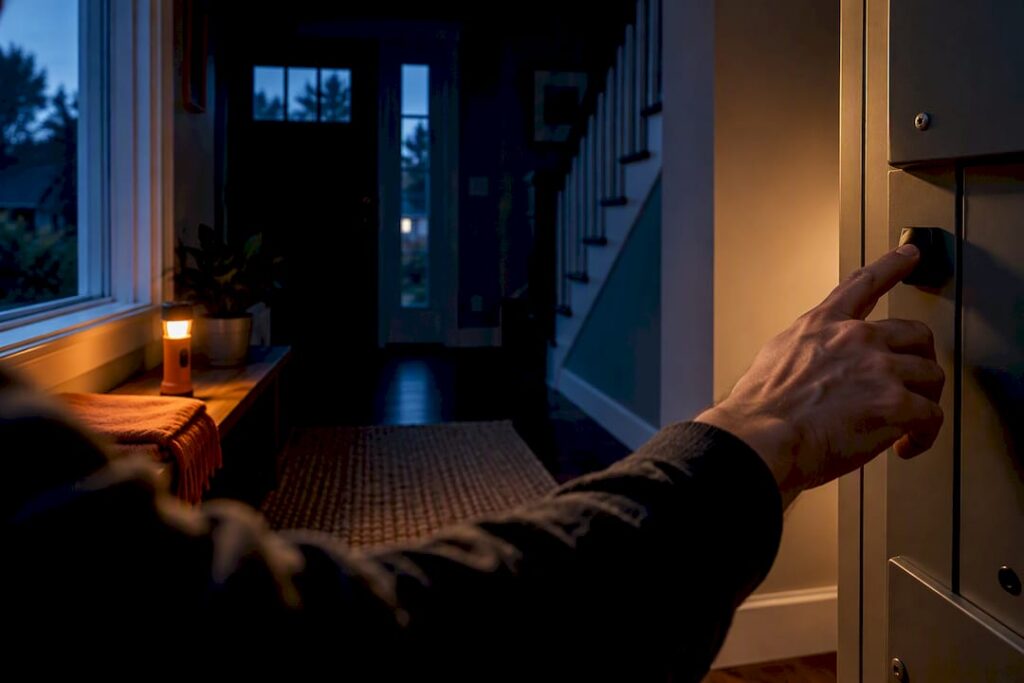
For renters, portable battery and solar generators are the quietest practical choice since they run without fumes or fuel and need no electrical work. Homeowners wanting whole-home resilience without noise should look at professionally installed battery backup with an automatic transfer switch. Anyone with higher power needs might consider an inverter portable generator or a properly sited standby unit, understanding each trades some quiet for capacity. Before choosing, check safety guidance from the Consumer Product Safety Commission, PGMA G300-2018, and UL 2201.
TL;DR:
- Portable battery and solar generators are ideal for renters because they operate silently and require no electrical modifications, making them highly portable.
- The quietest fuel-powered options, inverter generators like the Honda EU7000iS, typically produce between 52 and 58 dB(A) at rated load but still require outdoor use.
- Installed battery systems with automatic transfer switches provide whole-home silent backup but involve professional installation and are generally suited for homeowners.
- Backup power sizing should prioritize essential loads with a 20 to 30% safety margin, ensuring the chosen unit can handle peak startup wattages and extended outages.
- Safety guidelines recommend keeping fuel-burning generators at least 20 to 25 feet away from structures to prevent deadly carbon monoxide buildup, with regular maintenance and safety checks.
Table of Contents
- How loud is “quiet,” really?
- The four main types of quiet backup power
- Sizing your backup: watts, kilowatts, and kilowatt-hours
- Carbon monoxide, standards, and battery safety
- Keeping your system reliable between outages
- What renters and homeowners can each install
- Weighing your options before you decide
- When a professional installer earns their fee
- Comparing emissions across generator types
- What actually matters when you’re choosing quiet backup
- Getting pro-installed quiet backup for your home
- Where this information comes from
- Sources
- FAQ
How loud is “quiet,” really?
Noise gets measured in decibels using the A-weighted scale, written as dB(A), which adjusts the raw sound level to match how human ears actually perceive different frequencies. The scale isn’t linear: every 10 dB(A) increase sounds roughly twice as loud to you, so the difference between 50 dB(A) and 70 dB(A) is dramatic, not modest.

Manufacturers don’t always test the same way, which makes comparing specs tricky. Some report noise at 1 meter (about 3 feet) from the unit, others at 7 meters (about 23 feet), and load conditions vary too. A generator idling produces far less noise than one running at rated capacity.
Here’s what typical ranges look like across common backup options:
- Quiet conversation: around 50 dB(A), a useful reference point for comparison.
- Battery power stations in low-power mode: often in the 30 to 40 dB(A) range at 1 meter.
- Quiet inverter generators at rated load: commonly in the low 50s to high 50s dB(A).
- Open-frame or standby generators: frequently 60 to 80 dB(A) depending on load and distance.
Always check whether a spec sheet lists the measurement distance and load. A number without that context tells you very little.
The four main types of quiet backup power
Each option below handles noise, runtime, and installation differently, so the right pick depends heavily on where you live and what you need powered.
-
Portable battery and solar generators run completely silent since there’s no combustion involved, which makes them the only option safe for indoor use. They store a fixed amount of energy measured in kilowatt-hours (kWh), so runtime is capped until you recharge, either from a wall outlet or attached solar panels. A manufacturer example shows some units advertising roughly 30 dB(A) at 1 meter in a low-power mode, though noise rises under heavier loads. Many models let you add extra battery packs to extend capacity, which suits renters who want flexibility without any electrical modification.
-
Inverter portable fuel generators produce cleaner, more stable power than older open-frame designs and run noticeably quieter, but they still burn gasoline or propane and must stay outdoors. One well-known example, the Honda EU7000iS, reports noise in the 52 to 58 dB(A) range at rated load and includes CO-detection features on certain models. These units suit homeowners who need more power than a battery station provides but don’t want a permanent installation.
-
Installed battery systems with an automatic transfer switch (ATS) connect directly to your home’s electrical panel and switch over seamlessly when the grid drops, powering selected circuits without any noise at all. Installation requires a licensed professional, but the payoff is quiet, hands-free backup for a refrigerator, medical equipment, or home office circuits.
-
Standby generators run on natural gas or propane, sit permanently outside the home, and deliver enough power to run most or all of a house. They tend to be louder than inverter portables and require careful siting to manage both noise and carbon monoxide exposure, which we cover in the safety section below.
Sizing your backup: watts, kilowatts, and kilowatt-hours
Sizing starts with a simple question: what do you actually need to keep running? List each essential item’s wattage, which is usually printed on the appliance label or found by multiplying volts by amps (a device drawing 5 amps at 120 volts uses 600 watts). Add those numbers together for your starting point, then add roughly 20 to 30% headroom for appliances like refrigerators that draw extra power when starting up.
Two quick examples show how this plays out:
- Overnight essentials (refrigerator, Wi-Fi modem, a few LED lights, phone chargers) typically total 400 to 600 watts continuous, which a battery station in the 1 to 2 kWh range can often cover for several hours.
- Multi-day partial-home needs (refrigerator, well pump, some lighting, a window AC unit) can push continuous draw past 2,000 watts, which points toward a larger battery bank, an inverter generator in the 3,000 to 7,000 watt class, or a standby unit.
Use this checklist when comparing product specs:
- List every essential appliance and its running watts, not just its startup surge.
- Add 20 to 30% headroom for motor-driven appliances that spike on startup.
- Match total watts to the generator’s continuous power rating, not its peak rating.
- Check kWh capacity against how many hours you need to run, not just total wattage.
- Confirm whether recharging depends on solar, an outlet, or a fuel supply.
Getting this right upfront saves you from buying a unit that technically “fits” on paper but can’t actually keep your fridge running through a multi-day outage.
Carbon monoxide, standards, and battery safety
Fuel-burning generators produce carbon monoxide, an odorless gas that can be fatal within minutes in an enclosed space. The CPSC recommends operating portable generators outdoors at least 20 feet from any structure, including windows and doors.
One in a range of studies from CPSC staff finds that certification to voluntary safety standards, specifically PGMA G300-2018 and UL 2201, along with automatic CO shut-off features, is estimated to reduce CO-related fatalities substantially, an estimate the agency puts between 87% and 100%. Look for these certifications on the product label before you buy.

For stationary or standby generators, CPSC staff technical analysis recommends increasing separation distances to at least 25 feet from structures, up from the older 5-foot guidance, based on simulation work modeling CO exposure scenarios. Standby units can sometimes emit CO at rates higher than portables, so conservative siting matters even more.
Battery systems carry different risks, mainly related to fire. Follow these practices:
- Register every battery unit with the manufacturer so you receive recall notices directly.
- Keep firmware updated, since manufacturers push safety patches through software.
- Ensure adequate ventilation around any hardwired battery system, following the installer’s spacing guidance.
- Install CO and smoke alarms near any fuel-burning backup equipment and test them monthly.
Keeping your system reliable between outages
A backup system that fails when you actually need it defeats the purpose of owning one, so a light maintenance routine matters more than most people expect.
For battery systems, check firmware updates monthly since manufacturers often patch safety and performance issues remotely. Run a capacity test every few months, confirming the unit still holds close to its rated kWh, and inspect ventilation around hardwired units at least twice a year.
For portable and inverter fuel generators, change the oil per the manufacturer’s schedule, usually every 100 hours of use or annually, and store fuel in approved containers away from living spaces. Run the unit for 15 to 20 minutes every month even without an outage, which keeps the engine and fuel system from gumming up.
- Check firmware and run a capacity test on battery units every few months.
- Change oil and inspect fuel lines on portable generators per the manufacturer’s schedule.
- Register products immediately so you’re notified of any safety recalls.
- Test CO and smoke alarms monthly, especially near fuel-burning equipment.
Pro Tip: Set a recurring calendar reminder for generator run-cycle tests. It’s the single easiest habit that prevents a dead battery or gummed carburetor from ruining an outage.
What renters and homeowners can each install
Renters generally have more flexibility than they realize, since portable battery and solar generators require zero electrical modification and can move with you between apartments.
-
Renter-friendly options include portable battery stations, solar panels for recharging, and UPS-style backup devices for small electronics. None of these touch your building’s wiring, so landlord approval typically isn’t a concern.
-
Homeowner installations involving an ATS or a standby generator require permitted electrical work, and many neighborhoods with a homeowners association require design approval before installation begins.
-
Questions worth asking any installer include what warranty covers the battery and inverter, what a maintenance plan costs annually, how the system interconnects with your existing panel, and how long the full installation timeline runs from contract to activation.
Weighing your options before you decide
Every quiet backup option makes a tradeoff between silence, power, and how much installation it demands.
- Portable battery/solar: silent and renter-friendly, but limited by kWh capacity and recharge speed.
- Inverter portable fuel generators: more power than batteries, quieter than open-frame designs, but outdoor-only and fuel-dependent.
- Installed battery + ATS: seamless and silent for chosen circuits, but requires professional installation and upfront cost.
- Standby generators: highest power output, but louder and requiring careful CO-conscious siting.
| Option | Typical noise | Best use case | Installation |
|---|---|---|---|
| Portable battery/solar | 30 to 40 dB(A) at 1 m | Renter-friendly, essential loads | Plug-and-play |
| Inverter portable fuel | 52 to 58 dB(A) at rated load | Short-duration, higher power | Plug-and-play, outdoor only |
| Installed battery + ATS | Silent | Whole-home select circuits | Pro-installed with ATS |
| Standby generator | 60 to 80 dB(A) | Whole-home, extended outages | Pro-installed, permitted |
Match your pick to your actual budget, runtime needs, installation limits, and noise tolerance rather than the biggest number on the box.
When a professional installer earns their fee
Some tasks are safe to handle yourself, like plugging in a portable battery station or swapping fuel filters on a schedule. Others genuinely require a licensed professional: calculating your home’s load profile, sizing and installing an ATS, wiring a subpanel for backed-up circuits, pulling permits, and handling utility interconnection paperwork.
A professional installer typically handles load analysis, ATS and subpanel installation, permitting, interconnection with your utility, and warranty registration on your behalf. That last piece matters more than it sounds since a battery system registered incorrectly can complicate a future recall or warranty claim. If you’re weighing a pro-installed option, Alpha Solar Solutions handles battery backup design and installation for homeowners who want the seamless, silent version of backup power rather than the plug-and-play version.
Comparing emissions across generator types
Portable battery and solar generators produce zero emissions during operation since there’s no combustion involved, which makes them the cleanest option for indoor or close-quarters use. Their environmental footprint shifts upstream, tied to how the battery was manufactured and, if solar-recharged, how much of that energy comes from panels versus the grid.
Fuel-burning generators, whether inverter portables or standby units, emit carbon monoxide, nitrogen oxides, and particulate matter proportional to how much fuel they burn and for how long. Propane generally burns cleaner than gasoline, producing fewer particulates, while natural gas standby units burn relatively cleanly but still emit CO and require the same outdoor siting precautions.
Installed battery systems paired with solar panels offer a middle path: silent and emission-free during operation, with recharging drawn partly or fully from sunlight rather than fossil fuel combustion. For homeowners already invested in solar, adding battery backup extends that clean-energy setup into outage protection without introducing new emissions at the point of use.
The tradeoff isn’t purely environmental. Standby generators remain the most reliable choice for extended, multi-day outages in areas without strong grid backup, even though they carry a heavier emissions profile than battery-based alternatives.
What actually matters when you’re choosing quiet backup
Most people shopping for quiet backup power get distracted by the lowest decibel number on the spec sheet, but that number rarely tells the whole story. A unit that’s whisper quiet at idle can climb 15 or 20 dB(A) under real load, and a battery system that’s silent by nature still needs correct sizing to actually carry your fridge through a three-day outage.
The households that end up satisfied aren’t the ones who bought the quietest unit. They’re the ones who matched capacity, noise tolerance, and installation reality to what their home actually needs. Safety and reliability should outweigh novelty every time, especially where carbon monoxide is involved.
Take an honest inventory of your essential loads before you shop, not after.
— Anthony
Getting pro-installed quiet backup for your home
If you’ve decided that seamless, silent, whole-home backup makes more sense than a portable unit you have to manage yourself, a custom-designed system can provide this convenience, including handling design, installation, permitting, and paperwork so you’re not stuck figuring out ATS sizing or interconnection rules on your own.
Services typically include:
- Custom battery backup design sized to your actual essential circuits.
- Professional installation including ATS and subpanel work, with necessary permits and inspections.
- Paperwork handling, including permitting and utility interconnection.
- Support after installation to help system reliability through future outages.
A consultation starts with a look at your home’s panel and typical loads, then a design tailored to what you actually need backed up. If quiet, reliable backup power sounds like the right next step, you can schedule a consultation to see what a custom system would look like for your home.
Where this information comes from
- CPSC carbon monoxide fatality report and generator safety guidance
- CPSC technical analysis on generator separation distances
- DOE Energy Storage Safety Strategic Plan
- Jackery HomePower 3600 Plus specifications
- Honda EU7000iS generator specifications
- National Weather Service home power backup guidance
Sources
- CPSC releases new report on carbon monoxide (CO) fatalities; urges generator safety
- Portable Generators – revisions to TN 2048 and resolution of comments
- Energy Storage Safety Strategic Plan
- Jackery Solar Generator HomePower 3600 Plus – Jackery
- Honda EU7000iS Generator | Super Quiet EU7000iS Generator
FAQ
Which backup generators are the quietest?
Battery-based portable power stations are the quietest option since they run without combustion, with some models advertising around 30 dB(A) at 1 meter in low-power mode according to manufacturer specifications. Among fuel-burning generators, inverter models like the Honda EU7000iS run quieter than open-frame designs, reporting 52 to 58 dB(A) at rated load.
What is the best power backup solution for a home?
The best solution depends on your outage length and budget: short-duration needs favor a battery station or UPS, while longer outages favor hybrid battery-plus-solar or fuel-backed standby systems depending on fuel availability, as DOE guidance notes. Homeowners wanting whole-home coverage without noise typically choose an installed battery system with an automatic transfer switch.
How do I stay safe using a fuel-powered generator?
Keep portable generators at least 20 feet from any structure, including windows and doors, following CPSC guidance. For stationary or standby units, CPSC technical staff recommend even greater separation, at least 25 feet, based on CO exposure simulation analysis.
Do battery backup systems need much maintenance?
Battery systems need lighter maintenance than fuel generators, mainly firmware updates, periodic capacity tests, and ventilation checks around hardwired units. Registering your product with the manufacturer ensures you’re notified promptly if a safety recall is issued.
Can renters use quiet backup power without landlord approval?
Yes, portable battery and solar generators require no electrical modification, so renters can use them freely without landlord permission. Installed battery systems with a transfer switch, by contrast, require permitted electrical work and typically aren’t an option for renters.