
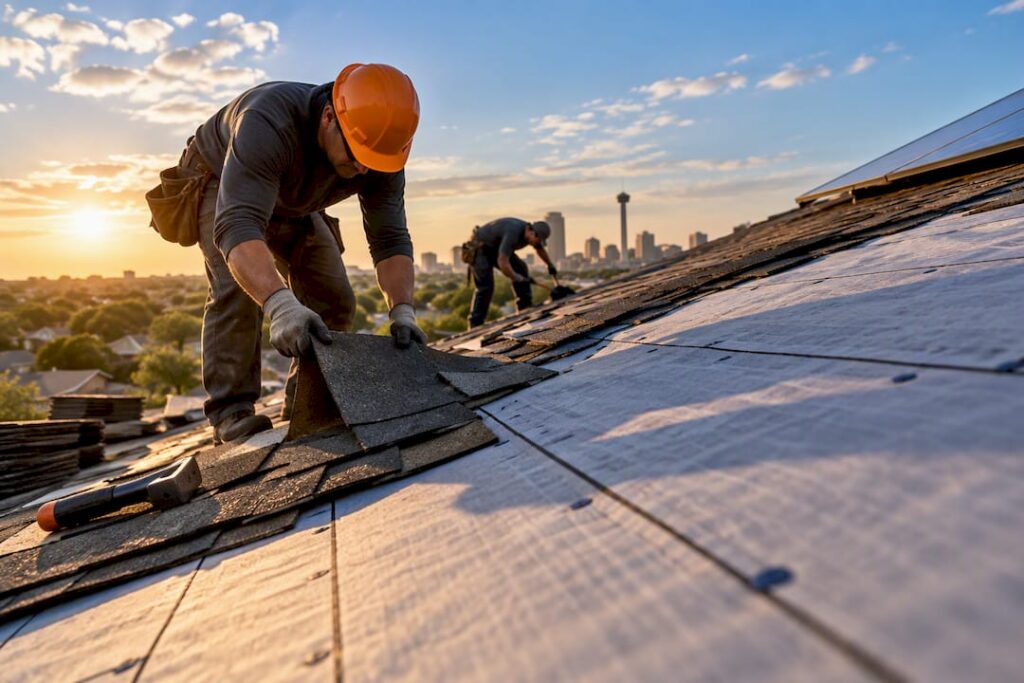
Replace your roof first only if it has less than about ten years of useful life left. If your roof is healthy and likely to outlast most of a 25 to 30-year solar system, you can install panels now and skip the extra expense. Waiting until later can add hundreds of dollars per panel in detach-and-reset costs, so factor in San Antonio’s hail history, your decking condition, and local permit requirements before you decide.
TL;DR:
- Replacing your roof before installing solar is advisable if it has less than ten years of remaining useful life, especially in hail-prone San Antonio.
- A typical asphalt roof replacement costs $7,000 to $12,000, and bundling it with solar can save around $4,000 compared to separate projects.
- Detach-and-reset work for solar panels adds $200 to $500 per panel, so replacing the roof first can prevent these additional costs over 20 panels.
- Roof materials like standing-seam metal last longer and reduce rework, with metal often outlasting the solar system itself, making it a long-term option.
- Proper coordination of permits and inspections is critical, especially when structural changes occur, to avoid delays that extend project timelines.
Table of Contents
- How to decide: roof age and condition benchmarks for San Antonio homes
- Costs and savings: bundling roof replacement with solar vs doing them separately
- Solar detach, reset, and contractor coordination: what to expect
- Permits, inspections and code items specific to San Antonio
- Best roofing materials and attachment methods for long-lasting solar in San Antonio
- Practical timeline and next steps to replace a roof before (or with) solar
- Local homeowner perspective: common tradeoffs in San Antonio
- Alpha Solar Solutions: one contractor for roof and solar coordination
- Sources
- FAQ
How to decide: roof age and condition benchmarks for San Antonio homes
Solar panels are built to run for 25 to 30 years, so the real question is whether your roof can keep pace. A roof that needs major work halfway through that window forces you to pay for panel removal and reinstallation you never budgeted for.
Service life varies a lot by material and by what San Antonio’s hail and summer heat have already done to your shingles. Architectural asphalt shingles typically last 20 to 30 years, three-tab shingles less than that, while standing-seam metal and tile often reach 40 years or more.
Before you commit either way, walk the roof (or have a contractor do it) and check these items:
- Decking integrity and any soft or spongy spots underfoot
- Flashing around chimneys, valleys, and vent pipes
- Vent boots and pipe collars for cracking
- Attic water stains or musty odors after rain
- Visible sagging along the ridge or eaves
- Hail bruising or missing granules on shingles
- Soffit and ridge ventilation airflow
Pro Tip: If your roof is likely to need major repairs within 5 to 10 years, replace it before solar goes up. That window covers most of the risk period contractors worry about.
Costs and savings: bundling roof replacement with solar vs doing them separately
Typical asphalt roof replacements in San Antonio run $7,000 to $12,000, while larger or premium roofing jobs can top $20,000. Combined roof and solar projects generally land between $25,000 and $45,000, depending on system size and roofing material.
Coordinating the two projects avoids paying twice for mobilization, scaffolding, and permitting. The DOE and NREL estimate average savings around $4,000 when homeowners bundle roof replacement with a new solar installation instead of running them as separate jobs months apart.

Detach-and-reset work, by contrast, typically adds $200 to $500 per panel. On a 20-panel residential array, that is $4,000 to $10,000 you would not spend if the roof had simply been replaced first.
A few practical notes before you sign anything:
- Bundling saves the most when your roof clearly needs replacement anyway
- Solar-first makes sense if your roof was replaced recently or just passed inspection
- Always ask for separated pricing on roof and solar line items rather than accepting one vague “free roof” bundle
- Financing terms vary by lender and system size, so get quotes in writing before comparing
One note on incentives: the federal Residential Clean Energy credit no longer applies to solar equipment placed in service after December 31, 2025, so factor project costs on their own merits rather than around a credit that has expired.
Solar detach, reset, and contractor coordination: what to expect
When your solar array is healthy but the roof underneath needs work, a detach-and-reset keeps you from tearing out a functioning system unnecessarily. Local providers in San Antonio coordinate this process directly with roofing crews so nothing sits exposed longer than necessary.
The typical workflow looks like this:
- Panels are unbolted, labeled by position, and moved to safe on-site storage
- Mounting hardware and conduit are removed or protected
- Roofing work proceeds, including decking repair and new material installation
- Panels are reinstalled in their original positions
- The system is recommissioned and tested for output and safety
Cost and timeline depend on panel count, whether you have microinverters or optimizers, and available weather windows. Before work starts, confirm in writing who is liable if a panel is damaged during downtime, and require a signed testing acceptance once the system is back online.
Pro Tip: Ask both contractors, roofer and solar installer, to inspect the mounting hardware before reinstallation. Reused lag bolts and flashing are common failure points.

Permits, inspections and code items specific to San Antonio
Re-roofing in San Antonio does not always require a separate permit, but certain projects trigger full plan review. The city’s Development Services department requires a permit when a project changes roof pitch or involves structural work, which is common when you are adding solar mounting hardware at the same time.
Before hiring anyone, confirm these items:
- Contractor registration with the city, which costs $170 for a two-year period
- Minimum insurance coverage of $500,000 per occurrence and $1,000,000 total liability
- Whether your specific project needs a standard permit or full plan review
- How permit timing affects your overall project calendar, since plan review can add weeks
Sequencing matters here. If solar mounting changes anything structural, get that reviewed before roofing work starts, not after.
Best roofing materials and attachment methods for long-lasting solar in San Antonio
Your roofing material affects both how long the roof lasts and how much rework you will face if you ever need to service the array underneath. Asphalt shingles are the most common and least expensive option, but they also have the shortest lifespan relative to a 25 to 30 year solar system.
Standing-seam metal often makes the most sense for a long-term solar host. Panels can be clamped directly to the seams, which reduces roof penetrations and lowers long-term leak risk compared to shingle mounts that require drilling. Metal roofs frequently outlast the solar array itself, so you avoid a detach-and-reset entirely during the system’s working life.
Tile roofs perform well too, though installers need specialized flashing to avoid cracking tiles during mounting. Flat roofs bring their own concerns: check for ponding water, seam integrity, and attachment methods that do not compromise the membrane.
- Standing-seam metal: fewer penetrations, longest material lifespan
- Tile: durable but requires specialized mounting hardware
- Flat membrane roofs: watch for ponding and seam wear
- Solar shingles: an integrated option worth comparing on cost versus a traditional array
Practical timeline and next steps to replace a roof before (or with) solar
A combined roof and solar project usually moves through five stages, each with its own timing.
- Inspection (1 to 2 days): a roofer and solar installer both assess condition and system design
- Quoting (1 to 2 weeks): get separated pricing from each contractor, not one bundled number
- Permitting (1 to 4 weeks): timing depends on whether your project needs plan review
- Roof replacement (2 to 5 days): weather-dependent, faster in dry stretches
- Solar installation and commissioning (1 to 3 days): includes final testing
Ask both contractors how their warranties interact. A roof warranty and a solar panel warranty rarely cover the same failure, so get it in writing which company is responsible for what.
Pro Tip: Schedule roofing work outside of San Antonio’s peak summer heat and spring hail season when possible. Late fall and early spring tend to offer the most predictable weather windows.
Local homeowner perspective: common tradeoffs in San Antonio
Every homeowner I talk to about this decision is weighing the same two things: budget today versus risk tomorrow. In a market where hail rolls through most springs and summer heat bakes shingles for months at a stretch, an honest inspection matters more than any sales pitch.
The contractors worth hiring are the ones who tell you the truth about your roof’s remaining life, even when that truth means a bigger bill upfront. If your roof and your solar plans are both on the table, ask for a coordinated estimate that separates the two costs. That is the only way to see what you are actually paying for.
— Anthony
Alpha Solar Solutions: one contractor for roof and solar coordination
A single contractor can eliminate the need to manage separate crews and timelines by handling scheduling, permitting, and coordination between roofing and solar work for a combined roof and solar project.

Alphasolarsa installs residential solar systems designed around your roof’s actual condition, and if your panels need to come down for roof work, the removal and reinstallation service keeps your existing array intact instead of forcing a full replacement. The team also handles battery backup installation, EV charger setup, and ongoing panel cleaning and maintenance, so your system keeps performing years after the roof work wraps up. Permitting and paperwork are handled as part of the project, reducing the coordination gaps that cause delays when two separate companies are involved.
If your roof and solar plans are both on the table, request a coordinated estimate from Alphasolarsa’s residential solar installation page and find out what a single-contractor approach looks like for your home.
Sources
- Replacing Your Roof? It’s a great time to add solar | Office of Energy Efficiency & Renewable Energy (DOE)
- Contractors and building permits — City of San Antonio Development Services
- Do You Need A Roof Replacement With Solar Panels? | EnergySage
FAQ
Should I replace my roof before getting solar panels?
Replace your roof first if it has less than about 10 years of useful life remaining, since solar systems are designed to last 25 to 30 years. If your roof is healthy and recently inspected, you can typically install solar now without extra risk.
Will insurance cover a 20 year old roof in Texas?
Coverage depends on your specific policy and insurer, and many Texas insurers apply depreciation or exclusions on older roofs, especially after hail damage. Check your policy directly and ask your insurer how age affects claim payouts before assuming full replacement coverage.
What is the typical cost of replacing a roof in San Antonio?
A standard asphalt shingle roof replacement in San Antonio typically runs $7,000 to $12,000, while larger or premium roofs can exceed $20,000. Combined roof and solar projects generally range from $25,000 to $45,000.
What is the 25 percent rule for roofing?
Definitions vary by jurisdiction, but some building codes use a threshold where repairing more than a set percentage of a roof triggers full replacement or additional permit requirements. Check with San Antonio’s Development Services department for the exact rule that applies to your property.
Does Alphasolarsa handle both roof coordination and solar installation?
Alphasolarsa specializes in solar and battery installation, including panel removal and reinstallation when roof work is needed, and coordinates scheduling with your roofing contractor. Pricing for residential solar installation runs $12,000 to $25,000, with other services quoted directly on request.