

CPS Energy’s last approved rate increase was 4.25%, effective February 1, 2024, adding a small amount to the average residential bill. As of early 2026, CPS has not filed for a new increase, leaning instead on refinancing and borrowing to manage costs, though board discussions about a future hike have surfaced in local reporting. If your bill still jumped, the cause is usually fuel costs or peak-season charges, not a new base rate. Assistance programs can help right now, and the sections below break down exactly where those charges show up.
TL;DR:
- Fuel price swings and wholesale gas costs, not the 4.25% rate increase, are responsible for most sudden bill spikes, especially during extreme weather.
- The Peak Capacity Charge applies during summer months for usage over 600 kWh, often causing monthly bills to rise sharply with air-conditioning use.
- Assistance programs, like the expanded Affordability Discount Program, can help manage higher bills, but enrollment should be proactive before bills become overdue.
- Future rate hikes are publicly announced through CPS meetings and filings, making changes predictable and requiring formal approval.
- Installing solar panels and batteries can mitigate future rate increases, especially the Peak Capacity Charge, by offsetting high summer energy demands.
Table of Contents
- What Changed in 2024 and Why CPS Raised Rates
- Why Your Bill Can Still Spike Beyond the Base Rate
- How to Decode the Rate Charges on Your CPS Bill
- Who Qualifies for Bill Relief: ADP and Payment Assistance
- Is CPS Energy About to Raise Rates Again?
- Steps San Antonio Residents Can Take Right Now
- Solar and Battery Storage as Protection Against Future Rate Hikes
- What Residents Should Prioritize Next
- Alpha Solar Solutions: A Local Option for Lower Exposure to CPS Rate Hikes
- Sources
What Changed in 2024 and Why CPS Raised Rates
CPS Energy’s Board of Trustees approved a base rate increase in late 2023, and the San Antonio City Council signed off on the rate request before it took effect on February 1, 2024. That approval process matters: CPS is a municipally owned utility, so its rate changes go through both an internal board vote and a public City Council decision, unlike investor-owned utilities regulated solely by the state.
CPS said the new revenue was earmarked for specific priorities, not general overhead. The utility pointed to:
- Grid resiliency upgrades after repeated severe weather events
- Technology and cybersecurity investment
- Workforce staffing to keep pace with San Antonio’s growth
- Infrastructure maintenance deferred during prior budget cycles
For most residential customers, the increase translated into a small additional amount per month. Small commercial accounts saw a comparable percentage increase, scaled to their usage. The 4.25% figure applied to base rates only. It did not touch fuel costs or the separate recovery charges discussed below.
Why Your Bill Can Still Spike Beyond the Base Rate
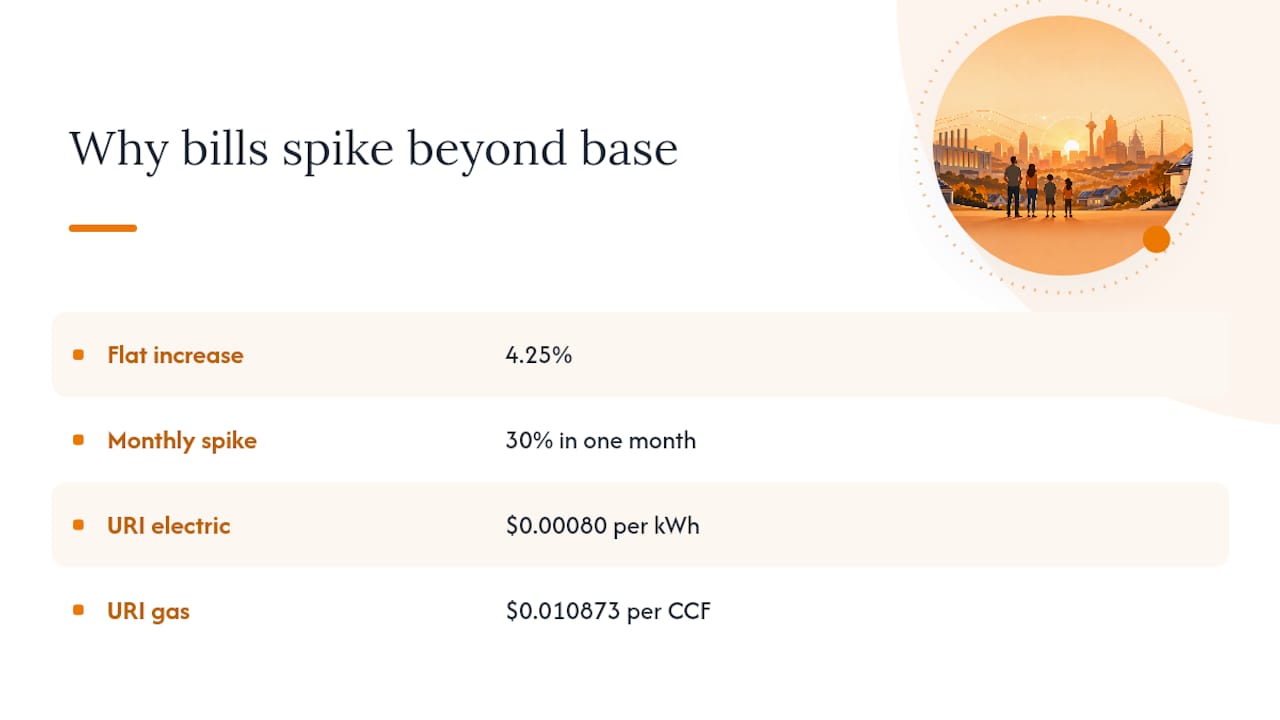
A flat 4.25% increase does not explain a bill that jumps 30% in a single month. That kind of spike almost always traces back to fuel costs, not the rate CPS charges for delivering power.
Natural gas prices swing with national demand, and CPS passes those wholesale costs through to customers as a fuel adjustment. When a cold snap or supply crunch spikes gas prices across Texas, that cost shows up on your next bill even if your own usage barely moved. KSAT reported in February 2026 that many customers saw higher bills despite using less electricity, with experts pointing to gas market spikes and pass-through fees as the likely cause.
Statistic Callout: Winter Storm Uri recovery factors are still active line items on today’s bills, adding about $0.00080 per kWh for electric service and $0.010873 per CCF for gas. It’s a small per-unit charge, but it compounds across a full billing cycle and it has nothing to do with your current usage habits.
Extreme weather creates a “double whammy,” as local reporting describes it: usage climbs during a heat wave or freeze at the same time wholesale fuel costs spike, and both hit the bill together.
How to Decode the Rate Charges on Your CPS Bill
Your CPS Energy bill breaks costs into several distinct categories, and knowing which line reflects which charge helps you spot what actually changed.
- Service Availability Charge: a fixed monthly fee for being connected to the grid, regardless of usage.
- Energy Charge: the per kWh rate for electricity consumed. This is where the 4.25% base increase from 2024 lives.
- Peak Capacity Charge: applies only during summer billing months, June through September, on usage above 600 kWh. Rate schedules list this at $0.02150 per kWh for the excess above that threshold.
- Fuel and pass-through adjustments: variable charges tied to wholesale gas prices and past recovery factors, including the Winter Storm Uri surcharges.
If your bill spiked in July or August, check whether you crossed the 600 kWh threshold. A window unit running nonstop or a pool pump on a bad schedule can push a household well past that line, and the Peak Capacity Charge only makes that overage more expensive.
Who Qualifies for Bill Relief: ADP and Payment Assistance
The 2024 rate increase came with an expanded safety net. CPS raised the Affordability Discount Program (ADP) monthly discount from $16.14 to $18.36 and set a target of growing enrollment from about 65,000 households to more than 80,000.
If you think you might qualify, here’s how to move forward:
- Check eligibility through income guidelines tied to federal poverty levels; CPS uses a sliding scale similar to other assistance programs.
- Use the Assistance Finder on CPS Energy’s website to locate ADP enrollment, payment plans, and third-party aid in one place.
- Apply before your bill becomes past due. Payment plans are easier to arrange proactively than after a disconnection notice.
Struggling customers shouldn’t wait for a crisis. ADP enrollment and payment plans exist precisely to smooth out spikes like the ones described above.
Is CPS Energy About to Raise Rates Again?
Rate increases at CPS follow a defined path involving approval by the Board of Trustees and the San Antonio City Council before any new charge takes effect. That two-step process means a hike can’t happen quietly. It requires public board agendas and a council vote, both matters of public record.
As for what’s next, reporting has been mixed. The San Antonio Report found that CPS held off on filing for a new rate increase while preparing to borrow or refinance, with figures discussed to involve significant financing, an alternative that avoids an immediate customer hike but can add interest costs over time. Separately, board discussions have touched on a possible increase later in the decade.
Watch for these signs if you want advance notice:
- Board of Trustees meeting agendas posted on CPS Energy’s website
- City Council committee hearings referencing utility finances
- Formal rate request filings, which CPS publishes when they happen
- Local coverage from KSAT, San Antonio Report, and Texas Public Radio
Steps San Antonio Residents Can Take Right Now
You don’t have to wait on City Council to manage your exposure to future increases. Some fixes take five minutes. Others take a season. A few are long-term investments that pay off for decades.
Right now:
- Log into your CPS account and check for billing errors, especially unexplained meter readings or estimated bills.
- Enroll in ADP or a payment plan if you’re behind or at risk of falling behind.
- Walk through your home for obvious energy drains, an aging window unit, a fridge running warm, appliances left running.
This season:
- Schedule HVAC servicing before summer; a poorly maintained system is often the single biggest driver of a Peak Capacity Charge overage.
- Weatherize doors, windows, and attic insulation. Small sealing jobs often cost under $200 and pay back within a year.
- Check CPS’s rebate programs, including EV charger incentives, before buying new appliances or a home charger.
Long-term:
Rooftop solar paired with battery storage reduces how much power you buy from the grid altogether, and it specifically targets the Peak Capacity Charge, since batteries can offset your highest summer-hour draws rather than just your average daily use. That distinction matters if you’re a heavy air-conditioning user: shaving peak hours does more for your bill than simply maximizing total kWh offset. Before committing, weigh payback period, warranty terms, and battery round-trip efficiency, and get a localized estimate through a tool like the Texas Solar Savings Calculator.
Pro Tip: Pull up your last 12 months of bills and look specifically at your June through September usage. If any month crossed 600 kWh, that’s the Peak Capacity Charge at work, and it’s the single easiest cost to target with efficiency upgrades or a properly sized battery.
Solar and Battery Storage as Protection Against Future Rate Hikes
A rooftop solar system offsets the electricity you’d otherwise buy from CPS at the Energy Charge rate, and it does so for the life of the system, not just the current rate cycle. Add a battery, and you gain protection against the Peak Capacity Charge specifically, since stored power can cover your highest summer draws instead of pulling from the grid during the priciest hours.
For San Antonio homeowners weighing whether solar makes financial sense, the Texas Solar Savings Calculator provides a localized starting estimate, and Alphasolarsa’s guide on how solar panels cut energy costs walks through the mechanics in plain terms.
What Residents Should Prioritize Next
If your budget is stretched, enroll in ADP or a payment plan before your bill becomes urgent. Everyone else should treat this as a planning window: get HVAC serviced, check rebates, and price out solar before the next rate cycle. Keep an eye on CPS board agendas. A quiet year now doesn’t mean rates stay flat forever.
— Anthony
Alpha Solar Solutions: A Local Option for Lower Exposure to CPS Rate Hikes
Alphasolarsa is a fixed alternative to riding out every CPS rate adjustment: once your system is installed, your solar production cost doesn’t move with fuel pass-throughs or Peak Capacity Charges the way a grid-only bill does. A local company handles residential solar installation, battery storage, EV charger installation, solar panel cleaning, and panel removal and reinstallation for San Antonio homeowners and businesses.

If you’re weighing whether solar fits your situation, start with the Texas Solar Savings Calculator for a localized estimate, or head straight to the residential solar installation page to request a consultation. Homeowners replacing an aging roof can also review the panel removal and reinstallation service before starting roof work that would otherwise disturb an existing array.
Sources
- CPS Energy Rate Request
- CPS Energy Rate Increase goes into effect February 1, 2024 (CPS newsroom)
- Why your CPS Energy bill may be higher this month — even if you used less power (KSAT)