
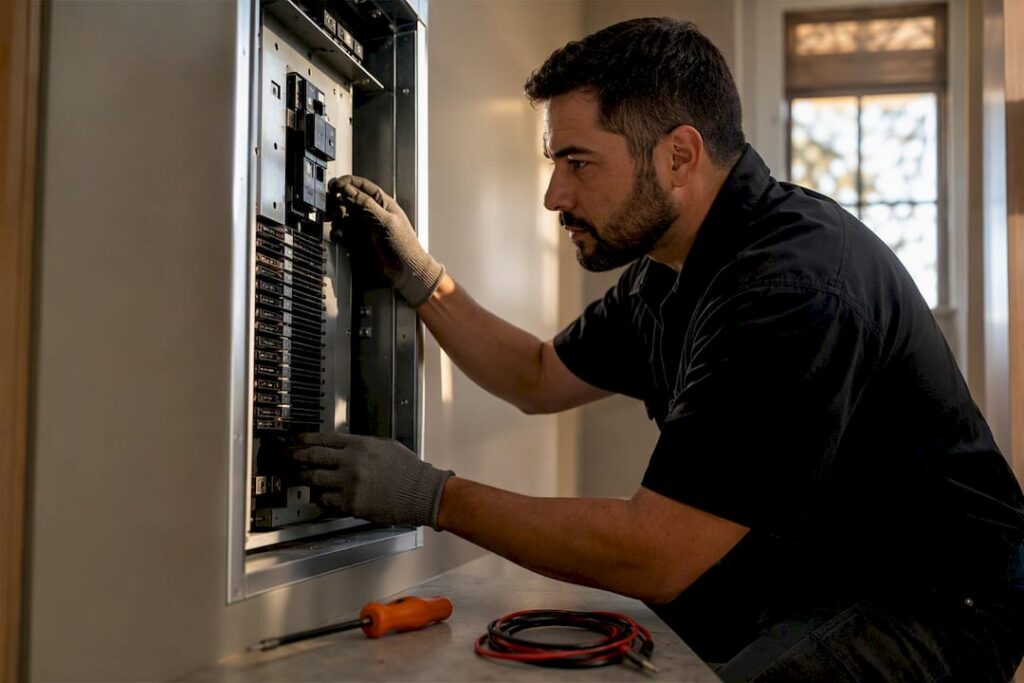
Most homes with 200A service can install one Level 2 EV charger without a full panel upgrade, but roughly 1 in 5 homes needs additional electrical work first. The only way to know for certain is a licensed electrician’s NEC Article 220 load calculation. Cheaper alternatives and utility rebates often close the gap before you spend money on a service upgrade.
TL;DR:
- The cost for panel upgrades varies from 500 to over 4,500 dollars, depending on whether it involves simple circuit addition, sub-panels, or complete system replacement.
- Cheaper alternatives like load management systems or lower-amp chargers can often delay or eliminate the need for costly panel upgrades.
- Utility rebates typically cover wiring and charger installation, with some programs offering financial aid for panel upgrades if pre-approved.
- Proper load calculation, not panel age or size alone, determines whether a full upgrade is necessary, so homeowners should verify their current capacity before committing.
Table of Contents
- How to Check Your Panel Before Calling an Electrician
- What Does an EV Charger Panel Upgrade Cost?
- Are There Cheaper Alternatives to a Panel Upgrade?
- Which Rebates Cover EV Charger Panel Upgrades?
- What to Expect When Hiring an Electrician
- Is a Full Panel Upgrade Worth It Long-Term?
- How Alpha Solar Solutions Handles EV Charger Panel Upgrades
- What Homeowners Get Wrong About Panel Upgrades
- Get an EV Charger Assessment From Alpha Solar Solutions
- Where to Verify Rebate and Technical Details
- Sources
How to Check Your Panel Before Calling an Electrician
Open your panel door and look at the main breaker. That number tells you your service size: 60A panels are outdated and almost always need work, 100A panels are borderline for a Level 2 charger, and 200A panels usually have room to spare. Count how many empty slots you have. A charger circuit typically needs one or two open slots for a 40 to 60 amp breaker.
None of that replaces a real NEC Article 220 load calculation, which is the math an electrician runs to see what your home already draws against what it’s allowed to carry. It factors in square footage, your HVAC system, water heater, range, and dryer, then applies demand factors that account for the fact that not everything runs at once. This is the step that actually decides whether you need an electrical panel upgrade for your EV charger, not a guess based on panel age.
Watch for these warning signs before you even call anyone:
- Breakers that trip repeatedly, especially when you run the dryer and microwave together
- Lights that flicker or dim when large appliances kick on
- A panel brand you’ve never heard of, or one older than 25 to 30 years
- Visible rust, scorch marks, or a fuse box instead of breakers
Before a technician arrives, snap photos of the panel label, your electric meter, and the spot where you want the charger installed. It saves a visit and speeds up your quote.
Pro Tip: Text those photos to the electrician ahead of time. Many can give you a rough read on your setup before they even show up, which saves everyone a wasted trip.
What Does an EV Charger Panel Upgrade Cost?
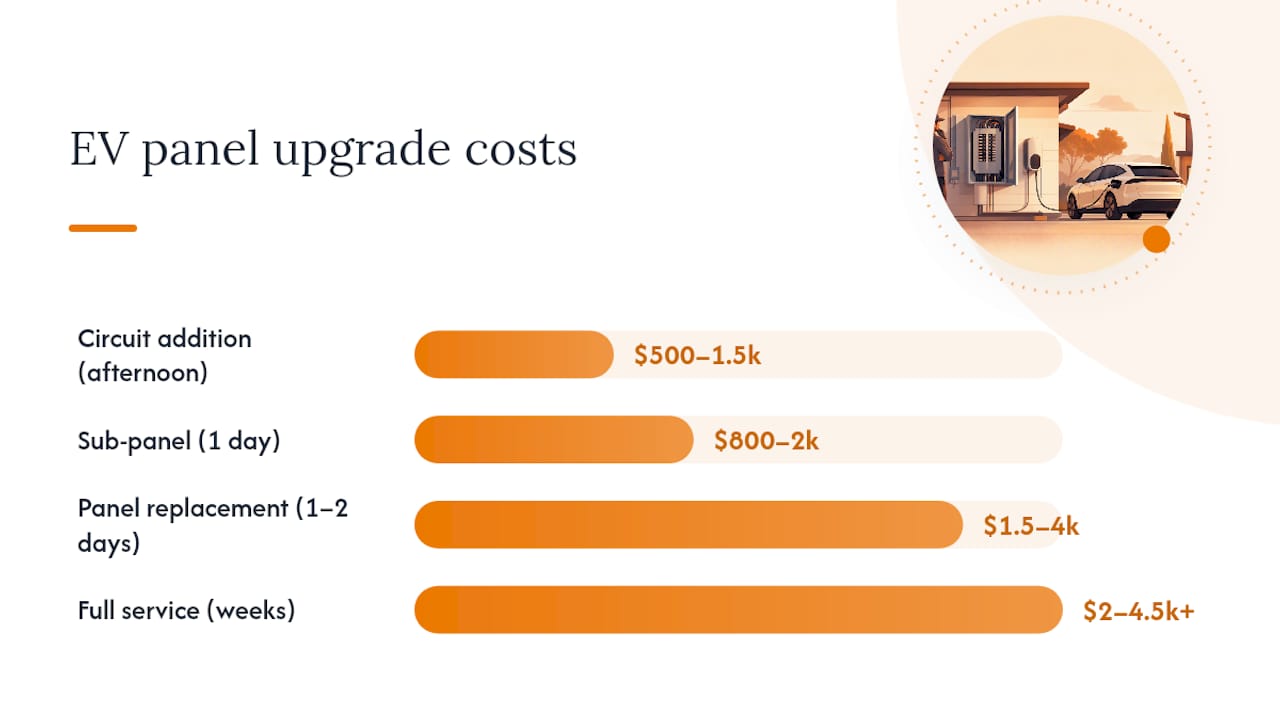
Panel work generally falls into four tiers, and knowing which one you actually need keeps a contractor from upselling you into the most expensive option by default.
- Circuit addition ($500 to $1,500): You have open slots and enough capacity. The electrician just runs a new dedicated circuit. Done in a few hours.
- Sub-panel installation ($800 to $2,000): Your main panel is full but the service itself is fine. A small secondary panel handles the new circuit. Usually a one-day job.
- Panel replacement ($1,500 to $4,000): The panel itself is outdated, damaged, or too small, even if the service amperage is adequate. Expect one to two days.
- Full service upgrade ($2,000 to $4,500 or more): Your home doesn’t have enough amperage overall, so the utility has to get involved. This is the most expensive tier and the one most homeowners fear, and often the one they don’t actually need.
If you skip the panel upgrade entirely and just need a basic Level 2 charger install, plan on $1,000 to $3,500 total. Add any panel work and that range climbs toward $3,000 to $7,000 depending on scope.
What moves the number inside each band: labor hours, the length of conduit and wire runs, permit and inspection fees, whether the panel needs to be relocated, and utility coordination fees for a service upgrade. A circuit addition might take an afternoon. A full service upgrade can take weeks once you factor in utility scheduling.
A quote without a load calculation attached is a red flag. Ask your contractor to show the math, not just hand you a number.
Are There Cheaper Alternatives to a Panel Upgrade?
A full service upgrade isn’t always the only path to a working charger. Several options solve the same problem for less money.
- Load management systems. These devices monitor your home’s total draw in real time and throttle the charger when other big appliances turn on, letting you install a charger your panel technically can’t support at full output simultaneously with everything else.
- Circuit-sharing devices. These let a charger share a circuit with another large appliance, like a dryer, switching power between them. They’re code-compliant when installed correctly, but NEC rules are specific about which loads can share this way, so this isn’t a DIY project.
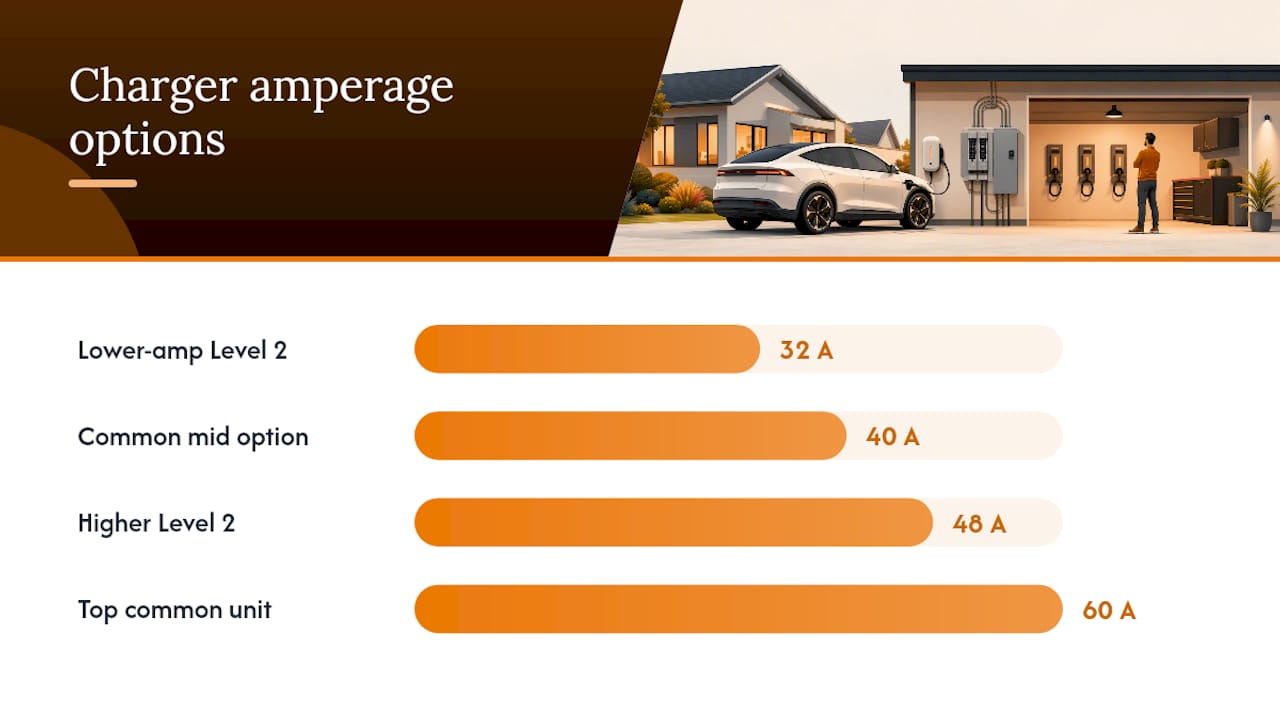
- Lower-amp Level 2 charging, or Level 1 as a bridge. A 32-amp charger draws meaningfully less than a 48 or 60-amp unit and may fit your existing panel with no changes at all. Level 1 charging off a standard outlet is slow, but it can cover daily commuting until you’re ready for more.
- A sub-panel as the middle ground. If your main panel is full but your service size is adequate, a sub-panel adds the circuit without touching your utility connection.
Homeowners can explore EV charging load management options before considering a full upgrade.
Pro Tip: If you’re comparing charger models, amperage matters as much as brand. A 40-amp charger paired with the right circuit often outperforms a 60-amp unit that’s throttled down anyway.
Which Rebates Cover EV Charger Panel Upgrades?
Rebate programs vary heavily by utility and state, but a few patterns show up again and again. Wiring rebates cover the cost of running new circuits. Panel-upgrade rebates offset the pricier tier of work. Charger and install rebates cover the hardware itself. Some programs add income-qualified tiers that increase the rebate amount for eligible households.
Program mechanics tend to follow a similar script:
- You often need pre-approval before work starts, not after
- Many utilities run “Trade Ally” contractor networks, meaning only enrolled electricians can process the rebate
- Photos and itemized invoices are usually required for reimbursement
- Some programs pay the contractor directly, so you never front the rebate amount at all
| Program type | Example | What it typically covers |
|---|---|---|
| Panel-upgrade rebate | Charge Ready Home | Wiring, panel work, charger install |
| Managed charging / meter swap | ChargeBoost | Faster charging without a panel upgrade |
| Rebate database | DSIRE | Local incentive search by state |
Southern California Edison’s Charge Ready Home program and PG&E’s ChargeBoost illustrate how these mechanics work in practice, though coverage is regional, not nationwide. Check DSIRE’s incentive database, your own utility’s website, and ask your electrician directly what’s locally available before assuming you’ll pay full price.
What to Expect When Hiring an Electrician
Getting quotes from three electricians isn’t overkill for a project this size. It’s the fastest way to spot who’s actually running the numbers versus who’s guessing.
- Verify the license with your state’s contractor board, and confirm they’ve handled EV charger installs specifically, not just general panel work.
- Ask who pulls the permit. A reputable electrician handles this themselves. If they suggest skipping it, walk away.
- Request a written load calculation before you sign anything. This is your proof the recommended tier of work is actually necessary.
- Expect an itemized quote, not a single lump number, and expect a realistic timeline that accounts for utility scheduling if a service upgrade is involved.
Permit fees are modest compared to the project cost, but utility coordination for a full service upgrade can add real time. The EPA’s home EV charging guidance reinforces the same point: hire licensed, and don’t skip the permit and inspection step, even if a contractor offers to.
Pro Tip: If a contractor recommends a full service upgrade without showing you a load calculation first, get a second opinion. That’s the single most common way homeowners overpay.
Is a Full Panel Upgrade Worth It Long-Term?
A full service upgrade earns its cost when your household is heading toward more electrical demand, not less. That includes a second EV, converting gas appliances to electric, adding a home battery, or running a workshop or pool alongside daily charging.
If you’re just getting your first EV and your panel is close but not quite there, a cheaper alternative now, paired with an upgrade later, is often the smarter financial move.
- Multiple EVs or planned electrification: upgrade now
- One charger, panel close to capacity: try alternatives first
- Adding a home battery or solar expansion soon: upgrade now
- Selling within a year or two: weigh resale value against upfront cost
Real estate agents in growing EV markets increasingly note updated panels as a selling point, though it rarely swings a sale price on its own.
How Alpha Solar Solutions Handles EV Charger Panel Upgrades
Every project starts with a site visit, not a sales pitch. We run a proper load calculation, hand you a written itemized quote, and file the permit ourselves once you approve the work. Installation and inspection follow, and we coordinate directly with your utility if a service upgrade turns out to be necessary.
Alpha Solar Solutions handles EV charger installation, panel upgrades, permitting, utility coordination, and solar and battery integration for homeowners who want one contractor managing the whole picture. Before your visit, have your panel photos and utility account information ready. We’ll follow up with a written recommendation, not a verbal guess.
What Homeowners Get Wrong About Panel Upgrades
The biggest mistake I see isn’t skipping the electrician. It’s calling one before doing the five minutes of homework that would let you ask smarter questions. A homeowner who walks in already knowing their panel is 200A with two open slots gets a faster, cheaper, more honest conversation than one who has no idea what they’re looking at.
Conventional advice treats a panel upgrade like an inevitability of EV ownership. The data doesn’t support that. Most homes don’t need one for a single charger, and the ones that do usually have a specific, identifiable reason, like an outdated fuse box or a maxed-out 100A service.
What actually protects your budget is sequencing: check your panel yourself, ask for the load calculation in writing, price out load management or a sub-panel before agreeing to a full service upgrade, and only then decide if the bigger investment makes sense for where your household is headed. Skip that order and you’re negotiating from a position of not knowing what you actually need, which is exactly where overpriced quotes come from.
— Anthony
Get an EV Charger Assessment From Alpha Solar Solutions
If you’d rather skip the guesswork of comparing load-management devices and contractor quotes on your own, Alpha Solar Solutions handles the whole process directly, from the initial panel check to the final inspection, without passing you between separate electricians and installers.
Send us photos of your panel label, your meter, and where you want the charger mounted, along with your utility account information, and we’ll come back with a real load calculation instead of a rough guess. If solar or battery storage is on your radar too, we handle that integration in the same visit rather than treating it as a separate project down the line. Request a quote or schedule a site visit through our EV charger installation page and get a written answer on what your home actually needs.
Where to Verify Rebate and Technical Details
For details specific to your address, these sources stay current and cover the technical ground this article touches on:
- EPA’s home EV charging guidance for load calculation and permit basics
- DSIRE’s incentive database for state-by-state rebate search
- SCE’s Charge Ready Home program and PG&E’s ChargeBoost as examples of regional program mechanics
Sources
- Do you need an electrical panel upgrade for your EV? | EnergySage
- Panel Upgrade for EV Charger: Cost, Process & NEC Requirements (2026) – ChargeRight
- Charge Ready Home | Rebates for Electrical Panel Upgrades
- ChargeBoost | PG&E
- Getting started with home EV charging | EPA