
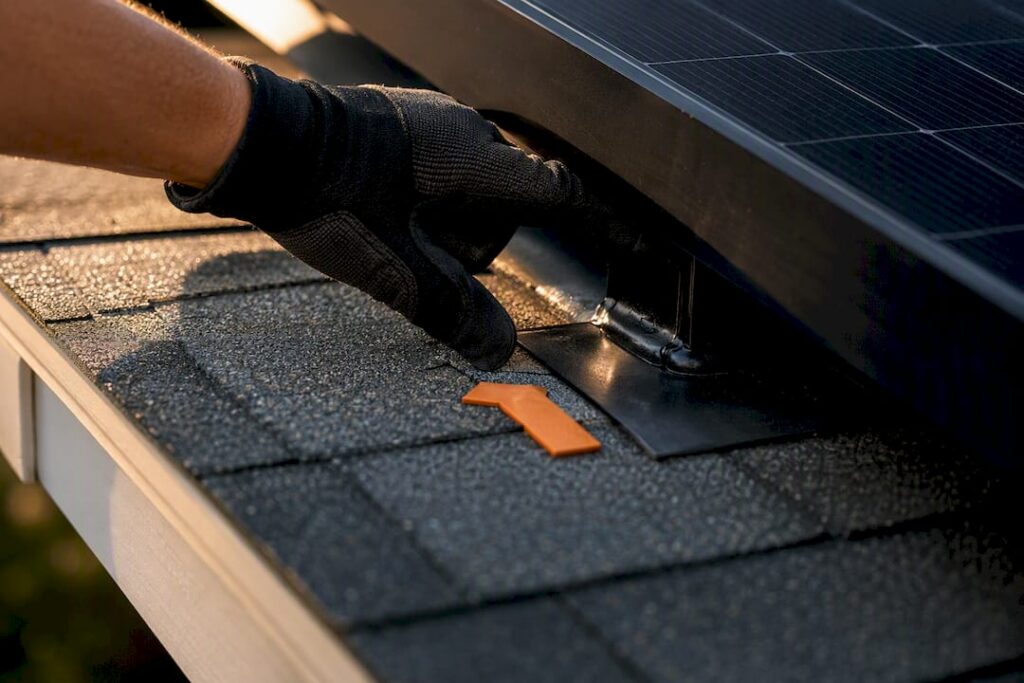
Installing solar panels does not automatically void your roof’s manufacturer warranty, as long as the system goes on according to the manufacturer’s specifications. What voids coverage isn’t the presence of solar. It’s sloppy installation work, and that risk falls under your solar installer’s workmanship warranty, not the shingle maker’s. Manufacturers like Owens Corning, GAF, Malarkey, and CertainTeed all publish technical bulletins spelling out approved mounting methods and what’s excluded. A coordinated installer can walk you through that paperwork before a single panel goes on the roof.
TL;DR:
- Installing solar panels does not void your roof warranty if the installer follows the manufacturer’s approved mounting methods and specifications.
- Distinguishing between manufacturer warranties and workmanship warranties is crucial, as the former covers material defects and the latter covers installation errors.
- Common reasons for voided claims include improper flashing, unauthorized sealant use, and mounting onto aged or structurally compromised roofs.
- A workmanship warranty’s duration varies widely and is unreliable if the installer goes out of business; third-party insurance can provide additional protection.
- Preparing detailed documentation and ensuring contractor credentialing before installation can prevent claim delays and costly disputes later on.
Table of Contents
- Roof Warranty With Solar: How the Two Coverage Types Actually Differ
- What Do Owens Corning, GAF, Malarkey, and CertainTeed Say About Solar?
- How Long Do Workmanship Warranties Last, and What Happens If the Installer Closes Up Shop?
- What Actually Voids Roof Warranty Coverage After Solar Goes In?
- The Pre-Install Checklist Every Homeowner Should Demand
- If Your Roof Needs Repair After Solar Panels Are Installed
- How a Full-Service Installer Protects Both Warranties at Once
- A Homeowner’s Real Priority Here
- Get a Coordinated Roof-and-Solar Install With Alphasolarsa
- Technical Bulletins and Resources Worth Reading
- Sources
Roof Warranty With Solar: How the Two Coverage Types Actually Differ
The confusion around roof warranty with solar installations comes from treating “roof warranty” and “solar warranty” as one document. They aren’t. They’re two separate contracts covering two separate risks, and knowing which one applies to your problem saves you weeks of back and forth with customer service lines.
The manufacturer warranty (from Owens Corning, GAF, Malarkey, or CertainTeed) covers defects in the shingles or tiles themselves. Think cracking, granule loss, or premature deterioration that has nothing to do with what’s bolted on top. These warranties often run 25 to 50 years, sometimes for the life of the home.
The installer workmanship warranty covers labor. It’s what protects you if a solar mounting bracket is drilled in wrong and rain starts finding its way into your attic. This warranty is usually much shorter, and its terms depend entirely on who installed your system.
- Manufacturer warranty: covers material defects, not installation errors
- Workmanship warranty: covers leaks, flashing failures, and other labor mistakes
- Removal and reinstallation labor: rarely covered by either when panels need to come off for a roof repair
If your roof leaks at a mounting point, that’s a workmanship issue. If your shingles are curling three rows away from any solar hardware, that’s a manufacturer issue. Mixing up which warranty to file under is the single most common reason homeowner claims get delayed.
What Do Owens Corning, GAF, Malarkey, and CertainTeed Say About Solar?
Every major shingle manufacturer allows solar installation on a warrantied roof. None of them ban it outright. But each attaches conditions worth reading before you sign a contract.
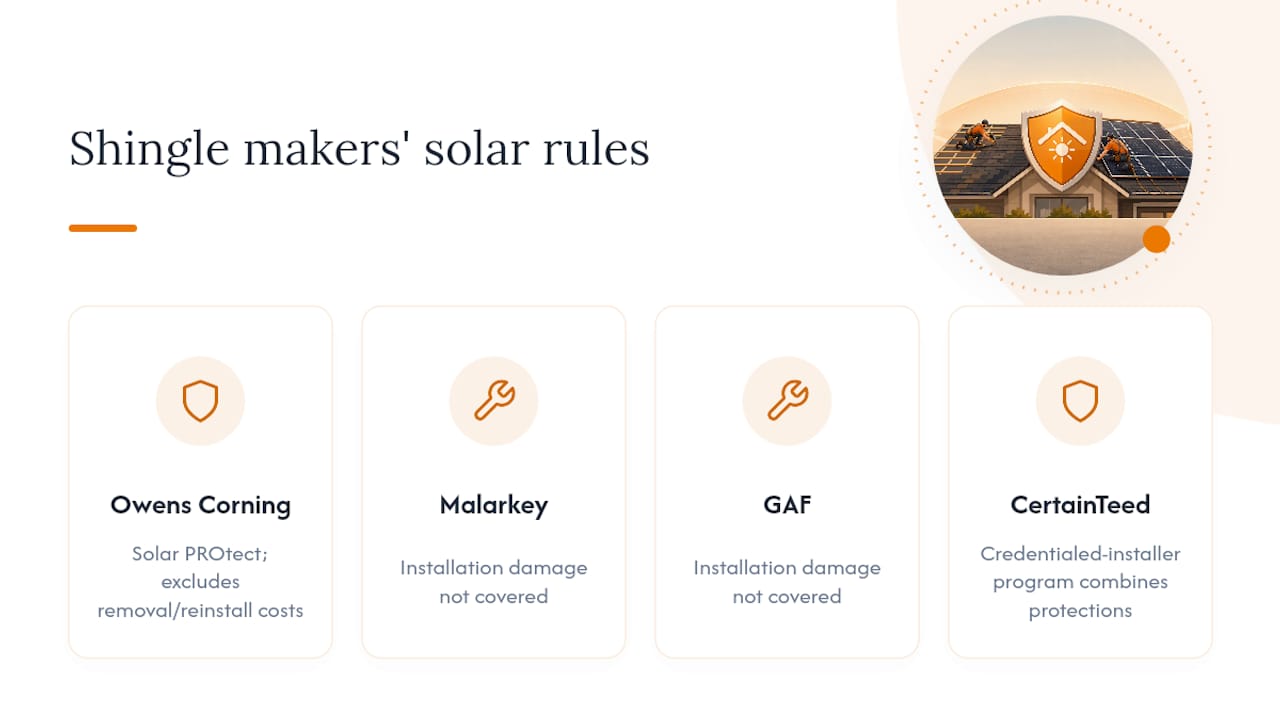
Owens Corning runs a program called Solar PROtect™, which extends warranty protection when specific eligibility rules are met, including using a credentialed installer and an approved product combination. One condition trips people up more than any other: the program typically excludes the cost to remove and reinstall panels if the roof itself ever needs warranty repair underneath them.
Malarkey takes a similarly permissive but pointed stance. Its technical bulletin states plainly that compatible solar equipment is allowed on warrantied projects, but damage caused by the installation process itself is not covered by the shingle warranty.
GAF and CertainTeed follow the same general pattern: solar is fine if installed to spec, and installation damage sits outside manufacturing coverage. CertainTeed goes a step further with programs tied to credentialed or master installers, which can combine materials and workmanship protection when eligibility rules are satisfied.
Pro Tip: Search “[your shingle brand] technical bulletin solar” or check the manufacturer’s roofing page directly. These documents are usually free PDFs, and they’re the closest thing to a rulebook for what will and won’t get your claim approved.
How Long Do Workmanship Warranties Last, and What Happens If the Installer Closes Up Shop?
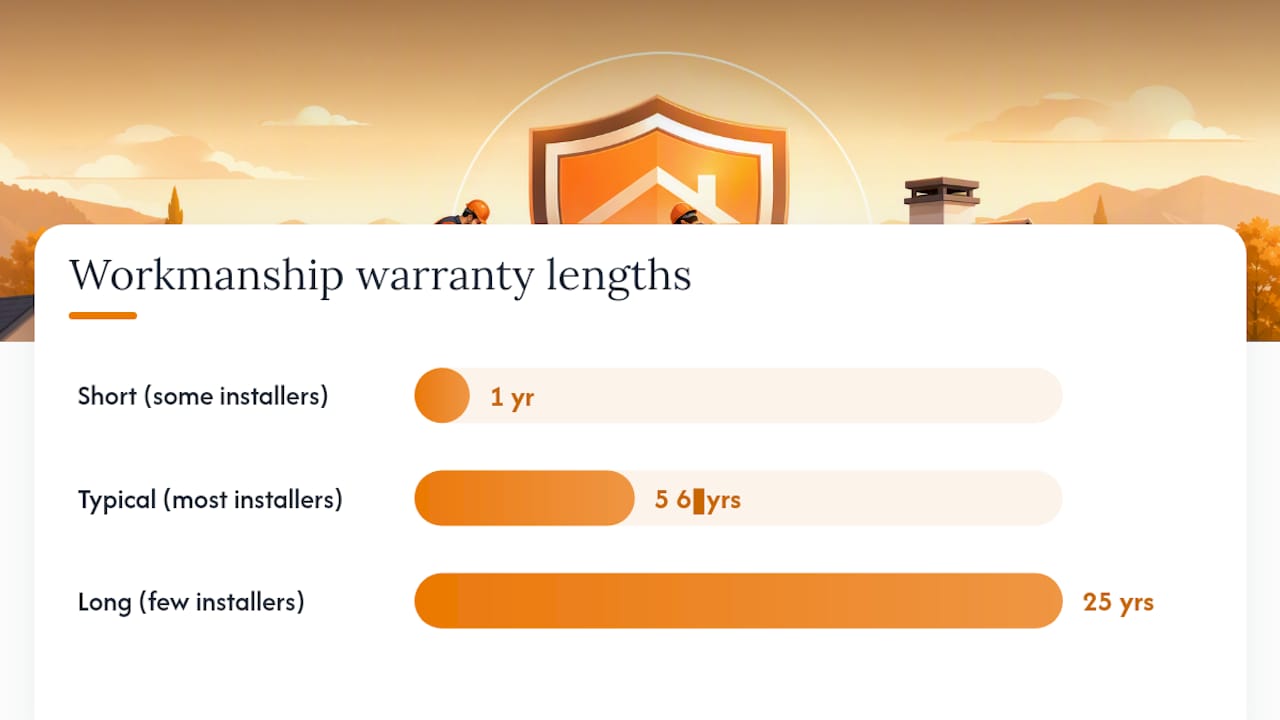
Workmanship warranties vary more than almost any other number in this industry. Some installers offer as little as one year. Others stretch to 25. Most fall somewhere between 5 and 12 years, and that warranty typically covers labor for repairs and leaks tied directly to the solar mounting points.
The real risk isn’t the warranty’s length. It’s whether the company offering it still exists when you need to file a claim. Solar installers close, merge, or exit regional markets more often than roofing manufacturers do, and a workmanship warranty from a defunct company is worth exactly nothing.
That’s where third-party programs, sometimes called SolarInsure-style warranties, come in. These are insurance-backed policies that step in for labor and parts coverage if your original installer disappears. Some manufacturers also administer their own extended programs for credentialed installers, which can offer similar protection.
Before signing with any installer, ask these questions:
- Does the workmanship warranty explicitly cover roof-penetration leaks, or just the solar equipment itself?
- Is the warranty transferable if you sell the house?
- What happens to your coverage if the company stops operating?
- Is there a third-party backstop available, and what does it actually cost?
- Who handles claims: the installer directly, or a separate administrator?
A written amendment covering roof-leak claims tied to panel penetrations is worth asking for at contract signing. Homeowners who skip this step sometimes end up paying removal and reinstall labor themselves after year five, once the original installer is gone.
What Actually Voids Roof Warranty Coverage After Solar Goes In?
Solar itself has never been the problem. The installation method is. Manufacturers consistently point to the same handful of mistakes when they deny a claim.
- Improper flashing around mounting brackets, letting water track under shingles
- Sealants that aren’t approved by the shingle manufacturer, which can degrade or react with roofing materials
- Cutting or field-modifying shingles to fit mounting hardware instead of using approved kits
- Mounting a solar system onto a roof that’s already near the end of its service life
- Unauthorized structural changes made without manufacturer or code review
The fix for all five is the same: use brand-approved flashing kits, fasten into rafters or structural decking rather than just the shingle layer, and never let an installer improvise a workaround because a bracket doesn’t quite line up. Improper flashing and fastener choices cause the overwhelming majority of voided claims, not the solar panels themselves.
Pro Tip: Ask your installer to photograph every flashing point and sealant application before the panels go on top. Date-stamped photos showing brand-approved materials are often the deciding factor when a manufacturer reviews a disputed claim.
The Pre-Install Checklist Every Homeowner Should Demand
Protecting your roof warranty with solar installation comes down to paperwork you collect before work ever starts, not paperwork you scramble for after a leak shows up.
- Ask for the shingle manufacturer’s technical bulletin and proof the installer is credentialed for that specific brand.
- Get written specifics on the flashing type and sealant brand being used, plus the plan for future panel removal if roof repairs are ever needed.
- Request a copy of the installer’s workmanship warranty, including transfer rules and any third-party insurance backing.
- Save permit records, before-and-after photos, and every warranty document in one folder, physical or digital.
Reviewing roof preparation requirements before installation begins also helps you understand what condition your roof needs to be in before mounting hardware goes anywhere near it.
If Your Roof Needs Repair After Solar Panels Are Installed
Roofs eventually need work regardless of what’s mounted on them. When that happens with solar already in place, the process runs in a specific order: notify your installer, document the issue with photos, determine which warranty applies, get written repair estimates, and schedule panel removal before any roofing work begins.
- Manufacturing defect (shingle failure unrelated to mounting): manufacturer warranty applies, but removal/reinstall labor is usually excluded
- Installation-caused leak: installer workmanship warranty or a third-party backstop typically covers both the fix and the labor
- Routine roof aging: falls on the homeowner, separate from any warranty
Coordinating a single team for both the roofing fix and the panel removal and reinstallation cuts down on delays and finger pointing between two separate contractors.
How a Full-Service Installer Protects Both Warranties at Once
A single vendor handling installation, cleaning, and removal/reinstallation eliminates the coordination gap that causes most warranty disputes. Alphasolarsa provides residential solar installation, panel removal and reinstallation, and solar panel cleaning for homes and businesses in the San Antonio area. One vendor means one set of documentation, one point of contact for warranty claims, and no gap between “whose responsibility is this” when a roof issue surfaces years after installation.
A Homeowner’s Real Priority Here
Documentation beats worry every time. The installer’s credentials and a photographed, spec-compliant install matter more than any fear that solar itself will void your coverage. Keep that checklist and warranty packet somewhere you can find it, especially if you sell the house.
— Anthony
Get a Coordinated Roof-and-Solar Install With Alphasolarsa
Some homeowners prefer one contractor accountable for both the solar system and the roof it sits on, instead of piecing together a roofer and a separate solar crew and hoping their warranties line up. That single-vendor structure is the practical answer to most of what causes disputes in this article: mismatched flashing, undocumented sealants, and no clear owner when something goes wrong five years later.

During your estimate, ask specifically for a credentialed installation, documented flashing and sealant details, and a full warranty packet you can keep on file. Alphasolarsa handles residential solar installation, commercial solar installation, panel removal and reinstallation, cleaning, and EV charger installation, all under one roof, literally. If you’re weighing a new system or need panels off for a roof repair, request a quote and get the documentation question answered before you sign anything.
Technical Bulletins and Resources Worth Reading
Check Owens Corning’s Solar PROtect™ page for eligibility rules, Malarkey’s technical bulletin for installation exclusions, and SolarPowerWorld’s breakdown of common voiders. The Asphalt Roofing Institute’s photovoltaic guidance covers approved mounting practices in more technical depth.
Sources
- Do solar panel warranties and roof warranties overlap? | EcoWatch
- Solar PROtect™ | Warranty Protection for Adding Solar Panels to Roof | Owens Corning Roofing
- Malarkey technical bulletin: installation of rooftop solar/PV equipment relative to Malarkey warranties
- Solar roof warranty: 3 warranties decoded | The Roofing Brief