
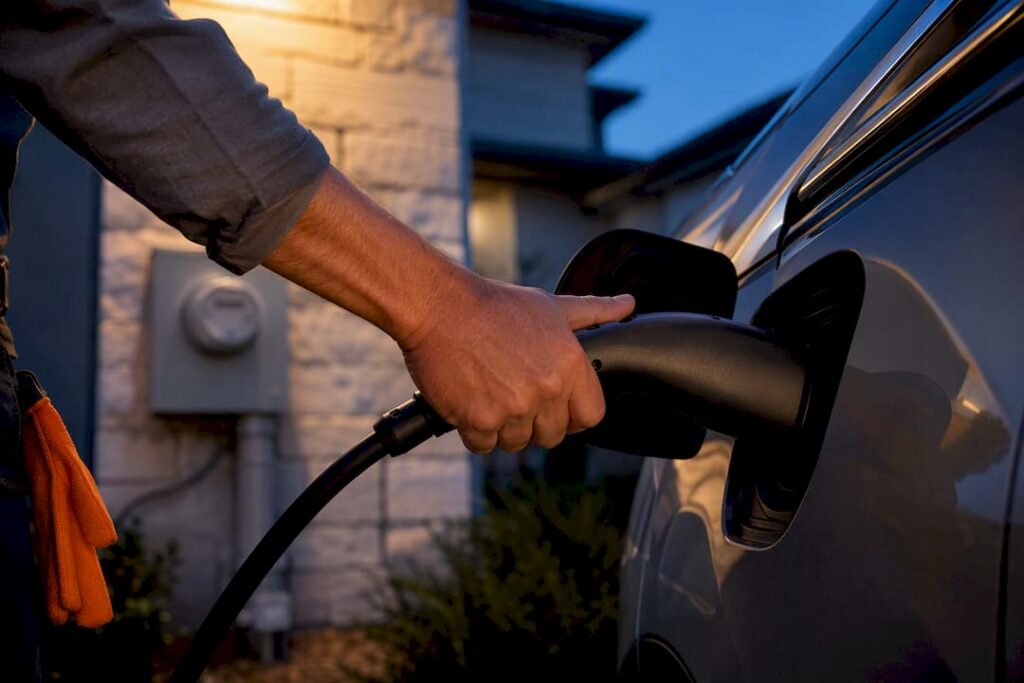
CPS Energy pays a $30 enrollment credit plus recurring monthly bill credits for customers who enroll in its EV Smart Rewards or EV Off-Peak Rewards programs. These are behavior-based bill credits tied to when and how you charge, not a one-time rebate for buying a charger. To sign up, visit CPSEnergy.com/EV and create a WeaveGrid account to link your vehicle or charger.
TL;DR:
- The monthly credit for participating in CPS Energy’s EV programs ranges from $5 to $10, depending on automation and control level, with total annual credits capping around $120.
- Eligibility requires being a CPS Energy residential customer with an approved EV or charger, limited to two devices per household, and verified through proper documentation and permits.
- The $30 enrollment bonus is a one-time incentive, while ongoing savings derive from behavior-based credits and demand reduction support, not from hardware rebates.
- Automation through WeaveGrid offers higher monthly payouts and simplifies compliance, making smart-charging programs more advantageous than manual off-peak commitments.
- Enrollment is most valuable when paired with desired off-peak charging and solar energy use, as the credits offset operating costs rather than covering installation expenses.
Table of Contents
- How Do EV Smart Rewards and EV Off-Peak Rewards Differ?
- Who Qualifies for the CPS Energy EV Charger Rebate Programs?
- How Much Does CPS Energy Actually Pay, and When?
- How to Enroll in a CPS Energy EV Rebate Program
- What Documentation Protects Your Eligibility?
- Is This the Same as a Charger Installation Rebate?
- How Does CPS Energy Compare to Other EV Incentive Programs?
- Will Enrolling Actually Lower Your Electric Bill?
- Is Enrolling Worth It for Your Household?
- Get Your Charger Installed Right the First Time
- Sources
How Do EV Smart Rewards and EV Off-Peak Rewards Differ?
Both programs pay the same $30 upfront credit per device. The difference is how much control you hand over, and how much you earn every month.
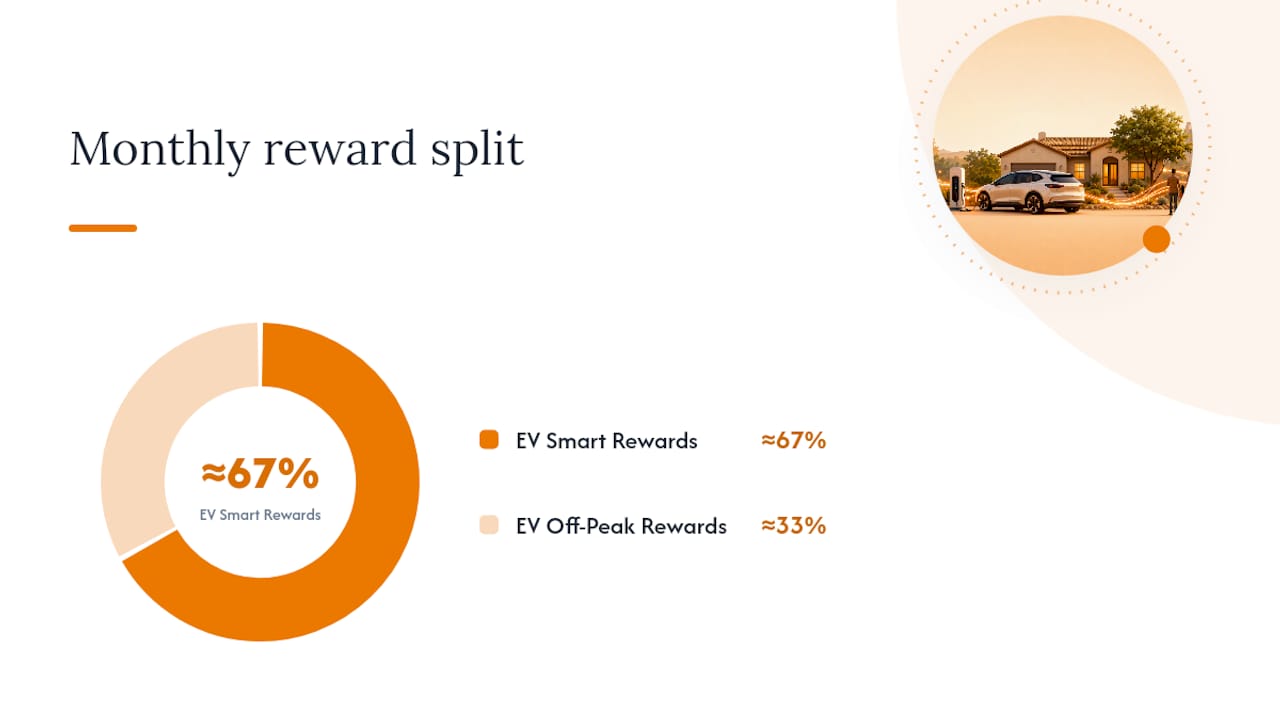
EV Smart Rewards links your charger to a WeaveGrid account, which automatically schedules your charging around grid needs. In exchange, you get $10 a month, on top of the enrollment bonus. You can still override the schedule if you need a full charge right away.
EV Off-Peak Rewards works more like an honor system. You commit to charging during designated off-peak hours yourself, without automated scheduling, and CPS Energy pays $5 a month for that commitment.
- EV Smart Rewards: $30 enrollment + $10/month, fully automated through WeaveGrid
- EV Off-Peak Rewards: $30 enrollment + $5/month, manually self-managed
- Both support grid reliability by shifting demand away from peak evening hours
The gap between $10 and $5 a month is CPS Energy’s way of rewarding automation. A WeaveGrid-connected charger removes the guesswork, and removing guesswork is exactly what keeps you compliant with the program’s verification standards.
Who Qualifies for the CPS Energy EV Charger Rebate Programs?
Eligibility hinges on your utility account, your vehicle, and your equipment. Before you apply, confirm you meet these basics:
- You must be a residential CPS Energy customer with an active electric account in your name
- Your EV or charger needs to appear on CPS Energy’s approved list, which has included vehicles like Tesla and Jeep models, along with charger brands such as ChargePoint, Emporia, and Wallbox
- Enrollment is capped at two devices per household
- Signups run first-come, first-served, so there’s no guarantee of a slot once capacity fills
CPS Energy updates its eligible vehicle and charger lists periodically, so check the official electric vehicle programs page before assuming your setup qualifies. A charger that worked for a neighbor last year might not be on this year’s list, and vice versa.
How Much Does CPS Energy Actually Pay, and When?
Here’s where the numbers matter most. Every enrolled device earns a $30 credit once you complete setup. After that, EV Smart Rewards pays $10 a month for automated participation, while EV Off-Peak Rewards pays $5 a month for manual compliance.
By the Numbers: CPS Energy’s own newsroom announcement references up to $120 in annual bill credits for Smart Rewards participants who stay enrolled and compliant all year. That figure assumes consistent monthly qualification, not a guaranteed flat payout.
A few practical notes on timing:
- Credits post directly to your CPS Energy bill, not as a separate check or account
- Expect a lag of 6 to 10 weeks between a qualifying charging month and the credit showing up
- CPS Energy verifies demand reduction before releasing payment, and it can withhold a credit if your charging pattern doesn’t meet its measurement standards that month
That verification clause catches people off guard. If your smart charger drops offline, or you override the schedule too often, you can lose a month’s credit even after doing everything else right.
How to Enroll in a CPS Energy EV Rebate Program
Getting enrolled takes maybe 20 minutes if you have your paperwork ready. Here’s the order that works best:
- Pull up a recent CPS Energy bill and confirm your account number and service address.
- Go to CPSEnergy.com/EV and choose between EV Smart Rewards and EV Off-Peak Rewards.
- Create a WeaveGrid account and connect your eligible vehicle or charger through the app’s pairing process.
- For Smart Rewards, set your preferred departure time so the system knows when your car needs to be ready.
- Check your WeaveGrid dashboard periodically, and use the override function anytime you need an immediate full charge instead of the scheduled one.
Pro Tip: Enroll before a road trip season, not during one. If you sign up while you’re relying on frequent full charges, the automated schedule will feel like it’s fighting your routine, and you’ll be tempted to override it so often that you risk missing the monthly credit threshold.
What Documentation Protects Your Eligibility?
CPS Energy has historically required networked, smart Level 2 EVSE units on an approved-equipment list, and some enrollments call for pre-approval before you even buy the charger. Skipping that step is one of the most common reasons homeowners get denied after the fact.
San Antonio also typically requires a pulled electrical permit and inspection for home EV charger installations, separate from CPS Energy’s own enrollment process. Keep these on hand:
- Proof of EV ownership or lease agreement
- Charger make, model, and serial number
- Itemized electrician invoice showing the installation work performed
- Copy of the permit inspection report from the city
Losing any one of these documents can slow down eligibility verification if CPS Energy or an installer needs to confirm your setup later. A licensed installer who handles permits as part of the job saves you from tracking down paperwork months after the fact.
Is This the Same as a Charger Installation Rebate?
No, and this is the mix-up that trips up more homeowners than anything else. CPS Energy’s $30 enrollment credit is a signup bonus for participating in a charging behavior program. It is not reimbursement for buying or installing a charger.
Compare that to how some other Texas utilities structure their incentives. Austin Energy, for example, offers a hardware rebate of up to $1,200 toward a Level 2 home charging station, which is a genuinely different kind of benefit: money back on the equipment itself, not a monthly credit for how you use it.
- CPS Energy: recurring bill credits for charging behavior, no equipment reimbursement
- Austin Energy: one-time rebate toward the charger hardware itself
- Neither replaces the need to budget for installation labor, panel upgrades, or permitting costs upfront
Before you buy a charger expecting CPS Energy to offset the purchase price, confirm what other programs you might qualify for and whether they can be combined. Rules on stacking vary, and requirements change, so verify current terms directly with each program rather than assuming last year’s rules still apply.
How Does CPS Energy Compare to Other EV Incentive Programs?
Most Texas utilities fall into one of two camps: they either pay you to shift your charging habits, or they pay you upfront for the equipment. CPS Energy sits firmly in the first camp, which makes it fundamentally different from programs you might see referenced in national EV coverage.
Some municipal utilities elsewhere in Texas and across the country offer flat equipment rebates similar to Austin Energy’s $1,200 charger incentive. Others run time-of-use electricity rate plans that reward off-peak charging through lower per-kilowatt-hour pricing rather than a direct bill credit. CPS Energy’s approach is closer to a hybrid: a flat signup bonus plus an ongoing monthly credit that scales with participation, rather than a variable rate structure.
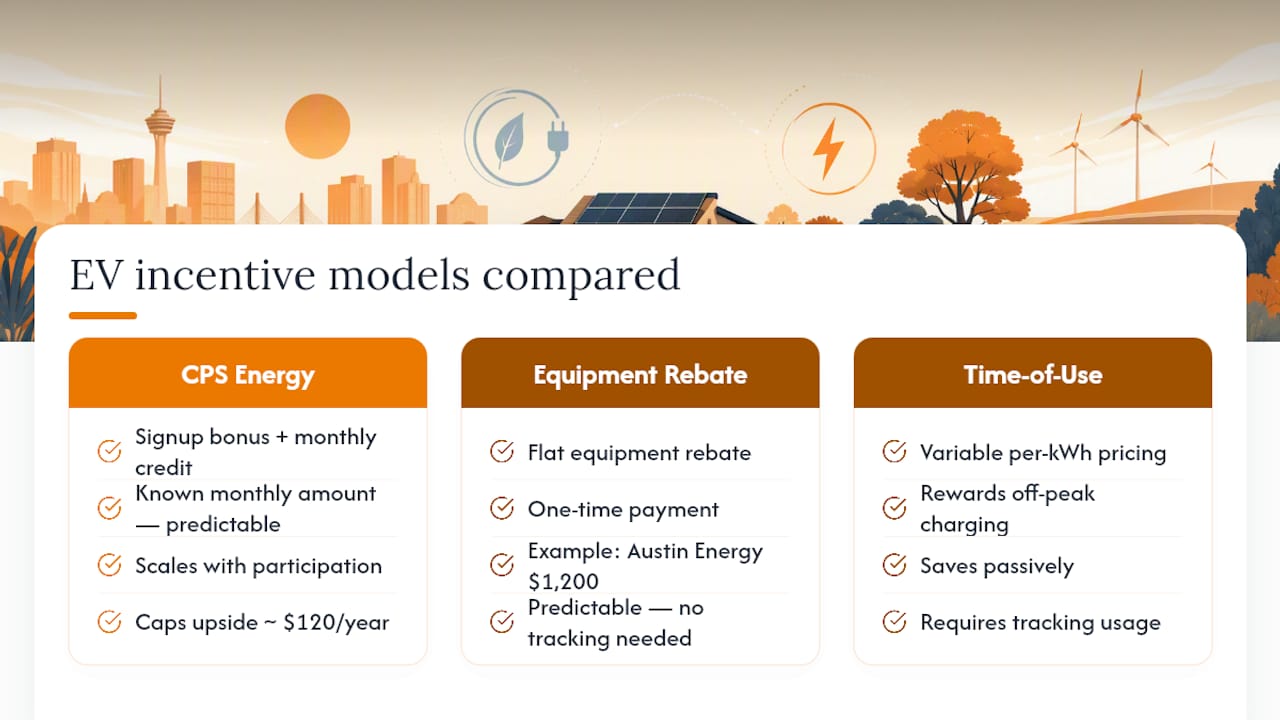
The practical difference for your wallet comes down to predictability. A rebate program pays once and you’re done. A rate-based program saves you money passively but requires you to track your own usage patterns to benefit. CPS Energy’s model pays a known amount every month you comply, which makes it easier to forecast but caps your upside at roughly $120 a year for Smart Rewards.
If you’re weighing whether to prioritize enrollment in CPS Energy’s programs over waiting for a different incentive to appear, remember that eligibility lists and offer terms shift over time. What’s available today through CPS Energy’s EV charging solutions page may look different next year, so re-check terms before assuming a locked-in rate.
Will Enrolling Actually Lower Your Electric Bill?
The honest answer is: modestly, and only if you stay compliant. A Smart Rewards participant earning the full $10 monthly credit is looking at roughly $120 a year in savings on top of the $30 signup bonus, based on CPS Energy’s own program messaging. That’s real money, but it’s not enough to offset a charger installation on its own.
Where the bigger savings show up is indirectly. Automated off-peak charging schedules tend to shift your EV’s electricity draw into hours when demand, and often pricing, is lower across the grid. If you pair that with home solar generation, the effect compounds: your car charges when your system either isn’t producing much or you’re drawing less from the grid overall, smoothing out your usage curve rather than spiking it every evening.
For most households, the CPS Energy credits function as a small, steady offset against a bill that would otherwise climb once you add EV charging to your usual electric load. Think of it less as a way to make EV ownership free and more as a discount on a cost you were already going to carry. Running your numbers through a solar savings calculator gives a clearer picture of how EV charging interacts with your total electric usage than looking at the rebate credits in isolation.
Is Enrolling Worth It for Your Household?
Recurring credits add up to real, predictable savings, but they will not cover what you spend on installation. Treat them as an ongoing discount on operating costs, not a way to fund the project itself.
Automated Smart Rewards charging is the better play for most homeowners. It requires less day-to-day effort and locks in the higher $10 monthly credit, as long as you resist the urge to override your schedule constantly.
If your household needs full charges on demand and rarely waits for off-peak hours, the math changes. You’ll likely earn less, and the manual compliance required for Off-Peak Rewards may not be worth the smaller payout.
— Anthony
Get Your Charger Installed Right the First Time
Choosing a knowledgeable installer can help you navigate CPS Energy’s approved-equipment list and ensure proper installation of licensed, networked Level 2 EV chargers compatible with WeaveGrid enrollment.
Beyond the install itself, a full-service installer can manage city permits, schedule inspections, and provide the electrician invoice and inspection paperwork needed if CPS Energy requests documentation. That’s the paperwork trail that keeps your monthly credits flowing instead of getting flagged during verification. If you’re planning an EV purchase or already own one and want your charger set up correctly from day one, request a quote through our EV charger installation page and we’ll walk you through what your home needs before you spend a dollar on equipment.
Sources
- New EV Smart Rewards Program can help you save – CPS Energy Newsroom
- Electric Vehicles – Charging Solutions
- WeaveGrid and CPS Energy launch EV Smart Rewards program to support grid reliability and help customers save