
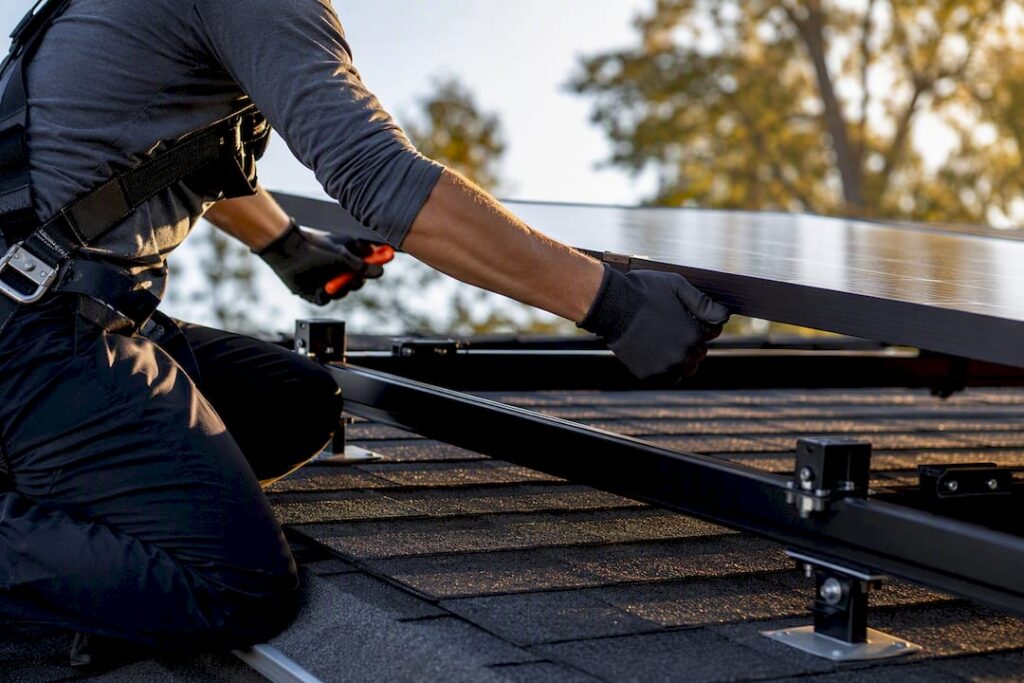
If your panels are under 15 years old, undamaged, and performing well, reinstalling them after roof work is usually the smarter move. Replacement makes more sense when panels are near the end of their 25 to 30 year lifespan, showing damage, or you want a real efficiency upgrade. Licensed installers, local permits, and manufacturer warranties all factor into which path actually saves you money.
TL;DR:
- Reinstalling panels is usually more cost-effective when they are under 15 years old, in good condition, and still under warranty, especially after roof work.
- The typical detach-and-reset cost ranges from $180 to $650 per panel, with higher prices in some regions and for complex roof configurations, and the process takes 3 to 10 days.
- Proper system reinstallation requires careful coordination between roofing and solar crews, including labeling, careful removal, storage, and reinstallation to preserve warranties.
- Replacing panels becomes advisable when they approach or exceed 25 years, show significant performance decline, or when a higher-efficiency upgrade is desired.
- Maintaining proper documentation and licensed expertise during removal and reinstallation minimizes the risk of warranty voids and reduces long-term troubleshooting issues.
Table of Contents
- Should You Reinstall or Replace Your Panels? A Quick Checklist
- What Does Reinstalling vs Replacing Panels Actually Cost?
- How Does a Professional Detach-and-Reset Actually Work?
- What Warranty and Permit Mistakes Should You Avoid?
- When Does Replacing Panels Beat Reinstalling Them?
- Is Reinstalling or Replacing Better for the Environment?
- Do Reinstalled Panels Perform Differently Than New Ones?
- What Problems Show Up After Reinstallation vs Replacement?
- How Should You Plan and Hire for This Project?
- What Would Alpha Solar Solutions Recommend?
- Get an Itemized Quote for Your Roof and Solar Project
- Sources
Should You Reinstall or Replace Your Panels? A Quick Checklist
Before you call anyone, run through a few basics. Most homeowners can sort their situation into “reinstall” or “replace” in about ten minutes with the right questions.
Start with panel age and paperwork. Solar modules carry a typical useful life of 25 to 30 years, and most manufacturer warranties track that window closely. If your system is younger than 10 to 15 years and still under warranty, reinstalling after roof work almost always makes financial sense.
Next, look at performance and physical condition:
- Check your monitoring app or utility bills for a steady output decline of more than 10 to 15% over a couple of years.
- Look for visible cracking, discoloration, or delamination on the panel surface.
- Ask your roofer whether the new material or code requirements will force a racking change anyway.
- Confirm your existing mounts are rated for the new roof surface, especially if you’re switching from shingles to metal or tile.
- If a storm caused the roof damage, verify with your insurer whether the detach-and-reset cost is covered as part of the roof claim before authorizing any work.
Routine reroofing on an otherwise healthy system almost always favors reinstalling. Storm damage, code-driven racking changes, or a system already limping along are signs replacement deserves a serious look.
What Does Reinstalling vs Replacing Panels Actually Cost?
Cost is where the “reinstall vs replace” decision gets real. A straightforward detach and reset typically runs $180 to $650 per panel, depending on mounting complexity, roof access, and how much electrical work is involved, according to HomeCostCalc’s cost estimator. Full replacement costs more upfront but resets your warranty clock and often pays for itself through higher efficiency.
Several factors push detach-and-reset pricing toward the high end of that range:
- Panel count and array complexity (steep pitches or multiple roof planes cost more to access).
- Racking hardware that needs full replacement rather than reuse, which can add $200 to $800 on its own.
- Electrical reconnection, permitting, and any temporary storage or staging fees.
- Local permit and inspection requirements, which vary by city and utility.
Some markets see even steeper numbers. Detach-and-reset work in certain regions runs $350 to $850 per panel, and the process itself commonly adds two to six weeks of project complexity once permitting and inspections are factored in.
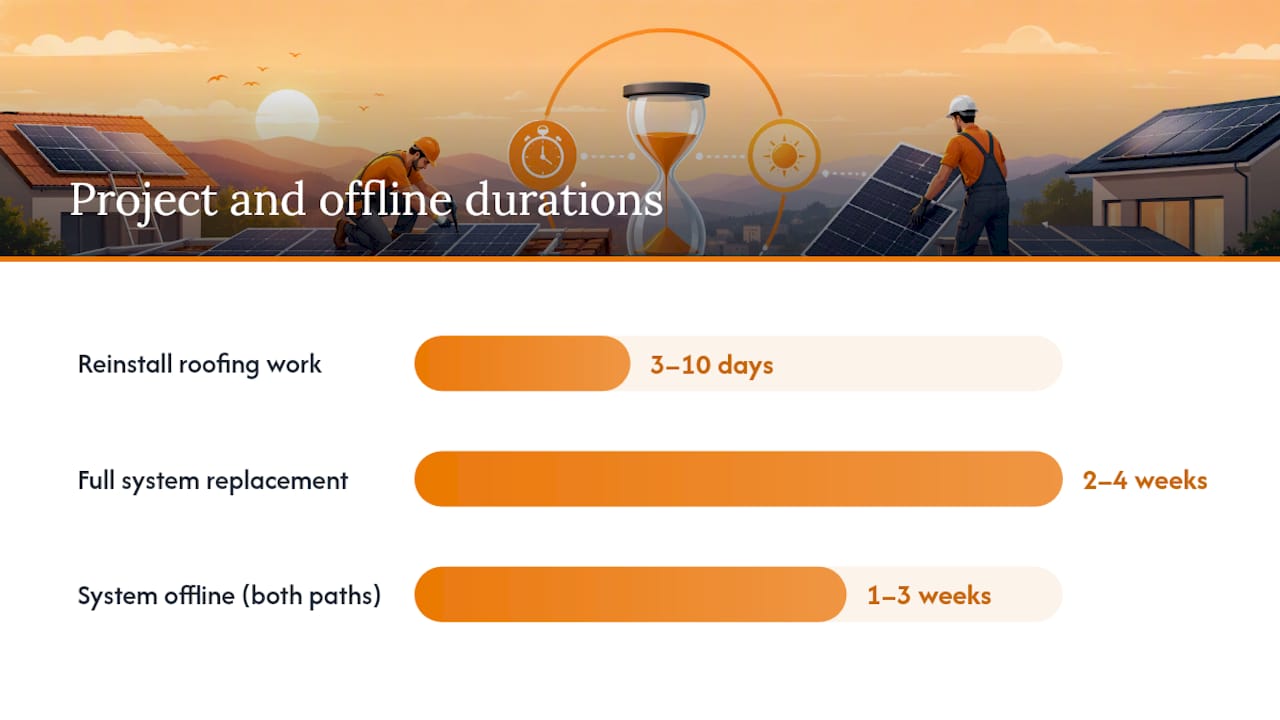
Timeline matters as much as price. A temporary removal and reinstallation project usually takes 3 to 10 days on the roofing side, according to New England Metal Roof, while full system replacement stretches to two to four weeks. Either way, plan on your system sitting offline for one to three weeks, which means a temporary bump in your grid electricity purchases while everything gets tested and reconnected.
How Does a Professional Detach-and-Reset Actually Work?
A proper reinstall isn’t just unscrewing panels and setting them aside. It follows a sequence designed to protect both your safety and your warranties.
- Electrical disconnect and labeling. A licensed electrician shuts down the system, then labels every wire, connector, and panel serial number before anything moves.
- Safe removal and racking teardown. Panels come off first, followed by the mounting racks, with everything staged for storage.
- Secure storage during roof work. Panels get stored flat, away from foot traffic, while your roofer replaces shingles, decking, or flashing.
- Roofing coordination and flashing integration. The roofer installs new flashing designed to accommodate the returning mounts, ideally with the solar crew consulting on placement.
- Racking inspection and reinstallation. Hardware gets checked for corrosion or code compliance, replaced if needed, then reinstalled and resealed.
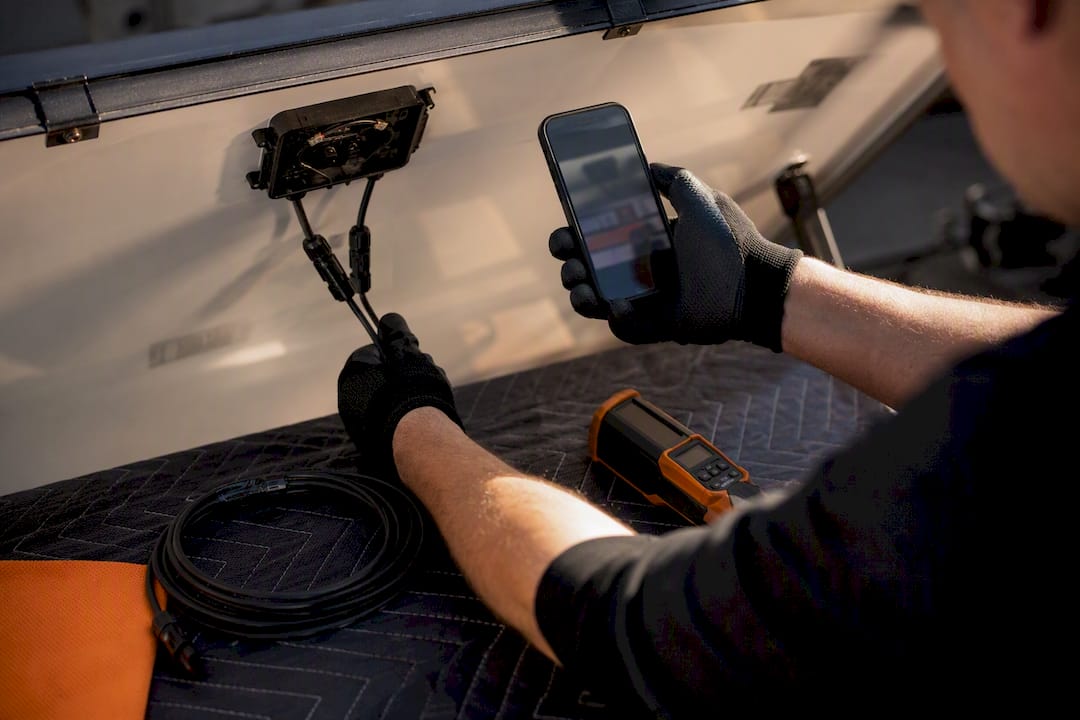
- Reconnection, testing, and monitoring verification. The system goes back online, gets tested, and your installer confirms your monitoring app shows normal output.
- Inspection and interconnection paperwork. Depending on your city, a final inspection or updated utility interconnection filing may be required before the system is considered active again.
This sequence, outlined by GreenLancer, is also your best window to catch problems early. Removal exposes micro-cracks or junction-box wear that’s invisible while panels sit on the roof, giving your installer a chance to flag or fix issues before they cause bigger failures later.
Pro Tip: Ask your installer to photograph every panel’s serial number and wiring layout before removal. That documentation is often what preserves your manufacturer warranty if a different crew handles reinstallation.
What Warranty and Permit Mistakes Should You Avoid?
The fastest way to turn a routine reroof into an expensive headache is letting an unlicensed crew touch your solar array. Panel and inverter warranties frequently require certified installation and removal, and skipping that step can void coverage entirely.
Roofing penetrations around mounts create a second risk zone. Improper flashing reinstallation is one of the most common causes of leaks after solar work, which is why coordinating your roofer and solar installer on sequencing and flashing placement matters more than most homeowners expect.
Before work starts, confirm these items:
- Your installer is licensed and certified, and your roofer knows the mount locations in advance.
- Local permit and inspection requirements are identified upfront, not discovered mid-project.
- Your homeowner’s insurance policy is checked for coverage if the reroof was storm-related.
- Both contractors put warranty responsibilities in writing before any panel comes off the roof.
When Does Replacing Panels Beat Reinstalling Them?
Reinstalling saves money in most routine roof-repair scenarios, but a few situations tip the math toward full replacement.
- Panels are approaching or past 25 years old, or already showing widespread output decline rather than isolated damage.
- You’ve had repeated failures, like multiple inverter faults or several panels underperforming across different parts of the array.
- You want more capacity or efficiency. Modern high-efficiency modules often produce meaningfully more power per square foot than panels installed a decade or more ago.
- Your new roof material or updated wind codes require a different racking system entirely, making reuse of old hardware impractical anyway.
If two or more of these apply, spending money to reinstall aging equipment usually just delays a replacement you’ll need soon regardless.
Is Reinstalling or Replacing Better for the Environment?
Reinstalling existing panels is the more sustainable choice in most cases, simply because it avoids manufacturing new modules. Producing a solar panel carries a real carbon and material cost, from silicon processing to aluminum framing, so extending the working life of panels you already own reduces your project’s overall environmental footprint.
Replacement isn’t automatically the worse option, though. Panels reaching the end of their 25 to 30 year lifespan are producing less energy per square foot than they once did, and pairing an old, degraded array with a new roof often means leaving efficiency gains on the table for another decade. In that case, newer, higher-output modules can generate more clean energy over their own lifespan than keeping underperforming panels in service, even when accounting for manufacturing impact.
There’s also a disposal question. Panels removed during replacement need responsible recycling or disposal rather than landfill dumping, since they contain metals and materials better recovered than wasted. Ask any installer you hire how they handle decommissioned modules. A reinstall sidesteps this issue entirely, since nothing gets scrapped. For most homeowners weighing routine roof repair against a full system swap, reinstalling healthy panels remains the lower-impact path, while replacement earns its environmental case only when the old array is genuinely inefficient.
Do Reinstalled Panels Perform Differently Than New Ones?
Performance after reinstallation should look nearly identical to performance before the roof work, assuming the crew handled reconnection correctly. Output dips are a warning sign, not something to expect as normal.
Expected lifespan is where the paths diverge more clearly. Reinstalled panels carry whatever life they had left before removal. If they were eight years into a 25 year expected lifespan, they’re still eight years in after going back on the roof. Replacement resets that clock completely, and pairing it with a new warranty period gives you a fresh 25 to 30 year runway.
There’s a subtle efficiency angle too. Panels manufactured even five to seven years ago often carry lower efficiency ratings than current modules, meaning a straight reinstall locks in the older performance ceiling. Replacement, especially when combined with a roof upgrade, is the only path that closes that efficiency gap. Homeowners chasing lower electric bills or planning to add battery storage down the line should weigh that difference seriously before defaulting to the cheaper reinstall option.
What Problems Show Up After Reinstallation vs Replacement?
Reinstalled systems most commonly run into connection issues, not equipment failures. A loose connector, a mislabeled wire reattached to the wrong string, or a junction box that took subtle damage during storage can all cause output drops that only show up once the system is back online and monitored for a few days.
Replaced systems tend to have a different troubleshooting profile. New inverters occasionally need firmware updates or configuration adjustments to talk properly with existing monitoring platforms, and utility interconnection paperwork can create temporary activation delays even when the hardware itself works fine.
For reinstalled panels, the fix usually starts with checking your monitoring app string by string to isolate which panel or connector is underperforming, then having your installer physically inspect that specific junction box. For replaced systems, most early issues resolve through a firmware update or a callback to confirm the utility has processed your new interconnection agreement. In both cases, keeping the documentation from your original installation, wiring maps, serial numbers, and permit paperwork, makes diagnosing any post-project issue dramatically faster.
How Should You Plan and Hire for This Project?
Before signing anything, get clarity on who owns which task. Ask your roofer and solar contractor to put removal, flashing, reinstallation, permits, and inspections into a single written scope, so nothing falls into a gap between the two crews.
- Confirm licensing and insurance for both the roofing contractor and the solar installer handling your panels.
- Ask about prior detach-and-reset experience specifically, not just general solar installation history.
- Request an itemized quote covering removal, storage, hardware, reconnection, permits, and any anticipated downtime.
- Require documentation, including pre-removal photos, wiring maps, panel serial numbers, and copies of any permits filed.
- Schedule early. Coordinating both crews before either starts work avoids rework, unexpected charges, and warranty disputes.
Pro Tip: Get the itemized quote in writing before work starts, and specifically ask what happens if hidden roof damage is found once your panels come off. That single question avoids most mid-project cost surprises.
What Would Alpha Solar Solutions Recommend?
If you’re weighing reinstall vs replace, our priority is always protecting your warranties first, minimizing how long your system sits offline second, and steering you toward replacement only when the numbers or the panel’s age genuinely justify it. We’ve watched homeowners save real money by reinstalling healthy panels, and just as many benefit from replacing tired ones. Document everything, and share those photos with whoever you hire.
— Anthony
Get an Itemized Quote for Your Roof and Solar Project
Some companies handle solar panel removal and reinstallation for homeowners and coordinate both the roof and panel work under one licensed crew to streamline the process.

When you book a detach-and-reset with us, you get licensed electricians handling disconnect and reconnect, full photo and serial-number documentation before anything comes off the roof, and direct coordination with your roofing contractor so flashing and racking placement don’t become a guessing game later. Every quote is itemized, covering removal, storage, hardware, and reconnection separately, so you know exactly what you’re paying for before work starts. If your system is closer to end-of-life, we’ll also walk you through what a residential solar upgrade could look like instead. Ready to see where your project lands? Request an itemized quote through our solar panel removal and reinstallation page and get a clear answer before your roofer breaks ground.
Sources
For deeper reading on pricing and timelines, see HomeCostCalc’s per-panel cost breakdown and SolarBidAnalyzer’s detach-and-reset guide. For the roofing side of coordination, Elevated Roofing and Siding’s process overview explains what to expect from your roofing crew. For a direct quote on removal and reinstallation, visit Alpha Solar Solutions’ service page.
- Solar Panel Removal and Reinstall Cost Calculator (2026) — Free Online Estimate | HomeCostCalc
- Solar Panel Removal and Reinstallation for Roof Work
- Detach and Reset Solar Panels for Reroofing (2026)
- Solar Panels and Roof Replacement: What to Expect – New England Metal Roof