
TL;DR:
- Solar power significantly reduces greenhouse gas emissions compared to fossil fuels, especially when installed on rooftops in sunny locations like San Antonio. Although manufacturing panels involves energy and potential hazardous materials, advancements and recycling efforts minimize environmental impacts over their lifespan. Rooftop solar offers an environmentally friendly solution that avoids land use, wildlife disruption, and waste issues associated with large-scale solar farms.
Most people assume solar power is clean and fossil fuels are dirty, and they’re right. But the full environmental story is more layered than that. Solar panels produce no emissions while they run, and solar PV cuts greenhouse gas emissions by 91–96% compared to fossil fuels across their entire lifespan. That’s an enormous difference. Yet questions still come up: what about the manufacturing process, the land it takes, and what happens when panels eventually wear out? This article walks you through the complete environmental picture so you can make a confident, informed decision about going solar in San Antonio.
Table of Contents
- Comparing the emissions: Solar power vs. fossil fuels
- The hidden costs: Manufacturing and materials impact
- Land use and local wildlife: Utility-scale vs. rooftop solar
- End of life: E-waste, recycling, and panel disposal risks
- What most guides miss about solar’s environmental impact
- Ready to make your home more sustainable?
- Frequently asked questions
Key Takeaways
| Point | Details |
|---|---|
| Drastic emissions savings | Solar power reduces greenhouse gas emissions by over 90% compared to coal. |
| Rooftop solar has minimal wildlife impact | Installing panels on homes avoids major land and animal disruptions. |
| Manufacturing improvements matter | Technology is quickly reducing the manufacturing footprint of new solar panels. |
| Disposal and recycling are key | Proper recycling of old panels is crucial to minimizing hazardous waste. |
| Homeowners are climate leaders | Switching to solar lets you make a real, local difference for the environment. |
Comparing the emissions: Solar power vs. fossil fuels
Let’s start with the numbers that matter most. When you generate electricity at home using solar, you’re replacing power that would otherwise come from a grid still heavily supplied by coal and natural gas. That substitution adds up to a massive environmental benefit over time.
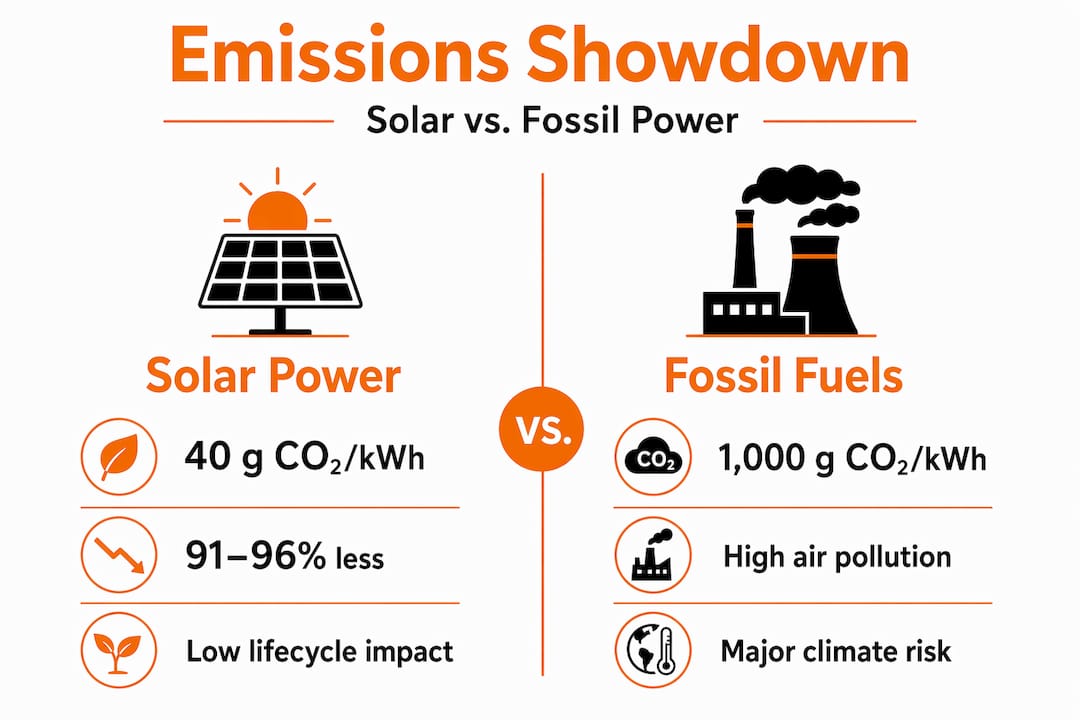
Solar photovoltaic (PV) systems, meaning panels that convert sunlight directly into electricity, emit roughly 40 grams of CO2-equivalent per kilowatt-hour (kWh) over their full lifecycle. That includes manufacturing, shipping, installation, and eventual disposal. Coal, by comparison, emits around 1,000 grams per kWh. Natural gas sits around 400–500 grams per kWh.
Here’s a simple side-by-side view:
| Energy source | Lifecycle emissions (g CO2e/kWh) |
|---|---|
| Coal | ~1,000 |
| Natural gas | ~400–500 |
| Solar PV (average) | ~40 |
| Wind | ~7–15 |
The gap between solar and coal is not subtle. It’s roughly a 25x reduction in emissions per unit of electricity produced. For a typical San Antonio home using around 1,200 kWh per month, switching to solar could prevent the release of thousands of pounds of carbon dioxide every year.
According to the Union of Concerned Scientists, solar cuts GHG by 91–96% compared to fossil fuel sources when you account for the full lifecycle. That makes solar one of the most effective tools available to homeowners who want to reduce their carbon footprint.
You can explore the broader pros and cons of solar energy to see how these environmental benefits stack up against cost and system considerations. For more clean energy insights on how solar compares to other energy sources, outside resources can give you added context.
Here are the key takeaways from the emissions comparison:
- Solar is dramatically cleaner than coal and natural gas in day-to-day operation
- The lifecycle number (40 g CO2e/kWh) already accounts for manufacturing and disposal
- Every kWh you generate at home is a kWh not pulled from a fossil fuel plant
- San Antonio’s sunny climate maximizes output, meaning your panels spend more hours generating clean energy each year
The bottom line is clear. When you look at the total picture from start to finish, solar is far and away the cleaner option.
The hidden costs: Manufacturing and materials impact
While solar panels produce no emissions once they’re installed, the process of making them does require energy. And since much of the world’s manufacturing still relies on fossil fuels, that process has a carbon cost worth understanding.
The greenhouse gas emissions from manufacturing a solar panel are measured in kilograms of CO2-equivalent per kilowatt-peak (kg CO2-eq/kWp). Kilowatt-peak is a way of measuring a panel’s maximum generating capacity under ideal sunlight conditions.
Here’s how different panel technologies compare:
| Panel technology | Manufacturing emissions (kg CO2-eq/kWp) |
|---|---|
| Monocrystalline silicon (mono c-Si) | 493–2,760 |
| Multicrystalline silicon (multi c-Si) | 312–1,800 |
| Cadmium telluride (CdTe) | ~300–600 |
| PERC (Passivated Emitter and Rear Cell) | ~500–900 |
According to recent sustainability research, mono c-Si panels, which are the most common type installed on homes today, produce between 493 and 2,760 kg CO2-eq/kWp during manufacturing. That wide range reflects differences in how and where panels are produced. Panels made using renewable energy in their factories fall on the lower end of that range.
The manufacturing footprint is energy-intensive by technology type, but here’s the crucial part: most solar panels generate enough clean electricity to “pay back” their manufacturing emissions within 1 to 4 years. With a lifespan of 25 to 30 years, the remaining 20+ years of operation are nearly emissions-free.
Think of it this way: The carbon cost of making a panel is a one-time investment. The emissions savings it delivers every year are ongoing returns on that investment.
Technology is also improving fast. Newer manufacturing processes are using more renewable energy in the production phase, which is steadily pushing the manufacturing footprint lower. The solar panel you install today is already significantly cleaner to produce than one installed ten years ago.
Pro Tip: If you want to minimize the manufacturing footprint of your system, ask your installer about panel origin and efficiency ratings. Higher-efficiency panels generate more electricity per panel, which means fewer panels needed overall and a smaller manufacturing impact for the same power output.
Keeping your panels clean and well-maintained also maximizes efficiency over their lifetime. Check out these solar panel cleaning tips to make sure your system runs at peak performance year after year.
Land use and local wildlife: Utility-scale vs. rooftop solar
Where solar panels are installed matters just as much as how they’re made. This is one of the biggest factors that separates your rooftop system from a large solar farm built in the countryside.
Utility-scale solar farms are large ground-mounted arrays that can cover anywhere from 3.5 to 10 acres per megawatt (MW) of generating capacity. A 100 MW solar farm could occupy over 500 acres of land. That land conversion can affect local ecosystems, disrupt habitat for animals, and alter how water drains through the soil.
On the positive side, research shows that ground-mounted PV arrays can actually create some surprising environmental benefits in certain conditions. Solar installations reduce wind speed and increase soil moisture beneath and around the panels. In some dry environments, this microclimate effect can actually support plant growth and improve local soil health.
AgriPV, which means combining solar panels with agricultural land use, and ecovoltaics, which means designing solar sites to also support native plant and animal species, are emerging approaches that can turn solar farms into net positives for local biodiversity.
Rooftop solar, on the other hand, is a different story entirely. When you install panels on your existing roof, you’re using space that’s already built. No land is cleared. No habitat is disturbed. The panels sit on your home and generate clean power without any footprint beyond what your house already occupies.
Here’s a quick comparison of the two installation types:
- Utility-scale solar: 3.5–10 acres per MW, potential habitat disruption, possible microclimate benefits, wildlife risk from large arrays
- Rooftop solar: Zero additional land use, no habitat impact, no wildlife conflict, integrates into existing urban environment
The wildlife consideration for large solar farms is real. Large PV installations can attract insects, birds, and bats due to polarized light reflection from panel surfaces. Globally, large PV installations may cause up to 17.3 million bird deaths per year through collisions and habitat displacement. Rooftop solar eliminates this risk entirely for homeowners.
Rooftop solar is the greenest form of solar installation available precisely because it piggybacks on infrastructure that already exists.
Pro Tip: If you’re considering solar for your San Antonio home, rooftop installation is the environmentally superior choice. You get all the emission-reducing benefits of solar without contributing to land use or wildlife concerns that come with large-scale solar farms.
For a deeper look at how going solar benefits San Antonio homeowners specifically, read about solar benefits for San Antonio homeowners. Solar can also have a meaningful impact on solar and home value, adding both financial and environmental returns to your property.
End of life: E-waste, recycling, and panel disposal risks
Even after 25 or 30 years of generating clean electricity, solar panels face one more environmental test when they’re decommissioned. This is an area that’s often overlooked in conversations about solar’s environmental benefits, but it’s important to understand.
Most solar panels contain small amounts of hazardous materials. Older silicon-based panels may contain lead in their solder connections, while cadmium telluride panels contain cadmium, a toxic heavy metal. When panels are improperly disposed of in landfills, these materials can leach into soil and groundwater.
The scale of future panel waste is significant. According to the EPA’s guidance on end-of-life solar panels, the U.S. is expected to generate around 1 million tons of solar panel waste by 2030, and that number could climb to 10 million tons by 2050 as the panels installed during the early solar boom reach the end of their useful lives.
Here’s what this means in practical terms:
- Lead and cadmium must be handled responsibly at disposal
- Panel volumes will grow significantly as older systems are retired
- Recycling programs can recover glass, aluminum, silicon, and metals for reuse
- Recycling reduces lifecycle impact by 29–34%, making each panel’s total environmental cost meaningfully lower
- Regulations vary by state, so working with a professional installer helps ensure proper disposal
The good news is that solar recycling technology is advancing quickly. Several companies now specialize in recovering valuable materials from retired panels, and solar recycling integration is becoming more accessible as the industry scales up. Recovered materials, including high-purity silicon, tempered glass, and aluminum frames, can be used in new panel production, reducing the need for virgin resources.
Pro Tip: When your panels eventually need to come down, whether for roof repairs, upgrades, or end of life, work with a company that handles solar panel removal responsibly. Proper removal protects your roof and ensures materials are handled safely. Keeping panels clean and well-maintained with regular panel upkeep also extends their lifespan, which delays disposal and maximizes your environmental return.
What most guides miss about solar’s environmental impact
Here’s an honest take based on everything we see working with San Antonio homeowners every day: the “solar isn’t truly green” argument almost always falls apart once you look at the full data.
Yes, manufacturing has a carbon cost. Yes, there are questions about end-of-life disposal. But these same criticisms apply to every energy technology, including coal plants, gas pipelines, and wind turbines. The difference is that when you run the full lifecycle math, solar comes out dramatically cleaner than the alternatives.
What most environmental guides miss is this: location and installation type change everything. A rooftop solar system in San Antonio is not the same environmental proposition as a utility-scale solar farm in the desert. When you put panels on your existing roof, you sidestep the land use debate entirely. You’re not displacing wildlife or converting habitat. You’re redirecting sunlight that would have hit your roof anyway into usable electricity.
San Antonio is also uniquely positioned to benefit. With around 220 sunny days per year, your panels work harder here than in most U.S. cities. More sunlight means more electricity generated per panel, which means the manufacturing carbon debt gets paid back faster and the net environmental benefit grows larger over time.
We also believe that individual homeowners in cities like San Antonio play an outsized role in the clean energy transition. Utility-scale solar is expanding, but so is the distributed power of thousands of rooftop systems operating quietly across neighborhoods. That distributed model reduces strain on the grid, avoids transmission losses, and builds community resilience.
Technology advances are also steadily reducing both manufacturing emissions and improving recycling rates. The panels available today are more efficient and cleaner to produce than anything available a decade ago. And the recycling infrastructure catching up to handle end-of-life panels means the environmental case for solar will only continue to strengthen.
For the most current look at solar power benefits in 2026, the data supports one clear conclusion: rooftop solar for San Antonio homeowners is one of the most impactful environmental decisions you can make at the household level.
Ready to make your home more sustainable?
If this article has shown you anything, it’s that rooftop solar is the cleanest, most practical path to reducing your home’s environmental footprint. At Alpha Solar Solutions, we design and install custom solar systems built for San Antonio homes, handling everything from initial consultation to long-term support.
Our residential solar installation service sets you up with a system sized for your home’s specific energy use and roof layout. We also offer professional solar panel cleaning to keep your panels performing at their best, and responsible solar panel removal and reinstallation when your roof needs work or your system needs updating. Every service we provide is designed to maximize both your energy savings and the environmental benefits of going solar. Reach out to our team today to find out what a custom solar system could do for your home.
Frequently asked questions
How much do solar panels reduce carbon emissions compared to traditional power?
Solar panels can cut emissions by 91–96% compared to coal-powered electricity when measured across the full lifecycle of the system.
Do solar panels create hazardous waste?
At the end of their life, some panels contain hazardous materials like lead and cadmium, but certified recycling programs can safely recover these materials and significantly reduce disposal risks.
How does rooftop solar affect local wildlife and land use?
Rooftop solar has minimal impact on land and wildlife because it uses existing roof space. Utility-scale solar farms, which require 3.5–10 acres per MW, can affect habitats and contribute to bird deaths at a much larger scale.
Is solar panel manufacturing worse than its environmental benefits?
While panel production does emit greenhouse gases, with manufacturing emissions ranging from 312 to 2,760 kg CO2-eq/kWp depending on panel type, the clean electricity generated over a panel’s 25 to 30 year lifespan far outweighs that upfront carbon cost.