
TL;DR:
- Solar panels can reduce San Antonio homeowners’ electricity bills by 60 to 90 percent.
- The typical payback period for solar systems in San Antonio is between 6.9 and 10 years.
- Adding batteries provides outage protection and higher energy independence, despite increasing upfront costs.
Solar panels in San Antonio can reduce electricity bills by 60 to 90%, saving the average homeowner between $1,200 and $2,180 every year. That’s not a marketing promise. It’s what thousands of local homeowners are already experiencing as CPS Energy rates continue to climb. Still, plenty of people hesitate because they’re unsure whether the numbers really work for their home, their roof, or their budget. This guide cuts through the uncertainty. We’ll show you exactly how solar works in San Antonio’s climate, what it costs after incentives, what batteries add to the equation, and who stands to benefit most.
Table of Contents
- How solar panels generate savings in San Antonio
- The real cost of going solar and your payback timeline
- Why add battery backup? Outage protection, TOU savings, and more
- Who benefits most and when does solar make less sense?
- Our take: What most San Antonio homeowners miss about solar savings
- Ready to maximize energy savings with solar?
- Frequently asked questions
Key Takeaways
| Point | Details |
|---|---|
| Major bill reduction | Solar panels can cut your San Antonio electricity bill by 60–90%—saving over $1,200 a year. |
| Realistic payback period | Most homeowners fully recoup their solar investment within 7–10 years, aided by the federal tax credit. |
| Batteries boost independence | Adding battery backup extends payback but enables backup power and greater energy control, especially with volatile Texas rates. |
| Solar isn’t right for every home | Homes with high energy use and sunny roofs benefit most; renters or shaded properties see less advantage. |
How solar panels generate savings in San Antonio
Now that you know what’s possible, let’s see exactly how solar disconnects you from high bills.
Solar panels use photovoltaic (PV) cells to convert sunlight into direct current (DC) electricity. An inverter then converts that DC power into alternating current (AC), which is what your home actually runs on. The process is straightforward, and the mechanics of solar panels are well established. What makes San Antonio particularly well suited for solar is the combination of abundant sunshine and rising utility rates. More sun means more electricity generated. Higher utility rates mean every kilowatt hour (kWh) you produce yourself is worth more in savings.
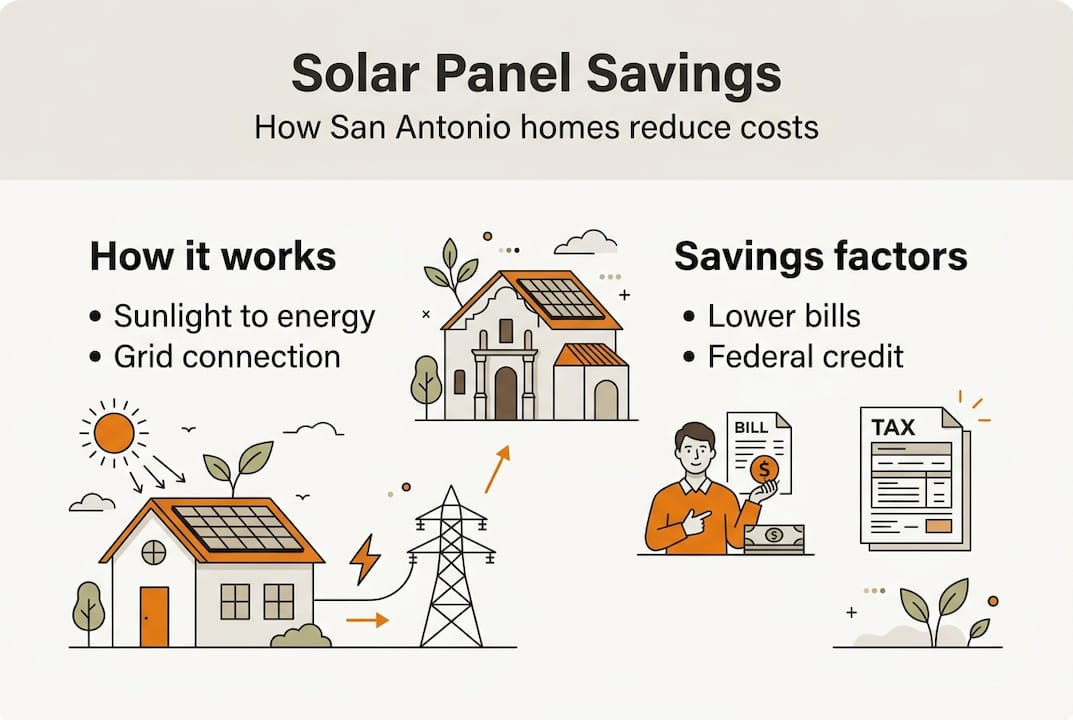
San Antonio homeowners can see 60 to 90% drops in their monthly electricity bills, with typical savings ranging from $120 to $180 per month. High-usage homes, those running central air conditioning heavily during summer, often see the biggest reductions. Explore more San Antonio homeowner benefits to understand the full picture.
Here’s how the savings flow works:
- Your panels produce power during daylight hours, which your home uses first.
- Excess power you don’t use is exported back to the grid through CPS Energy’s net billing program.
- You receive bill credits for that exported power, which offset what you draw from the grid at night.
- Your monthly bill reflects only the difference between what you used and what you generated.
Key stat: Average annual savings for San Antonio solar owners range from $1,200 to $2,180 per year, depending on system size and household usage.
Net billing is not the same as full net metering. CPS Energy pays a lower rate for exported power than the retail rate you pay to buy it. That gap is exactly why smart system sizing matters. A well-designed system covers your own usage first, rather than generating a large surplus to sell back at a discount. Check out additional solar panels insights to learn what sizing approach works best.
Pro Tip: Even if your roof has some shading or faces east rather than south, a ground-mount solar array can be positioned to capture maximum sunlight. Don’t assume your property isn’t a good fit until you’ve had a proper site evaluation.
The real cost of going solar and your payback timeline
Savings make solar exciting, but what does it really take to get started?
A typical 11 kW solar system in San Antonio costs around $33,000 before incentives. After applying the 30% federal Investment Tax Credit (ITC), that drops to approximately $23,100. The ITC is a dollar-for-dollar reduction on your federal income tax bill, not just a deduction, which makes it genuinely powerful. This tax credit eligibility is available to most homeowners who own (not lease) their system.
| System size | Pre-incentive cost | After 30% ITC | Estimated annual savings |
|---|---|---|---|
| 8 kW | $24,000 | $16,800 | $1,000 to $1,400 |
| 11 kW | $33,000 | $23,100 | $1,200 to $2,180 |
| 14 kW | $42,000 | $29,400 | $1,800 to $2,800 |
The payback period for most San Antonio homeowners falls between 6.9 and 10 years. As utility rates continue to rise, that timeline can shorten. A home that currently pays $200 per month in electricity saves more in real dollars each year, which accelerates the return.
Factors that affect your total cost include:
- System size: Larger homes with higher usage need bigger systems.
- Roof type and condition: Complex rooflines or older roofs may add installation costs.
- Battery add-ons: Adding storage increases upfront investment (more on this below).
- Panel brand and efficiency: Premium panels cost more but produce more power per square foot.
Texas offers no statewide solar rebate program, so the federal ITC is your primary incentive. Some local utility programs and manufacturer offers may apply depending on your situation. Review current solar tax credit info to stay up to date before you commit. You can also explore a full solar panel cost analysis to see how your home’s profile affects pricing.
Pro Tip: Homeowners who plan to stay in their home for 10 or more years and have high monthly electricity bills get the strongest return on investment. If your bill regularly exceeds $200 per month, the math typically works strongly in your favor.
Why add battery backup? Outage protection, TOU savings, and more
Beyond solar alone, storage can be a game-changer. Here’s how batteries stack up.
Adding a battery backup system to your solar setup costs an additional $12,000 to $16,000 and extends your payback period by three to five years. That sounds like a drawback, but in San Antonio’s energy environment, batteries offer real-world value that goes well beyond a simple bill calculation.
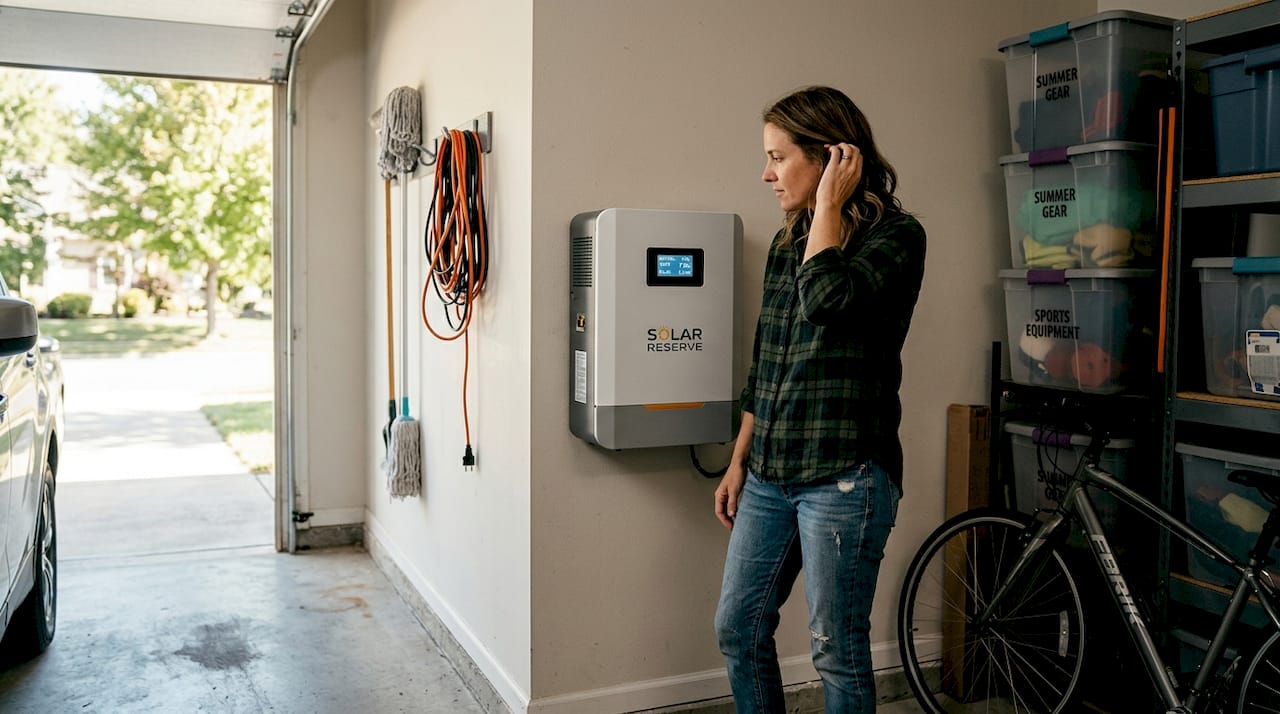
Texas has no statewide net metering, and CPS Energy’s export rates are low. That means selling excess solar power back to the grid is not particularly profitable. Storing that power in a battery so you can use it later is significantly more valuable. Batteries also provide essential backup power during outages, which are not uncommon in Texas given hurricane seasons and heat-driven grid stress.
Learn more about solar and battery benefits and how storage affects your overall energy plan. You can also read a detailed battery storage analysis to understand expected performance.
The top reasons San Antonio homeowners add battery storage:
- Outage protection: Keep essential appliances running when the grid goes down.
- Increased energy independence: Rely less on CPS Energy regardless of rate changes.
- Time-of-use (TOU) arbitrage: Store solar power during the day and use it during peak-rate evening hours to avoid higher charges.
| Feature | Solar only | Solar plus battery |
|---|---|---|
| Bill reduction | 60 to 90% | Up to 95%+ |
| Grid outage protection | None | Yes |
| TOU savings | Limited | Strong |
| Payback period | 7 to 10 years | 10 to 14 years |
| Energy independence | Partial | Near complete |
Recent solar storage science confirms that pairing panels with batteries improves overall system efficiency and grid resilience. And in Texas specifically, batteries are essential for maximizing bill control when export rates are low.
Pro Tip: Texas storms and grid instability make battery backup more valuable here than in many other states. If outage protection matters to your family, the extended payback period may be well worth it.
Who benefits most and when does solar make less sense?
Solar isn’t one-size-fits-all. Here’s who comes out ahead and when to pump the brakes.
High-usage homes spending more than $150 per month on electricity and long-term owners see the highest return from solar in San Antonio. The more electricity you currently buy, the more valuable every kilowatt hour you generate becomes.
Homes that are the best fit for solar typically share these traits:
- High monthly power bills (consistently over $150 to $200 per month)
- South or west-facing roofs with good sun exposure for most of the day
- Long-term residency plans of 10 or more years in the home
- Suitable roof condition with no major repairs needed soon
- No major HOA restrictions that prohibit solar installations
“Solar installations can boost home value by 3 to 4% for qualifying properties, making them a smart long-term investment even for homeowners who may eventually sell.”
Solar may make less financial sense in certain situations. Edge cases like shading or short-term homeownership can significantly reduce the financial benefit. Here are the key red flags to consider:
- Heavy tree cover blocking most of your roof’s sun exposure
- Frequent moves or plans to sell within five years
- Roof needing replacement in the near future, which may require panel removal and reinstallation
- HOA or deed restrictions that limit solar panel placement
- Renting your home rather than owning it
If shading is your main concern, explore renewable energy information on alternative mounting options. A ground-mount system can sometimes solve what a rooftop setup cannot. For more on Texas-specific suitability factors, Texas solar suitability research offers useful context. You can also find supporting clean energy resources to help you weigh your specific situation.
Our take: What most San Antonio homeowners miss about solar savings
Now, let’s get candid about what truly matters in the local solar equation.
Most conversations about solar focus on payback periods, and we get it. It’s the number everyone wants to know first. But in our experience, homeowners who fixate only on payback miss the bigger picture.
San Antonio’s climate gives you more solar output than the national average. More sun hours mean your system earns its keep faster than it would in a cloudier city. That’s a genuine advantage that doesn’t always show up in generic national calculators.
The battery question is where we see the most misunderstanding. Many homeowners assume batteries are just about storing leftover power. In San Antonio, they’re really about control. CPS low export rates and no Texas-wide net metering mean that power you send to the grid earns you very little. Power you store and use yourself saves you the full retail rate. That’s a meaningful difference.
We also think homeowners underestimate how much utility pricing will shift over the next decade. Pairing solar with battery storage now is a smart hedge against future rate increases. Your solar power impact grows every time CPS raises its rates.
Pro Tip: Think of battery storage as locking in today’s energy costs for the next 10 to 15 years. Even if the payback stretches a bit longer, the protection from future rate hikes has real financial value.
Ready to maximize energy savings with solar?
If you’re ready to turn savings potential into action, expert local support can smooth the way.
At Alpha Solar Solutions, we specialize in designing solar and battery systems that fit San Antonio homes specifically, not generic national templates. We know the local climate, the CPS Energy billing structure, and the installation challenges that come with Texas rooftops.

Whether you’re exploring residential solar installation for the first time or looking to add solar backup protection to an existing system, we’ll walk you through the options clearly. Our team provides a free assessment so you can see real numbers for your home before making any commitment. We also offer a full battery storage analysis to help you decide whether storage makes sense for your situation. Reach out today and let’s build a system that works for your home and your budget.
Frequently asked questions
How much can the average San Antonio homeowner save with solar panels?
Most homeowners see 60 to 90% reductions in their utility bills, which translates to roughly $120 to $180 per month or up to $2,180 per year depending on system size and usage.
Is a battery backup worth the extra cost in San Antonio?
A battery adds $12,000 to $16,000 upfront and extends your payback by three to five years, but it provides real outage protection, time-of-use savings, and greater energy independence that makes it especially valuable in Texas.
How long does it take for solar panels to pay for themselves?
After applying the 30% federal tax credit, most San Antonio homeowners reach payback in 6.9 to 10 years, with high-usage homes often reaching that milestone on the shorter end.
Who benefits most from installing solar panels?
High-usage homes spending over $150 per month on electricity and homeowners planning to stay long-term get the strongest financial return from solar in San Antonio.