
TL;DR:
- Solar installation costs include panels, labor, permits, and possible add-ons like batteries.
- Federal tax credits and local rebates significantly reduce overall expenses.
- Ongoing maintenance and system components impact long-term performance and costs.
Many San Antonio homeowners assume solar is out of reach because the upfront price looks intimidating. That assumption keeps a lot of people paying higher utility bills longer than they need to. The truth is, once you see exactly where each dollar goes, the investment starts to make a lot more sense. This guide walks you through every major cost component, from panels and labor to permits and batteries, plus the incentives that bring your actual out-of-pocket number down significantly. By the end, you’ll have a clear picture of what solar really costs and what it can save you right here in San Antonio.
Table of Contents
- What makes up the cost of going solar?
- How tax incentives and rebates impact your costs
- The real impact of solar battery storage and add-ons
- Ongoing costs: maintenance, operation, and utility bills
- Our take: What most solar cost calculators don’t tell San Antonio homeowners
- Ready to explore solar for your San Antonio home?
- Frequently asked questions
Key Takeaways
| Point | Details |
|---|---|
| Cost varies by component | Panels, labor, and permits each make up a significant part of your total solar investment. |
| Incentives can save thousands | Tax credits and rebates can dramatically lower your out-of-pocket costs. |
| Ongoing costs are modest | After installation, expect minimal maintenance and a reduced utility bill. |
| Add-ons like batteries affect savings | Consider battery storage and EV charging costs against your need for backup power and energy independence. |
What makes up the cost of going solar?
When you get a solar quote, it can feel like one big number with no explanation. Breaking it into parts makes it much easier to evaluate. Hardware, installation, and permitting make up the bulk of what you pay, and each piece plays a specific role in your system.
Here’s a look at the major cost components for a typical San Antonio home solar installation:
| Component | Estimated cost range | % of total system cost |
|---|---|---|
| Solar panels | $4,000 to $9,000 | 30 to 40% |
| Inverter (converts solar energy to usable power) | $1,000 to $2,500 | 8 to 12% |
| Mounting and racking hardware | $500 to $1,500 | 4 to 7% |
| Installation labor | $3,000 to $6,000 | 20 to 25% |
| Permits and inspections | $500 to $1,200 | 3 to 6% |
| Optional: battery storage or EV charger | $3,000 to $15,000+ | varies |
For a mid-sized home in San Antonio using around 1,200 kilowatt hours (kWh) per month, a 7 to 10 kilowatt (kW) system is common. That puts the base price before incentives somewhere between $18,000 and $28,000, depending on equipment quality and roof complexity.
Here are the factors that most influence where your quote lands:
- Panel brand and efficiency rating: Higher efficiency panels cost more upfront but generate more power per square foot
- Roof type and condition: Tile or metal roofs require more labor than standard shingle roofs
- System size: More panels mean more of everything: hardware, labor, and permits
- Local labor rates: San Antonio has a competitive solar market, which generally keeps labor costs reasonable compared to coastal cities
- Permit complexity: Some jurisdictions require more inspections, which adds time and fees
Pro Tip: Don’t focus only on the panel price when comparing quotes. Labor and permitting can easily add $4,000 to $7,000 to your total, and those costs vary between installers.
Understanding these solar cost factors before you request quotes puts you in a much stronger position to evaluate what you’re actually getting for your money.
How tax incentives and rebates impact your costs
You’ve seen every element of the solar bill. Now let’s slice those numbers down with the incentives available right here in San Antonio.
The single biggest cost reducer is the federal Investment Tax Credit (ITC). As of 2026, this credit equals 30% of your total system cost, applied directly to what you owe in federal income taxes. On a $22,000 system, that’s a $6,600 reduction. It’s not a rebate check, but it lowers your tax bill dollar for dollar, which is just as valuable.
Here’s a simple before-and-after scenario:
| Scenario | Amount |
|---|---|
| Total system cost (before incentives) | $22,000 |
| Federal ITC (30%) | -$6,600 |
| CPS Energy rebate (if applicable) | -$2,500 |
| Net cost after incentives | $12,900 |
That’s a meaningful difference. Federal tax credits can cover nearly a third of your installation costs, and local utility rebates can push savings even further.
Here’s a quick eligibility summary for the major incentives:
- Federal ITC: You must own (not lease) the system, and it must be installed at your primary or secondary residence. You need enough federal tax liability to use the credit.
- CPS Energy rebates: San Antonio’s utility provider has historically offered rebates for qualifying residential solar installations. Check current availability, as programs open and close based on funding.
- Property tax exemption: Texas exempts the added home value from solar from property tax assessments, so your tax bill won’t go up just because your home value did.
- Sales tax exemption: Texas also exempts solar equipment from state sales tax, which saves you another 6.25% on hardware costs.
“Incentives can dramatically lower your initial solar investment when you understand what’s available and apply on time.”
Pro Tip: Federal ITC is claimed when you file your taxes for the year the system is installed. If you’re planning a late-year installation, confirm with your tax professional that you’ll have enough liability to use the full credit that same year.
The real impact of solar battery storage and add-ons
Beyond basic panels and inverters, extra features can change your price tag and your day-to-day experience.
The most popular add-on is a home battery system. A battery stores excess solar energy generated during the day so you can use it at night or during a grid outage. In San Antonio, where summer storms can knock out power for hours, this is a real practical benefit. Adding battery storage increases your initial cost but can yield long-term savings by reducing how much power you pull from the grid during peak rate hours.
Here’s how common add-ons affect your project cost:
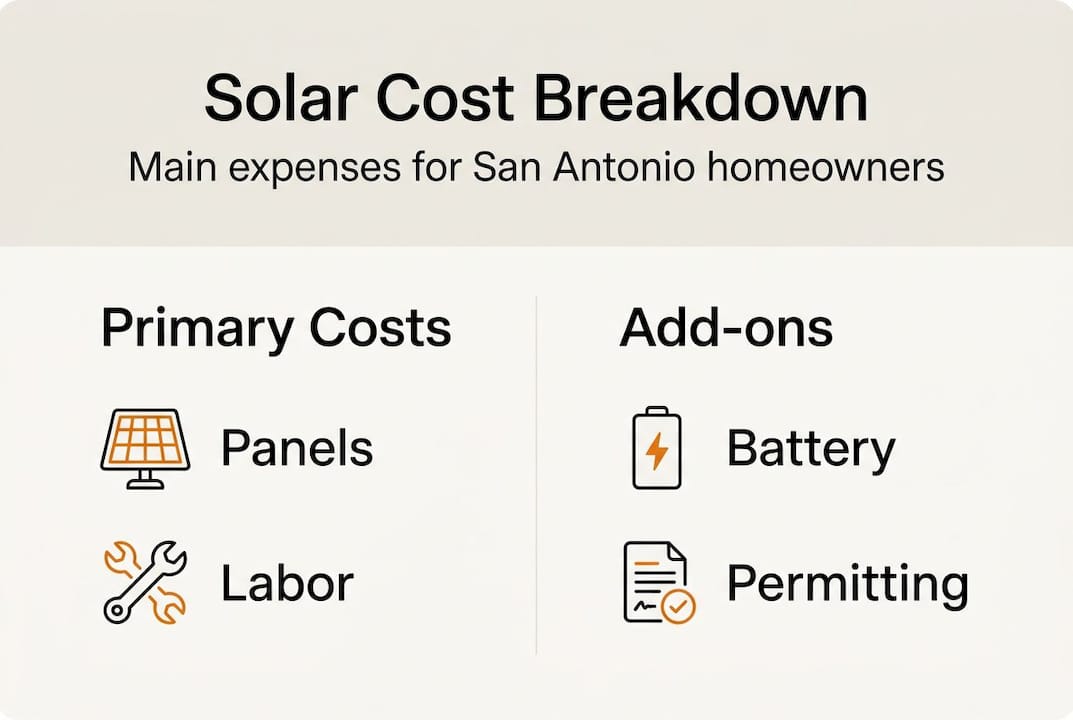
- Home battery (e.g., 10 kWh system): Adds $8,000 to $15,000 depending on brand and capacity. The federal ITC applies to batteries installed alongside solar, bringing the net cost down.
- EV charger installation: Adds $500 to $2,000 for a Level 2 charger, which charges most electric vehicles overnight. Pairing this with solar means you’re fueling your car with sunlight.
- System monitoring equipment: Usually included in the base quote, but premium monitoring dashboards can add $200 to $500.
- Panel upgrades (higher efficiency): Moving from standard to premium panels adds $1,000 to $3,000 but can increase output by 15 to 20%.
Batteries currently represent roughly 25 to 40% of the total project cost when included. That’s a significant portion, which is why it’s worth thinking carefully about whether backup power is a priority for your household before signing a contract.
Pro Tip: If you’re not ready to add a battery now, ask your installer to design the system as “battery-ready.” This means the wiring and inverter are set up to accept a battery later, saving you money on a future upgrade.
Ongoing costs: maintenance, operation, and utility bills
After installation, costs don’t disappear, but most are low and easy to anticipate.
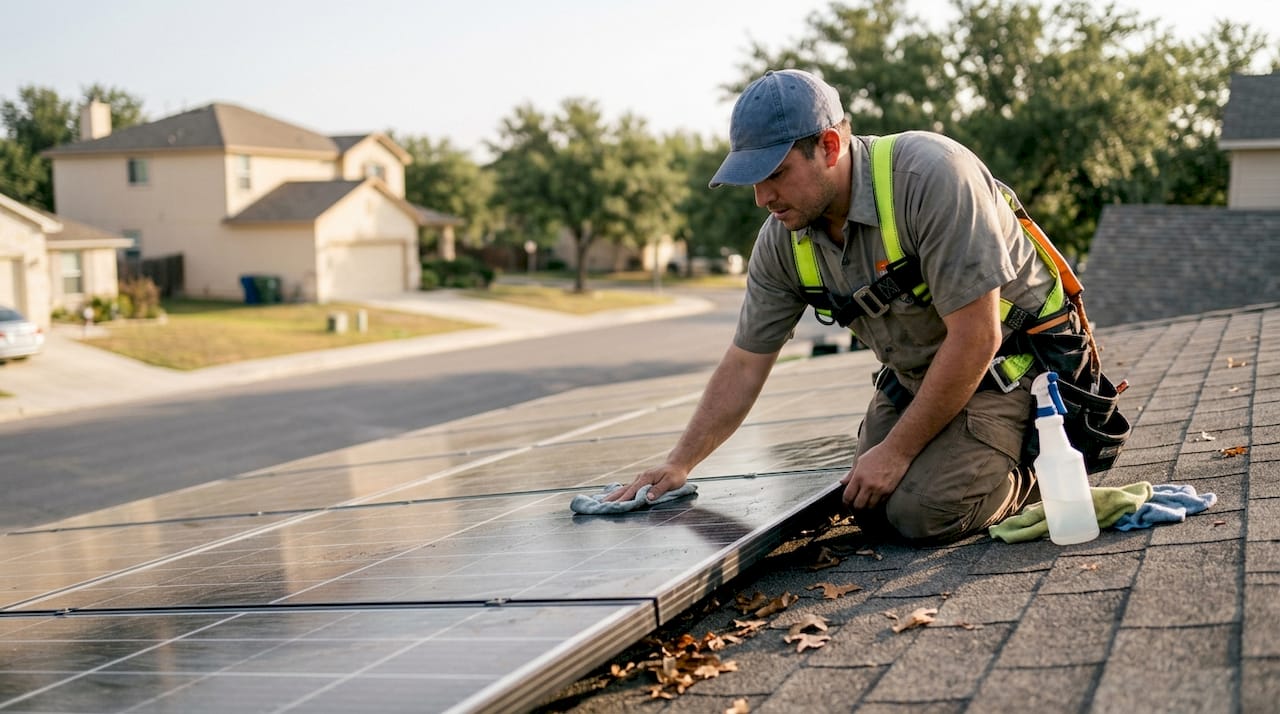
Solar panels are built to last 25 to 30 years, and they have no moving parts, so major repairs are rare. That said, a few recurring expenses are worth planning for. Proper maintenance can keep your solar system running efficiently for decades, which protects your original investment.
Here’s what to expect after your system goes live:
- Panel cleaning: San Antonio’s dust, pollen, and occasional bird activity can reduce panel output by 5 to 15% if left uncleaned. Professional solar panel cleaning typically costs $150 to $300 per visit, and most homeowners do it once or twice a year.
- Inverter replacement: String inverters (the box that converts DC power to AC power your home uses) typically last 10 to 15 years and cost $1,000 to $2,500 to replace. Microinverters, which attach to each panel individually, often last 20 to 25 years.
- System monitoring: Most modern systems include free app-based monitoring. If your production drops unexpectedly, you’ll catch it early.
- Roof repairs: If your roof needs work after installation, panels may need to be temporarily removed. Budget $300 to $600 for a panel detach and reattach service if that comes up.
Your electric bill after solar won’t be zero. Most San Antonio homeowners still receive a small monthly charge from CPS Energy for grid connection, typically $10 to $20. You may also owe for any energy used beyond what your panels produce, especially in winter when sun hours are lower.
Annual cleaning and a quick system checkup each year are the two most cost-effective habits for maintaining strong solar performance over time.
Pro Tip: Review your solar maintenance tips each spring before peak summer production season. Catching a dirty panel or a loose connection early can save you hundreds in lost energy output.
Our take: What most solar cost calculators don’t tell San Antonio homeowners
Online solar calculators are useful starting points, but they often miss the details that matter most to real homeowners. Most tools estimate your savings based on average sun hours and average utility rates. What they rarely account for is how your specific usage patterns, roof orientation, and daily habits shape the actual return you’ll see.
We’ve worked with homeowners in San Antonio who installed identically sized systems and saw very different results, simply because one household ran the dishwasher and laundry during peak sun hours and the other didn’t. Small behavioral shifts can add up to hundreds of dollars in annual savings.
Calculators also tend to ignore battery costs, panel cleaning, and inverter replacement over a 25-year period. When you factor those in alongside solar vs. utility costs, the comparison still favors solar strongly, but the honest number is different from the headline figure.
San Antonio’s combination of high sun exposure, rising CPS Energy rates, and strong state-level tax exemptions makes it one of the better markets in Texas for solar returns. That local advantage is real. But it works best when you go in with accurate expectations, not just the most optimistic projection a calculator can generate.
Ready to explore solar for your San Antonio home?
Understanding the cost breakdown is the first step. Getting real numbers for your specific home is the next one.

At Alpha Solar Solutions, we design custom systems for San Antonio homeowners based on your actual roof, usage, and goals. Whether you’re looking into residential solar installation for the first time or want to keep your existing system in top shape with our solar panel cleaning services, we’re here to help. No pressure, no confusing jargon. Just clear answers and honest pricing. Reach out today to schedule your free consultation and find out exactly what solar looks like for your home.
Frequently asked questions
How much does a typical solar installation cost in San Antonio?
San Antonio solar systems typically range from $15,000 to $30,000 before incentives, with the final number depending on system size, roof type, and any add-ons like batteries or EV chargers.
Will solar panels eliminate my electricity bill?
Solar can dramatically reduce your monthly bill, but most homeowners still pay a small grid connection fee. Grid-related charges from CPS Energy typically remain even with a fully producing solar system.
What happens if my panels need cleaning or repairs?
Budget for annual solar panel maintenance including cleaning and a system checkup to keep performance strong. Most repairs are minor and infrequent given the long lifespan of modern panels.
How do incentives reduce my out-of-pocket solar costs?
Federal and local solar incentives reduce your costs through a 30% federal tax credit, CPS Energy rebates, and Texas sales and property tax exemptions that together can cut your net cost by 35 to 45%.